Units
Work
Power
Machines
Physics Phenomena-Nature Edition!
100
The unit for distance
Meters
100
How can we tell work has been done on an object?
It moves
100
True or False? We do not need to know work in order to calculate power.
False
100
A __________ is a device that can transform forces or change direction of forces
Machine
100
Jet engines were designed based off of the nose of the peregrine falcon. What force do you believe these "cones" are deflecting?
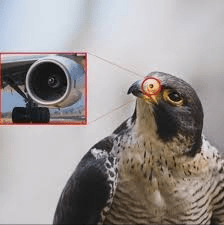
Air pressure from wind resistance
200
m/s is the unit for:
Velocity
200
What is the equation used to solve for work?
W=Fd
200
As a weightlifter, give an example of what you could do to increase your power.
Increase weight or increase speed of lift
200
Machines still follow the law of conservation of ___________.
Energy
200
This bird can rotate its wings, allowing it to hover, fly directly up, and even fly backwards.
Hummingbird
300
m/s2 is the unit for:
acceleration
300
The force exerted on an object must be (parallel/perpendicular) to the object's displacement
Parallel
300
If we are given a mass in kg and need to convert it to Newtons to find the "force" of weight, how would we do that?
Multiply by gravity's acceleration (9.81)
300
Two examples of a simple machine are:
Pulleys and Levers
300
This small marine mammal can deliver a punch with the acceleration of a .22 caliber bullet.
Mantis Shrimp
400
Measured in Joules
Work
400
When would we use the equation:
W=Fd (cos theta)
When work is done at an angle
400
What are the two basic equations that we can use to solve for power?
P=W/t or P=Fv
400
The "fixed point" that the bar of the lever pivots around is called the:
Fulcrum
400
This microscopic creature can pretty much survive anything--extreme radiation, extreme temperatures, extreme pressure, and even suspended animation(A slowing of all metabolic processes)!
Tardigrade (Water bear)
500
Measured in Newtons
Force
500
A weightlifter is holding a 50 kg weight 1 meter above his head. How much work is he doing?
None; no movement
500
1 horsepower is equal to how many Watts?
746 W
500
How is mechanical advantage calculated?
Output force/Input force
500
The bombardier beetle is famous for emitting *this* from its abdomen, similar to a well-known mythical creature.
Fire (boiling chemicals, basically)
600
Is equivalent to 1 joule/second
Watt
600
A weight lifter lifts a 50 kg weight 2 meters. How much work is he doing?
(50 x 9.81 x 2)=981 J
600
Say it takes 400 W to lift a 50 kg mass in 3 seconds. What distance is the weight being lifted in this example?
(400 x 3/50 x 9.81)
2.4 meters
600
Consider this pulley type:
Describe why this system decreases input force.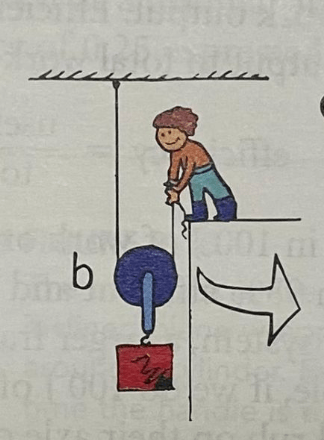
The weight of the load is split in half due to having two connection points.
600
The basilisk lizard utilizes water's natural surface tension in order to "walk" on it. What gives water its surface tension?

Water is a polar molecule, resulting in it having surface tension.
700
Is equivalent to a "Newton meter" (1 Newton x 1 meter)
Joule
700
1 joule of work is allegedly equivalent to lifting what object from your waist to to top of your head?
Apple
700
Which has more power: Horse A: doing 400 joules of work in 12 seconds, or Horse B: doing 200 joules of work in 4 seconds
Horse B
700
In a type 1 lever, the input force and the output force are in opposite directions. How does this differ from a type 2 lever?
Input and output forces are in the same direction in a Type 2
700
This animal can use seismic communication (sound waves through the ground) to send a message miles away. The receiver can actually "hear" the message---through their feet!
Elephants