My BFF Olson
Indecision, Action, and Agents! Oh my!
Democracies are for suckers
But, babe, I'm a good autocrat
Venezuela ain't just oil
We luv permitting reform
100
What is most important to collective action in Olson's theory?
Distribution of benefits -- as if at least one member gains enough that they'd do it alone, collective action is more likely to happen
100
Nathan is playing poker with members of his winning coalition. A player across the table goes “all in” and claims they have the best possible hand. However, you know this player frequently bluffs and has been caught lying before.
How might we use strategic thinking to analyze Nathan's reaction?
(1) Nathan should evaluate whether the “all in” move constitutes a credible signal. Because the player frequently bluffs and has been caught lying before, their reputation weakens the credibility of the claim.
(2) Because poker is a repeated interaction, Nathan must consider the “shadow of the future.” Since this player frequently bluffs and has been caught before, their past behavior affects how others interpret their signals as well as how the player might's them tactically.
100
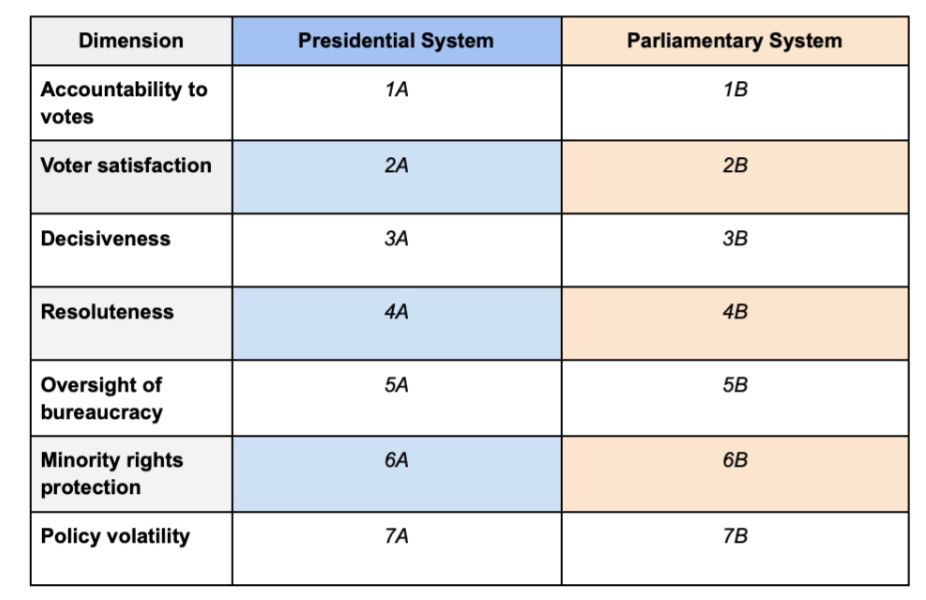
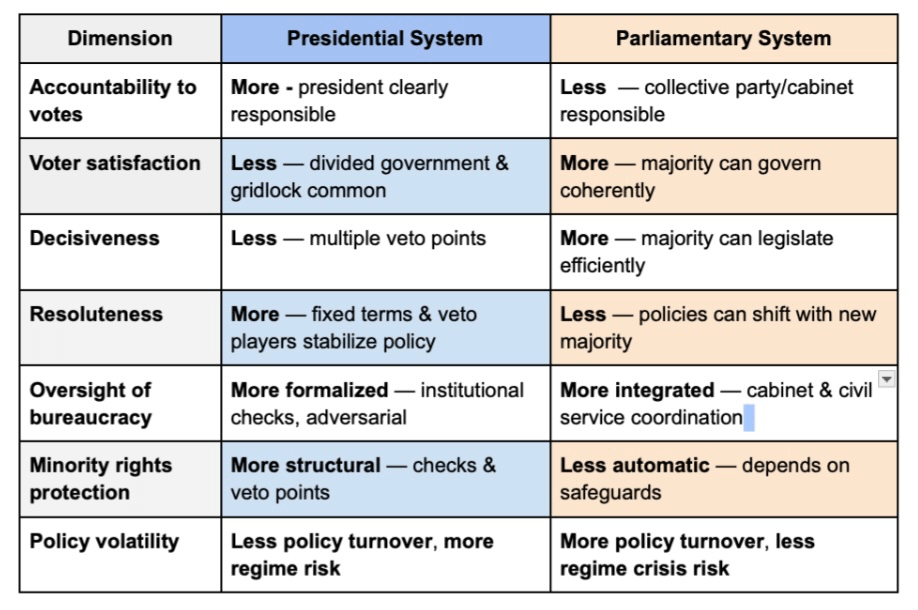
Which electoral system has comparatively more across each dimension of government:
100
Why is corruption a rational response from leaders in autocracies?
Because autocrats rely on a small winning coalition to stay in power, it is more cost-efficient to distribute private goods to this group to maintain loyalty, rather than invest in policy reform that would support the public.
100
What is Hausmann argue in regard to shifting the size of the winning coalition and/or selectorate, compared to what Trump's administration is planning?
(1) Hausmann advocates for expanding the winning coalition & selectorate through democracy to provide public goods
(2) Trumps approach looks to perserve a small-coalition focused on oil extraction, keeping the winning coalition & selectorate rather small
100
Why are environmental NGOs and business groups able to cooperate on permitting reform?
(A) Permitting inefficiency imposes concentrated costs on infrastructure developers, who all face the same bottlenecks despite coming to permitting from different perspectives
(B) This coalition may function as a "intermediate" or privileged group, which is relatively small in comparison to everyone who will be impacted by the permitting
(C) For each individual organization, benefits of the reform are larger than the organizational cost
[What am I missing]
200
(A) Define free-riding in the context of collective action
(B) Under what conditions does free-riding become less attractive? What would you think to change to reduce its prevalence?
(A) Free-riding is when a latent groups takes advantage of diffuse benefits from public goods without contributing to the collective action to secure the benefits.
(B) Free-riding is less likely when:
- Goods are exclusive, so you have to participate to receive the benefit
- The group is small, so that contributions can be clearly monitored by other members
- Select incentives, might coerce participation in collective action to achieve the goods (e.g., taxes) or create stronger incentives for those in the group (e.g., creation of a privileged member
200
Military leaders recommend intervention based despite negative projections because it has been successful in the past in other, similar situations, and civilian leaders approve without deep scrutiny.
Explain the dynamics taking place within and between these two groups?
(A) Military leaders are employing an availability / representative heuristic and are also overconfident -- leading them to rely on System 1 thinking rather than evaluating the decision with the new projections
(B) Civilian leaders experience an information asymmetry as they are not privileged to the hidden action and hidden information available to the military leaders.
(C) Taken together, this creates a loss of agency and a high potential for strategic miscalculation by military leaders
[What did I miss]
200
Sigh.. Democracies are so problematic...
(A) Explain the collective action problem within democratic legislatures?
(B) How do political parties solve collective action problems in democratic legislatures?
(1) Democratic legislatures suffer from the public good of plenary time to which any individual elected member can access. Each legislator has incentives to take up this time advance their personal interests, delay rival proposals, or free-ride on others coordination. Individually rational behavior lead to collective legislative dysfunction.
(2) Parties solve the collective action problem by delegating agenda-setting authority to chairs, committees, etc. and structuring decision-making. This is about restricting access to a common-pool resource. This increases decisiveness within the legislature, although concentrates authority and limits individual autonomy.
200
What is the challenger's commitment problem in autocracies?
In autocracies, challengers cannot credibly commit to maintain the existing coalition after taking power, so elites rationally stick with incumbents despite dissatisfaction. And autocrats are also less likely to trust those who 'flipped' on a previous autocrat.
200
Hausmann argues that prosperity comes from rights and public goods, not oil.
Using Olson’s Logic of Collective Action, explain why broad public goods like property rights are underprovided in autocracies.
Property rights and rule of law are underprovided in autocracies because they are diffuse public goods benefiting large latent groups that struggle to organize, while small elite coalitions within the autocracy can receive concentrated benefits for their loyalty.
Oil in Venezuela exacerbated this by allowing Maduro to not rely on taxes, instead relying on oil rents, so citizens have less leverage to request public goods.
200
How does this change to permitting reform shift political incentives for elected officials?
(A) Currently, elected officials can shift blame for delays onto agencies, courts or others, so there is little accountability; There also also incentives to act cautiously given legal and reputational risks
(B) Elected official can gain credit from infrastructure deployment, and face greater blame if damages occur
300
We love collective action, but....
(A) What are the baselines elements that affect how successful (or unsuccessful) collective action might be?
(B) What potential actions might be taken to make collective action more likely?
(A) Core factors are (i) Distribution of benefits -- more unequal the better, (ii) Size of group -- smaller the better, and (iii) Type of good -- Exclusive good more likely to lead to collective action
(B) Potential actions are (i) Select incentives -- (+) more benefits, privatization of good, (-) Sanctions, penalties, coercion & compulsion (ii) Reduce group size to make it more of a club good, (iii) Change the type of good privatizing public goods, and (iv) Empower a privileged actor or supporting monitoring / evaluation
300
Mallory delegates to her friends to get beer for a gathering, giving them some cash.
(A) What risks does she face through this delegation?
(B) What might be some ways she can mitigate these risks?
(A) Agency Loss -- Her friends may choose lagers that she hates; Hidden action -- Her friends may spend the money on churros, instead of beer; Hidden information -- Her friends might say the store was out of her favorite beer (Sip of Sunshine or Sierra Hazy) when it was really in stock :(
(B) Incentive alignment -- Tell them that she'll bring cookies if they get the correct beer; Clear contract -- Explicitly identify the types of acceptable beer and request the receipt after; Monitoring -- She could request a photo before store check-out; Screening -- She can choose only friends who have the same taste in beer as her to do the pick-up (re: Incentive alignment); Reduce delegation -- Order it online!
[Idk how fire-alarm monitoring would look here -- lmk]
300
Presidential systems are often described as less decisive but more resolute than parliamentary systems.
(A) Define decisiveness and resoluteness.
(B) How does the strength of the reversion point help explain this tradeoff?
(C) Briefly contrast how this operates differently in parliamentary systems.
(A) Decisiveness is the ability to change policy away from the status quo. Resoluteness is the ability to sustain policies once adopted.
(B) A reversion point is the default policy outcome if no agreement is reached (the status quo). Strong reversion points (often in systems with multiple veto players) make change harder → lower decisiveness. These same veto points make reversal harder → higher resoluteness.
(C) In parliamentary systems, a unified majority control weakens the reversion point and increases decisiveness but decreases resoluteness.
300
Owen is a democratically elected President, but there are worries that he's pushing his country towards autocracy. What might be some signals that there is 'democratic backsliding'?
(1) Owen will shrink the size of the effective winning coalition (W) by relying on a small circle of loyaltists, rewarding them with contracts, positions and advantages
(2) He will weaken institutions and monitoring systems by undermining independent media, limiting anti-corruption agencies and politicizing courts
(3) He will centralize agenda power by expanding executive degree and curtailing debate
(4) Owen will probably reduce electoral competitiveness by changing electoral laws or increasing barriers to opposition parties
300
What do we know about how Maduro felt about this own stability given who he managed innovation investment in the oil industry?
He was not fully secure (facing opposition, economic collapse, and international pressure), but removal was not easy enough to make him safely pursue reform.
Under political replacement theory, leaders in this moderately insecure position are most likely to block innovation and institutional reform, because reform increases the probability of replacement while the benefits of reform do not sufficiently reduce that risk.
300
Acting as a policy advisor, explain why the federal permitting process creates delays and uncertainty than can lead to investment risk for investors, but support stronger environmental safeguards.
Argue either for or against the reform.
(A) Congress (principal) delegates to agencies (agents) to enforce permitting rules, given their particular expertise. PRO: Reform lets agencies better use their expertise, CON: Delegation leaves congress move unaware of how permitting is implemented
(B) Constituents and NGOs act as aggressive fire-alarm oversight to the agencies enforcing permitting and creates many veto-points. PRO: Reform reduces the veto-points allowing projects to pass quickly CON: Reduces pathways for fire-alarm oversight
(C) Because of this, agents respond with over-compliance to avoid blame, leading to substantial delays in projects. PRO: Reform make elected officials/beauracrats more clearly responsible; CON: However, this will likely only occur after environmental harms have taken place
400
A large group of farmers all benefit from water infrastructure but fail to organize politically to advocate for more funding for it. Explain:
(A) Why have they failed to organize? What is likely driving this?
(B) What would need to change to make collective action more likely to succeed?
(A) The farmers fail to organize because this is a latent group collective action problem. The benefits of water infrastructure are diffuse and non-excludable, so each farmer has an incentive to free ride rather than bear organizing costs.
(B) Collective action would be more likely if incentives changed to overcome free riding. Selective incentives—such as contributor-only subsidies or access—could make participation individually rational. Alternatively, if benefits became more concentrated, creating a privileged actor, that actor might organize or fund the effort. Reducing group size or improving monitoring would also increase each farmer’s incentive to contribute.
400
Two countries cooperate in trade for many years, but one suddenly defects after securing a new trade partner.
(A) Why might they have previously had a rend of coordination?
(B) What might have been done to reduce the potential for defection?
(A) Cooperation was sustained through iterative action, where the shadow of the future made defection costly; However a strong outside option changed the potential payoffs
(B) Increasing the penalties for non-compliance, through stronger institutional enforcement mechanisms; Increasing the rewards for compliance, by deepening economic interdependence; or signaling stronger negative action in the event of defection
[What else?]
400
What are the top four factors that impact how representative an electoral system might be of its constituents?
(1) District Magnitude - # of seats / district, with more being more porportional
(2) Electoral formula - Majoritarian often decrease proportionality, PR increase
(3) Electoral threshold - Higher threshold = fewer parties = less proportional
(4) Legislature size -More seats means more possibility for representation
[Also district boundaries & ballot structure -- what else did I miss?]
400
Margaret is a dictator of a powerful, tropical country. She is relatively secure but still very cautious. She is debating if she wants to block or permit three new innovations. For each, explain how it might impact the selectorate and why she should/shouldn't allow it.
(A) Global social media platforms
(B) State owned oil fields
(C) Military technology innovation
(D) Broad education investment
(A) Global social media platforms will increase coordination among both the populous and elites. This risks a shift in the W/S ratio which reduces the loyalty norm, it also increases fire-alarm oversight which could but Margaret out of power. Block.
(B) Investing in state-owned oil fields will increase state revenues, and increase resource rents, which may decrease replacement risk by providing more private goods for Margaret's corruption coalition. Do not block.
(C) Military technology is entirely within Margaret's control and strengthens her coercive capacity, both domestically and abroad. However, if she doesn't have a strong loyalty from the military, then it may empower a rival faction. If she feels confident, do not block.
(D) Broad education investment will increase human capital and raise citizens ability to organize politically, which raises long-term replacement risk. Block.
[Does this feel right? What did I miss?]
400
The United States is considering a strategy focused primarily on restoring oil production quickly in Venezuela, even if institutional reform is delayed.
You are a policy advisor asked to evaluate this approach using the Political Replacement Effect theory.
(1) Oil rents raise the value of a holding office which means there is a bigger prize for controlling Venezuela, which will make old guard more willing to fight for control and less willing to accept reforms that dilute it.
(2) Without institutional reform, oil rents fund the old coalition who currently have power, and will help them settle in.
(3) Institutional turbulence reduce certainty for investment so there is unlikely to be significant investment until institutional reform is managed.
INSTEAD
(4) Focus on institutional reform now to protect and scale investment starting with credibility building moves, and then building up to full democracy over time
[What am I missing?]
400
What tradeoff does permitting reform represent between environmental protection and efficiency? What are the implications for bureaucratic oversight?
(A) More police oversight --> better environmental accountability, but less efficient... More efficient permitting --> faster (renewable) infrastructure but weaker procedural safeguards
(B) Weakens fire-alarm oversight by reducing the locations for actors to trigger views (reduces vetos)
May reduce policing from congress on agencies, resulting in decreased monitoring costs.
500
Many political institutions (parties, committees, executive offices) centralize authority.
(A) Why can institutional inequality be understood as a solution to a collective action problem?
(B) What tradeoffs arise when authority is concentrated to solve coordination problems?
(A) Institutional inequality centralizes authority to overcome coordination and free-riding problems in large groups, reducing delay and making collective action possible. By concentrating agenda or decision power, institutions lower transaction costs and solve the collective action problem of decentralized decision-making.
(B) While concentrating authority increases decisiveness, it creates tradeoffs such as reduced accountability, potential abuse of power, and new principal-agent problems.
500
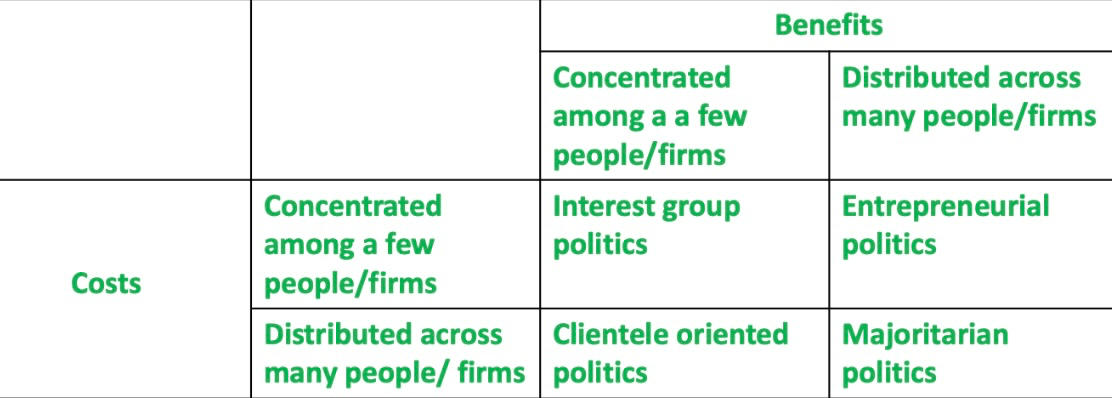
Where on this 2x2 are strategy games most likely to be prevalent in politics? Why?
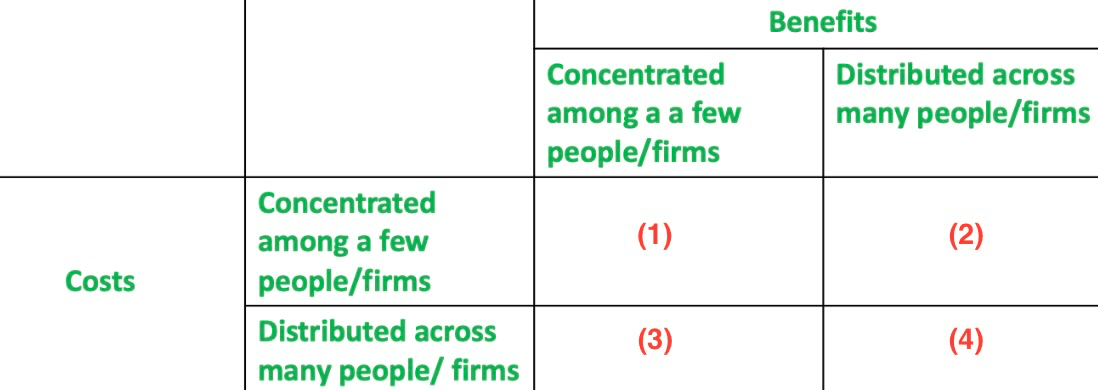
(1) Interest group politics is more likely to have strategy games because the winners and losers are small, coordinated groups with large incentives to mobilize. This means that interest groups will repeatedly interact leading to an environment where strategy gamester played
500
In a recent election, party A won 40% of the vote, but secured 60% of the seats in their legislature.
(A) What is this outcome called?
(B) What happened to produce it?
(C) What are the tradeoffs?
(A) This is a manufactured majority
(B) This happens when a majoritarian system has winner-take-all districts that convert small vote advantages into large seat bonuses (e.g., Party A might have won 5 districts by only a few hundred votes, even though Party B won 2 districts by landslides)
(C) This will result in a less proportional but more decisive government, as these systems often produce single-party government
500
Jennifer is an dictator and is feeling shaky, what should she do to stay in power?
(1) Keep winning coalition small relative to selectorate to make buying loyalty cheaper and increase elite dependence on her
(2) Distribute private goods instead of public goods to reinforce networks and prevent coordination among potential challengers
(3) Limit political competition by removing potential challengers and creating instability and reliance on her within the selectorate group
(4) Block innovation that may help the competition including empowering human capital to suppress citizen capacity to organize
(5) Limit information transparency to reduce information coordination among challengers, and fire-alarm oversight
500
Explain why Maduro let the Venezuelan oil sector, and Venezuelan wealth in general, decline in the last 20 years. Why was this a rational action?
(1) The political benefits of using oil rents to retain control and loyalty of his small winning coalition outweighed. Rewarding the winning coalition from oil rents was more cost effective that providing public goods for all -- Selectorate Theory
(2) Innovation and expansion of oil risked Maduro loosing power through reforms that empower competitors. Increased FDI, strengthened contract terms and other foundations for innovation would have weakened Maduro's control -- Political Replacement Effect
[What am I missing?]500
How can we think about this permitting reform in the context of reversion points? What are the implications?
(A) The reversion point is the default outcome that prevails if no new decision/action is made -- in this case, that default outcome is that no infrastructure will be built, as project approval requires action including multiple institutional hurdles.
(B-1) In the current situation actors with negative agenda power (e.g., veto players, environmental challengers, litigants) have more structural power. There is a strong status quo bias.
(B-2) The reform seeks to shift the inversion point by narrowing opportunities for vetos, shifting instead towards a default of permit approval. This moves power towards agencies and project proponents.