Definitions
Graphs
Polynomial Arithmetic
Multiplicity and End Behavior
Solving
100
What is the plain number term called when a polynomial is written in standard form?
Constant (or y-intercept)
100
How many x-intercepts does the graph of f(x) = (x-1)(x-2) have?
Two
100
(7x+4) + (5x+8)
12x + 12
100
True or False: The end behavior of a polynomial with an EVEN degree is always the same in both the positive and negative directions.
TRUE
100
How many solutions are there to (x-2)(x+3) = 0?
Two
200
What is the DEGREE of 2x4+9x3-5x2+6
4
200
What are the x-intercepts of f(x) = (x-1)(x-2)?
x = 1 and x = 2
200
(6x2+4) - (3x2+5)
3x2-1
200
True or False: The graph of f(x) = (x-1)2(x-2)4 crosses the x-axis at the points x=1 and x=2.
FALSE. It touches but does not cross the axis because the multiplicities are even.
200
What are the solutions to (x-2)(x+3) = 0?
x=2 and x=-3
300
"Like Terms" must have the same _________ and the same __________
variable and exponent
300
How many y-intercepts does the graph of f(x) = (x+1)8(x+2)4 have?
Every polynomial has exactly ONE y-intercept
300
(5x3+7x2+2x+2) + (2x3-2x+5)
7x3 + 7x2 + 7
300
In the polynomial f(x) = (x+2)(x-2)4, what is the multiplicity of the solution x = 2?
4, because of the exponent in (x-2)4
300
What are the solutions to 3(x-2)(x+3)(2x-2) = 0?
x=2 and x=-3 and x=1
400
Write an example of a polynomial in FACTORED FORM that has three different solutions.
Example: f(x) = (x+1)(x+2)(x+3)
400
What is the y-intercept of the graph of f(x) = -2(x+2)(x-1)?
(-2)(2)(-1) = 4
400
(x+5)(x+1)
x2+6x+5
400
What is the end behavior as x gets bigger in the NEGATIVE direction of f(x)=-2x3+1?
As x gets bigger NEGATIVE, y gets bigger POSITIVE
400
What are the solutions to x2+5x+6 = 0
x=-2 and x=-3
500
What is the maximum number of x-intercepts that the graph of x2+x6+x5+x7+x3+x4+x+1 could have?
7, because the degree is 7
500
Sketch the graph of the polynomial f(x) = -2(x+2)(x-1). Include x and y axes but do not label the points.
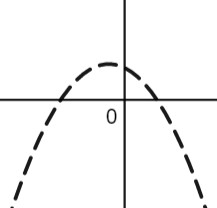
500
2(x+4)(x-2)
2x2 + 4x -16
500
Stand up and hold out your arms to show the end behavior of f(x) = -5x4 + 12x3 + 7

500
What are the solutions to x3 - 4x2 + 3x = 0?
x=0 and x=3 and x=1