Functions
Polynomial Functions
Rational Functions
Exponential Functions
Logarithmic Functions
100
Which type of discontinuity do you see in each of the following three graphs? List them in the correct order. (1 min)
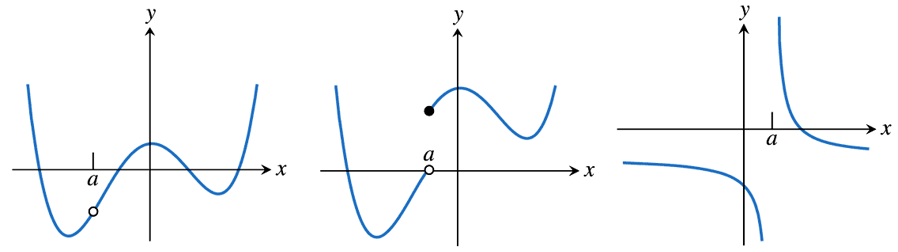
Removable discontinuity, Jump discontinuity, and Infinite discontinuity
100
Identify each transformation applied to the quadratic function f(x)=x^2 if the transformed function is g(x)=4-3(x-4)^2 .
(1 min)
Horizontal shift 4 units to the right
Vertical reflection
Vertical scaling by a factor of 3
Vertical shift up 4 units
100
What is the horizontal asymptote of the rational function?
r(x)=(-3x^3+x^2-3)/(2x^2-6+3x^3)
(1 min)
y=-1
100
Write the two limits that describe the end behavior of the exponential function f(x)=3*(1/4)^(-2x) .
(1 min)
lim_(x \rightarrow -infty) f(x)=0
lim_(x \rightarrow infty) f(x)=infty
100
Evaluate the logarithmic expression:
log_3 12 + log_3 18 - log_3 8
(1 min)
log_3 27 = 3
200
Identify whether the following points are local and/or absolute minimum and maximum points. (1 min)
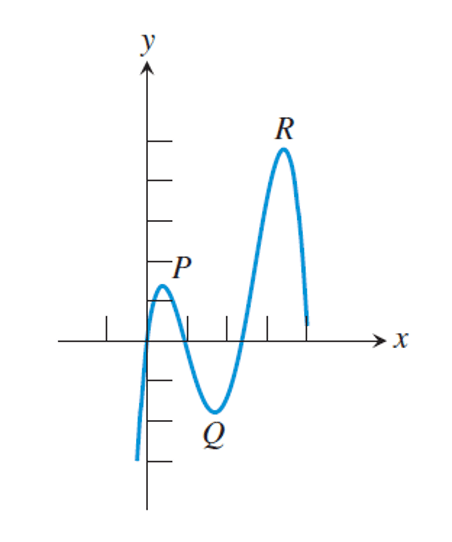
P: local maximum
Q: local minimum
R: local and absolute maximum
200
Divide 3x^3-2x^2+x-5 by x-1 .
What is the quotient and the remainder?
(1 min)
Quotient: q(x)=3x^2+x+2
Remainder: r(x)=-3
200
What are the vertical asymptotes of the rational function?
r(x)=(x^2-x-2)/(x^3-4x)
(1 min)
x=0
x=-2
200
Match each equation with its graph:
f(x)=2(1.3)^x
g(x)=2(1.8)^x
h(x)=4(1.3)^x
k(x)=4(0.7)^x
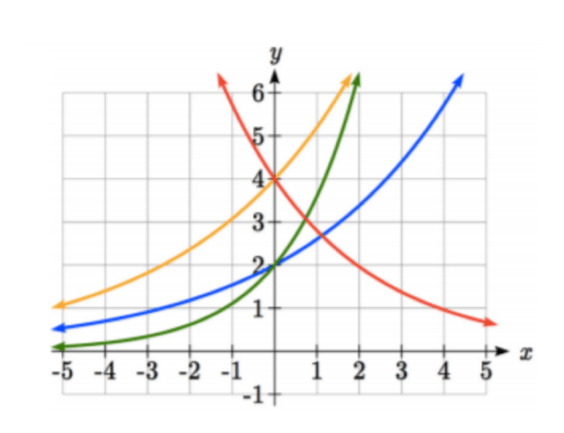
(1 min)
Red: k(x)
Yellow: h(x)
Green: g(x)
Blue: f(x)
200
Assume x and y are positive. Write 3lnx-6ln(xy)+8lny as a single logarithm.
(1 min)
ln (y^2/x^3)
300
Name the two types of function symmetry. What is their algebraic definition and what is their geometric definition? (2 mins)
Even symmetry: f(-x)=f(x) ; over the y-axis
Odd symmetry: f(-x)=-f(x) ; around the origin
300
Find the degree, leading coefficient, and the roots (with their multiplicities) of the polynomial function f(x)=4x^3+10x^2-24x .
(2 mins)
Degree: n=3
Leading coefficient: a_n=4
Roots: x=-4, x=0, x=3/2 each with a multiplicity of 1
300
Identify any horizontal or vertical asymptotes of the graph of y=x/(2x^2+5x-3) .
(2 mins)
Vertical asymptotes:
x=-3
x=1/2
Horizontal asymptote:
y=0
300
Find the formula of the exponential function represented by this table:
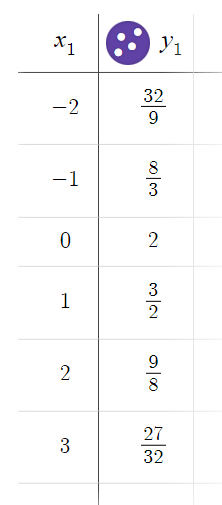
(2 mins)
y=2*(3/4)^x
300
Assume x, y, and z are positive. Expand log_2 ((sqrt(2xz)*y^4)/(16x)) .
(2 mins)
1/2log_2 z + 4log_2 y -7/2 -1/2log_2 x
400
Evaluate
f(g(3))
and
g(f(4))
based on the following table:
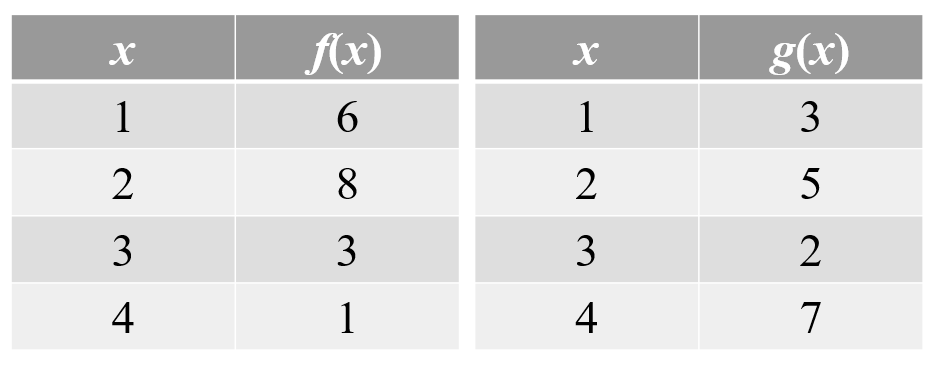
(2 mins)
f(g(3))=8
g(f(4))=3
400
Find the formula of the polynomial function graphed below.
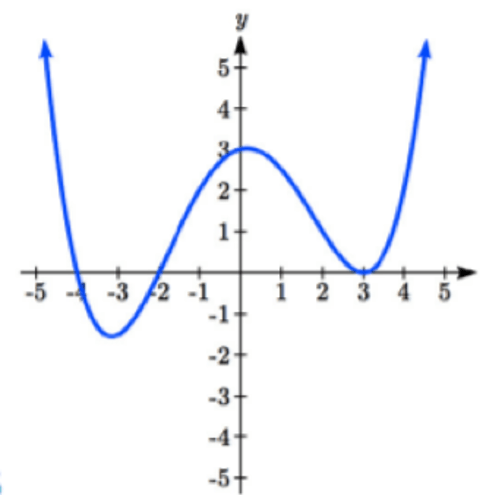
(2 mins)
f(x)=1/24(x+4)(x+2)(x-3)^2
400
Find the equation of the rational function graphed below.
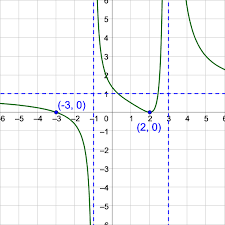
(2 mins)
f(x)=((x+3)(x-2)^2)/((x+1)(x-3)^2)
400
Solve the exponential equation:
(1/4)^(-x-3)*8^(x+2)=16^(2x)
(2 mins)
x=4
400
Solve the logarithmic equation:
log_3 (1-x)=log_3 (x+16-x^2)
(2 mins)
x=-3
500
Answer the following questions based on the nine toolkit functions:
a) Which one is the only function that is even and not continuous?
b) Which one is the only function that is even and concave up?
c) Which one is the only function that is odd and decreasing?
d) Which one is the only function that is not defined for negative x-values?
e) Which one is the only function that has an extremum point but is not concaved?
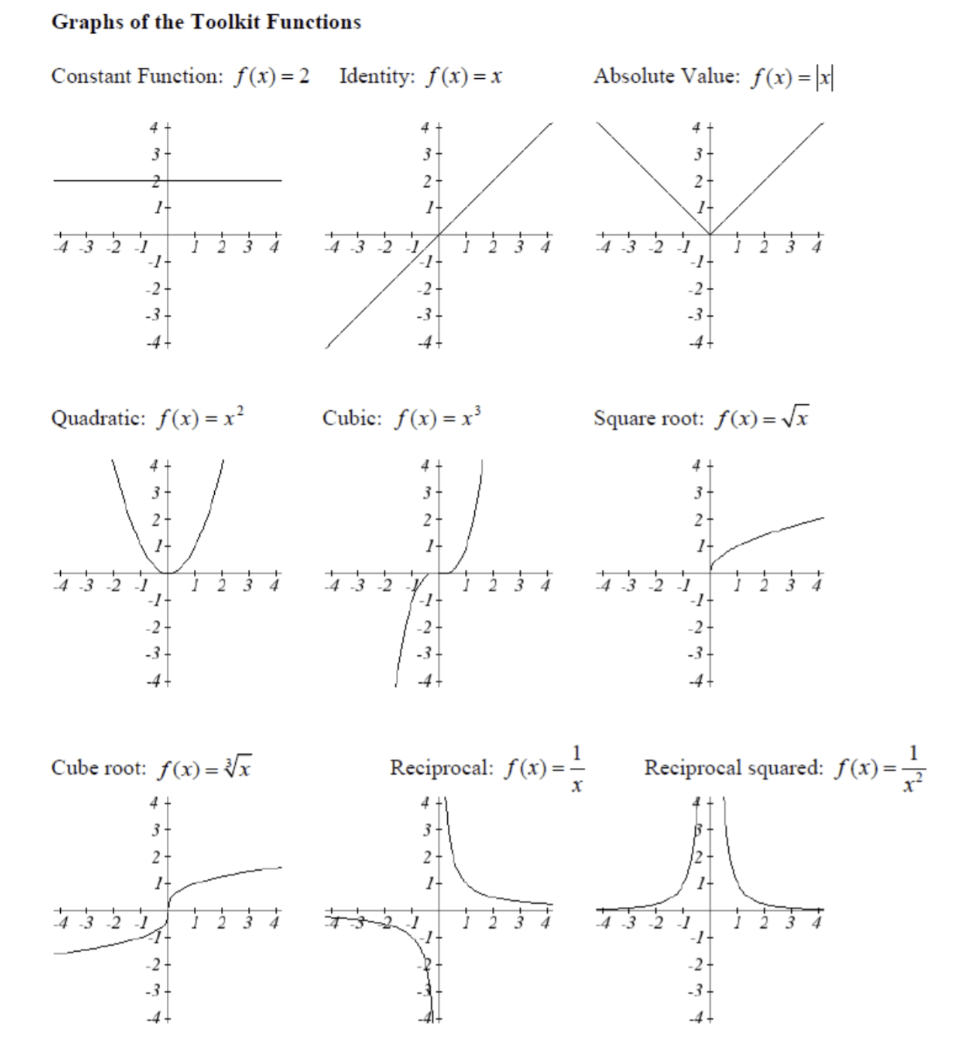
(3 mins)
a) Rational/Reciprocal Squared
b) Quadratic
c) Rational/Reciprocal
d) Square Root
e) Absolute Value
500
Convert the quadratic function f(x)=2x^2-8x+11 from standard form to vertex form by completing the square. Then, list the coordinates of the vertex and the equation of the axis of symmetry.
(3 mins)
Vertex form: f(x)=2(x-2)^2+3
Vertex: (2,3)
Axis of symmetry: x=2
500
Solve the rational inequality f(x) ≥ 0 when f(x)=(x+2)^2/(x(x-1)) .
Your final answers for x should be represented in interval notation.
(3 mins)
x \in (-infty,0) \cup (1,+infty)
500
Find the equation of the exponential function graphed below.
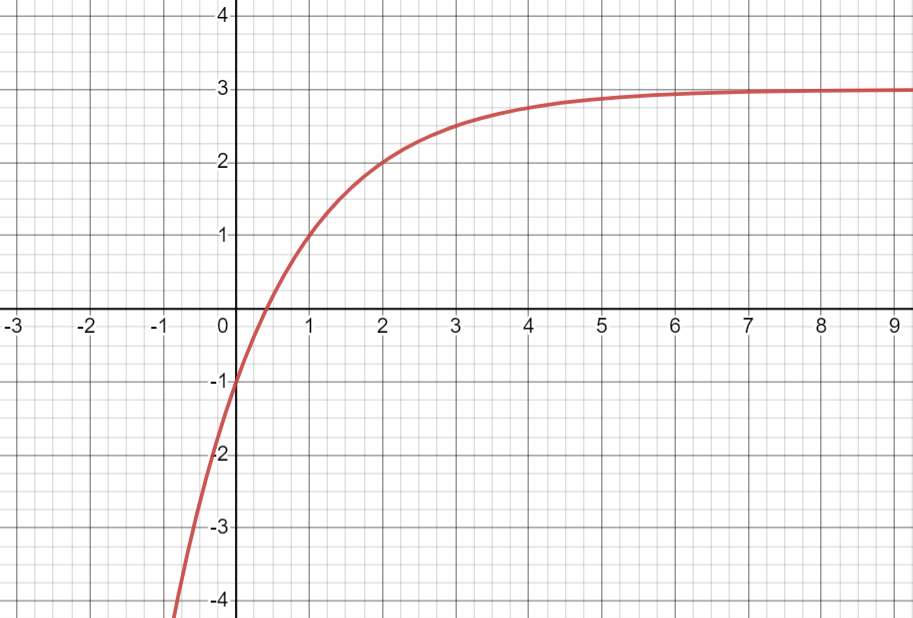
(3 mins)
f(x)=-4*(1/2)^x+3
500
Solve the logarithmic equation:
log_2 (3-x) + log_2 (5+2x) = log_2 14
(3 mins)
x=-1/2
x=1