Series and Sequences
Counting and Vocab
Probability
Calculus
Statistics
100
Arithmetic, geometric or neither. If possible, give the common difference/ratio.
-8, -3, 2, 7, 12, ...
arithmetic with common difference of +5.
100
Fundamental counting principle, permutations, or combinations?
Jenny is at Dunkin Donuts to get a dozen donuts for a meeting at work. She wants to get an assortment of donuts. The shop only has 10 different types of donuts today so she'll have to get some of the same type. How many ways can she get an assortment of 12 donuts?
Fundamental counting principle
Depending on how she wants to "assort" her donuts you could do: 10^12 or 10!*10*9 or 10!*10*10 ...
100
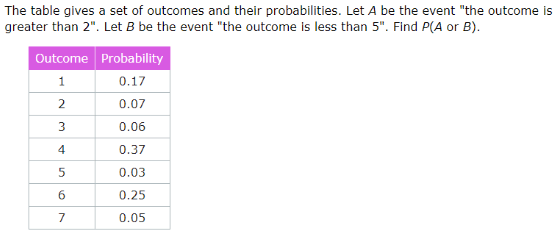
1
100
Does this graph have any places where the limit is undefined (does not exist)? Explain.
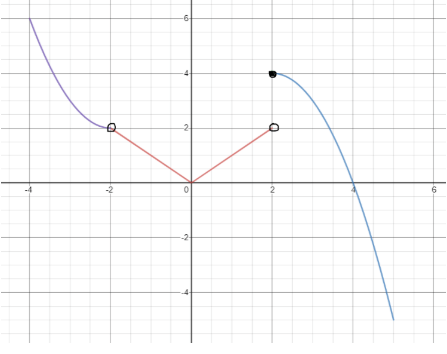
yes, at x = 2. because the right and left side limits do not match.
100
On the Statistics Based exam last year, the grades were: 87%, 90%, 100%, 95%, 82%, 70%, and 98%. Find the median
90 ... put them in order 1st!!
200
Write the first 5 terms of the sequence given by the explicit formula:
a_n = n/((n+2)!)
1/6, 1/12, 1/40, 1/180, 1/1008
or
1/6, 2/24, 3/120, 4/720, 5/5040
200
You're choosing a number from 1-20. Let event A be "choosing a multiple of 5". Give the event which is complementary to event A
not choosing a multiple of 5
200
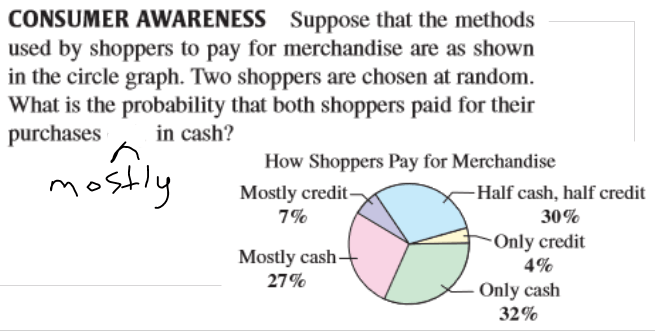
0.27*0.27 = 0.0729 or 7.29%
200
Does this graph have any places where the function is undefined? Explain.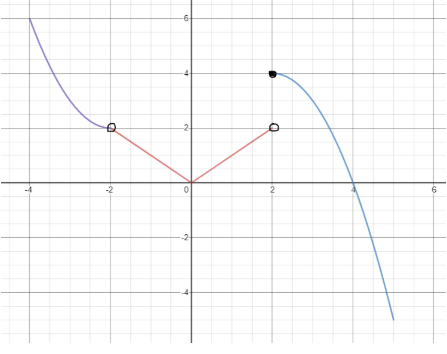
Yes, at x = -2 because there is a hole
200
Given that U = {1,2,3,4,5,6,7,8,9}, A = {2,4,6,8}, B = {3,5,7,9} and C = {3,8}. Find
(A' uu B) nn (B nn C)
{3} because (A' U B) = {1,3,5,7,9} and (B n C) = {3} so the intersection of those two is just {3}
300
My starting salary in the United States was $37,475. Each year, for the first 5 years, I would get a 2% increase. How much money had I earned after working 4 years in the United States?
sum_(n=1)^4(37475(1.02)^(n-1)) = $154383.07
300
You're choosing a number from 1-20. Let event A be "choosing a multiple of 5". Let event B be "choosing an odd number". Are A and B mutually exclusive? Why or why not?
No because they both contain the numbers 5 and 15. (the intersection is not the empty set)
300
You're choosing a number from 1-20. Let event A be "choosing a multiple of 5". Let event B be "choosing an odd number". Find P(A and B)
A and B = {5, 15} so P(A and B) = 2/20 = 1/10
300
Find the limit. If the limit is undefined, explain why. 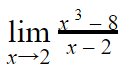
limit = 12. simplify the rational function first then plug in x = 2.
300
On the Statistics Based exam last year, the grades were: 87%, 90%, 100%, 95%, 82%, 70%, and 98%. Find the interquartile range
Q1 = 82, Q3 = 98 so IQR = 98-82 = 16.
400
Find the infinite sum. If it diverges, explain why.
sum_(n=1)^oo 8(5/3)^(n-1)
The sum diverges because |r| > 1. (r = 5/3 = 1.67)
400
There are 24 elementary teachers (9 men and 15 women). A group of 3 teachers interview incoming students. How many ways could you make the group if there should be 1 man and 2 women?
9C1*15C2 = 945 ways
400
There are 24 elementary teachers (9 men and 15 women). A group of 3 teachers interview incoming students. What is the probability that the group will be all men?
9C3/24C3 = 21/506 = 0.0415
400
Find the limit of the function as x approaches 0. if the limit does not exist, explain why. 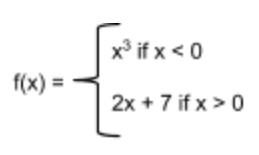
The limit does not exist because the LHL = 0 and the RHL = 7. These two limits do not match, therefore the limit does not exist.
400
Write the following in sigma notation
1 - 1/4 + 1/9 - 1/16 + 1/25 + ... -1/100
sum_(n = 1)^10 (-1)^(n-1)/n^2
500
Find the infinite sum. If it diverges, explain why.
sum_(n=1)^oo 8(3/5)^(n-1)
The sum converges to 8/(1-3/5) = 20
500
Mr. Blackburn will compete in a triathlon next year. If 200 people compete, how many ways could the top 3 (1st, 2nd, 3rd) finishers come in?
200P3 = 7880400
500
You're choosing a number from 1-20. Let event A be "choosing a multiple of 5". Let event B be "choosing an odd number". Find P(A or B)
P(A) + P(B) - P(A and B) = 4/20 + 10/20 - 2/20 = 12/20 = 6/10 = 3/5 = 0.6
500
Calculate the slope of the graph f(x) = ½ x3 - 1 at x = 2.
slope = 6. use the limit of the difference quotient as h approaches 0.
500
On a tropical island it consistently rains 40% of the days. Over the next 7 days, find the probability that it rains at most 2 times.
P(0 days)+P(1 day)+P(2 days) = 0.4198936
7C0(0.4)^0(0.6)^7+7C1(0.4)^1(0.6)^6+7C2(0.4)^2(0.6)^5