Trigonometry
Definitions
Logs
Exponentials
Polynomials
100
arccos(1/2)=
pi/3
100
A function is concave up if the rate of change is __________
increasing
100
log 1=
0
100
Is the following function a decay or a growth?
y=1/2(4^x)
growth
100
How many points of inflection does the graph have?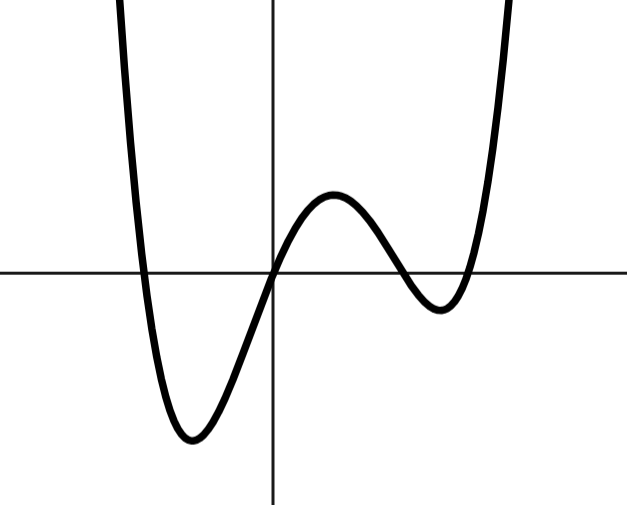
2
200
What is the period of the following function?
y=3.5cos(pi/6x)+4.6
12
200
What is the formula to find the average rate of change of f on the interval [a, b]?
(f(b)-f(a))/(b-a
200
Simplify:
ln12-2ln2
ln3
200
The value (2*2*2*2*4.7) is the output value of an exponential function. Complete the following:
The exponential function has an initial value of _____ and a base of _____, and the input value is _____.
The exponential function has an initial value of 4.7 and a base of 2, and the input value is 4.
200
List the interval(s) where the polynomial is negative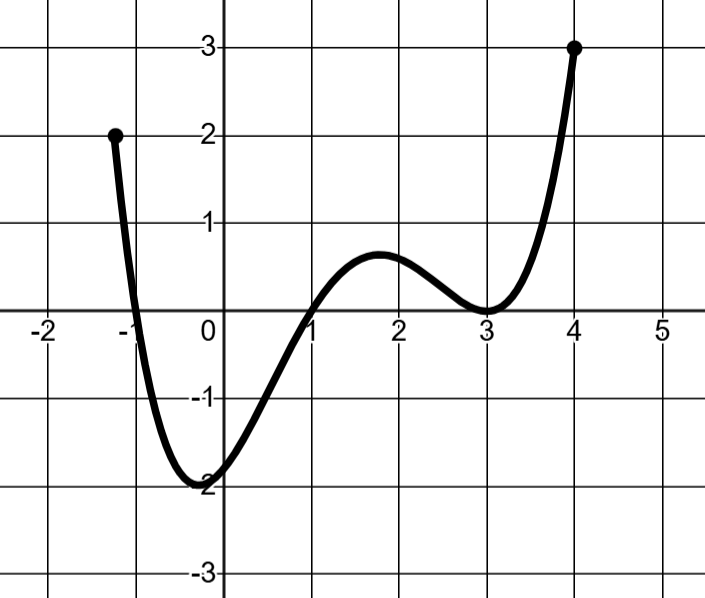
(-1,1)
300
Simplify:
4(cos^2x-sin^2x)
4cos(2x)
300
What does multiplicity mean?
The number of times a factor occurs or the number of times a zero repeats
300
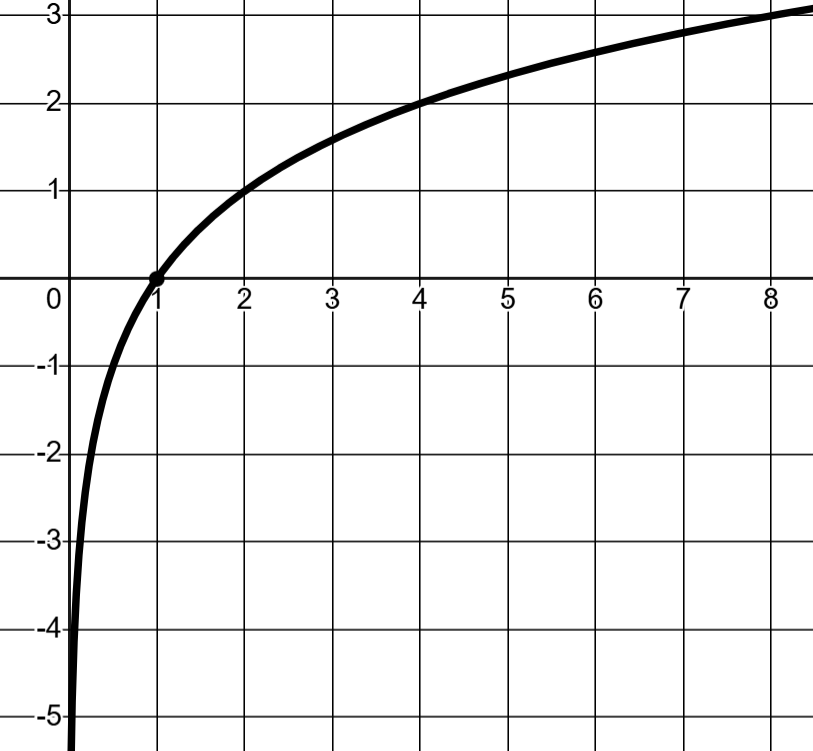
Draw the graph of the function f (must be on the coordinate plane with important information labeled)
f(x)=log_2x
300
Solve:
8(2^x)=256
5
300
The function f is defined for [0,4]. Use the table to find the interval(s) where the graph of f is concave down.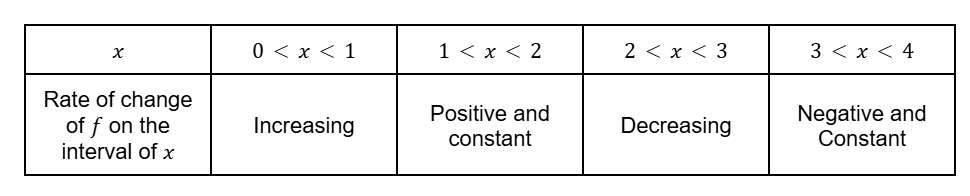
2<x<3
400
An angle of measure pi/4 in standard position has a terminal ray that intersects a circle at point P. The angle is subtended by an arc of the circle in quadrant I with length 40 units. What is the radius of the circle?
160/pi
400
When does a rational function have a slant asymptote?
The degree of the numerator is exactly one more than the degree of the denominator
400
Find f(g(x)) given the following:
f(x)=e^(2x)
g(x)=ln(3x)
9x^2
400
Solve g(x)=8
g(x)=2^(2x-3)
3
400
Determine the end behavior of f as x increases without bound. Use limit notation
f(x)=-3x^4+2x^2-x+1
lim_(x->oo) f(x)=-oo
500
What are the zeros of the function g on the interval [0, 2pi)?
g(x)=(1+sinx)/cosx
no zeros on the interval
sinx=-1,x=(3pi)/2
if x=(3pi)/2, cosx=0
g(x) is undefined at this value
500
sin2x=
2sinxcosx
500
Rewrite h(x) as a constant multiple of
log_3x
h(x)=log_3(x^2)+10log_9x
7log_3x
500
Solve k(x)=e for all values in the domain of k
k(x)=e^4/sqrt(e^x)
6
500
Use the table to find
h^-1(k(3))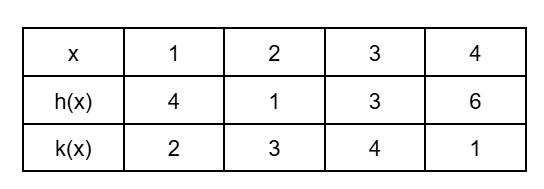
1