Vocabulary
Simple Events
Compound Events
Compound Events #2
Experimental vs Theoretical
miscellaneous
100
the list of all possible outcomes
sample space
100
A cup has sticks numbered 1 through 13. What is the probability of an odd number?
Answer: 7/13
sample space {1,2,3,4,5,6,7,8,9,10,11,12,13}
odd numbers {1,3,5,7,9,11,13}
odd/total = 7/13
100
A coin and a die are both rolled. What is the probability of flipping tails and an even number?
Answer: 3/12 or 1/4
P(T) = 1/2 P(even) = 3/6
P(T and even) = 1/2 x 3/6 = 3/12 = 1/2
100
A coin and a die are both rolled. What is the probability of flipping tails or an even number?
Answer: 3/4
P(T) = 1/2 P(even) = 3/6
P(T or even) = (1/2 + 3/6) - 3/12 (overlap)
= 1 - 3/12 = 3/4
T1, T,2, T3, T4, T5, T,6, H2, H4, H6 9/12 = 3/4
100
What is experimental probability?
What is the outcome when an experiment is completed.
100
Suppose you have a 3/5 chance of hitting any given free throw. You shoot 50 free throws. How many do you expect to hit?
Answer: 30 hits
50(3/5) =30
200
the result of an event
outcome
200
A spinner has 6 equal sections: red, blue, yellow, green, orange, and pink. What is the probability that the spinner will land on yellow?
Answer: 1/6
Sample Space {red,blue, yellow, green, orange, and pink}
yellow/total: 1/6
200
A bag contains the following marbles: 4 red, 2 green, 3 yellow, and 1 orange. What is the probability that a green then a red will be picked, if the marble is replaced for the second draw?
Answer: 8/100 or 2/25
10 total marbles
P(G) = 2/10 P(R)= 4/10 (replacement)
P(G and R) = 2/10 x 4/10 = 8/100 = 2/25
200
A blue number cube and an orange number cube are rolled. What is the P(3 or even)?
Answer: 2/3
P(3) = 1/6 P(even) = 3/6
P(3 or even) = 1/6 + 3/6 = 4/6 = 2/3 (no overlap)
1,2,4,6 4/6 = 2/3
200
A boy tosses a coin and gets heads 7 times out of 20. Is this theoretical or experimental?
Answer: Experimental
boy is tossing a coin - conducting an experiment
200
What is the sample space when drawing a vowel from the word Probability?
Answer: {o,a,i}
sample space is all possible outcomes
300
The expected likelihood of an event without conducting an experiment...
theoretical probability
300
A spinner has 10 equal sections, 1,2,3,4,5,6,7,8,9, and 10. If the spinner is spun, what is the probability of spinning a number less than 7?
answer: 6/10 or 3/5
Sample Space {1,2,3,4,5,6,7,8,9,10}
#s less than 7 {6,5,4,3,2,1}
#s less than 7/total =6/10 = 3/5
300
A drawer contains 4 white, 4 black, 2 yellow, and 5 polka-dot socks and Julie wants to find a pair of yellow socks to wear to school. What is the probability that she will choose a pair of yellow socks in her first two picks if she doesn't replace the sock she draws first.
Answer: 2/210 or 1/105
Total Socks: 15
P(Y) = 2/15 without replacement
(since there is no replacement and a yellow is picked more than once, you must assume the yellow is picked the first time- hence there is only 1 yellow sock to be picked from the 2nd time)
P (Y and Y)= 2/15 x 1/14 = 2/210 = 1/105
300
A spinner with equal sections of red, blue, green, and purple is spun while a number cube is rolled. What is the P (not blue or not a 3)
Answer: 23/24
P(not blue) 3/4 P(not 3) = 5/6
P(not blue or not 3)= (3/4 + 5/6) - 15/24 overlap
=1 7/12 - 15/24 = 23/24
Can be all outcomes except 3B
300
The probability of drawing an ace from a standard deck of cards is 4/52 or 1/13. Is this theoretical or experimental probability?
Answer: theoretical
this exactly what you should get
300
What is the sample space if you flip a coin and spin a spinner with 3 equal parts labeled D,O,G
Answer:
{TD,TO,TG,HD,HO,HG}
400
What probability word would describe a probability of 0.49 ?
Answer: unlikely
unlikely: less than 50% (0.50) chance of something happening, but not impossible (0).
400
A drawer contains 20 socks: 8 blue, 4 green, 6 black, and 2 white. What is the probability of picking out a blue sock?
Answer: 8/20 or 2/5
blue/total: 8/20 = 2/5
400
A blue number cube and an orange number cube are rolled. What is the P(3 and even)?
Answer:
P(3) = 1/6 P(even) = 3/6
P(3 and even) = 1/6 x 3/6 = 3/16 = 1/12
400
A bag contains the following marbles: 4 red, 2 green, 3 yellow, and 1 orange. What is the probability that a green then a red will be picked, if the marble is not replaced for the second draw?
Answer: 8/90 or 4/45
Total 10 marbles
P(G) = 2/10 P(R) = 4/10 no replacement
P(G, then R) = 2/10 x 4/9 = 8/90 = 4/24
400
A heart is randomly chosen from a deck of cards 7 out of 12 times. What is the experimental probability?
Answer: 7/12
400
Create a tree diagram and include the sample space of spinning a fair spinner labeled red, green and blue and flipping a coin.
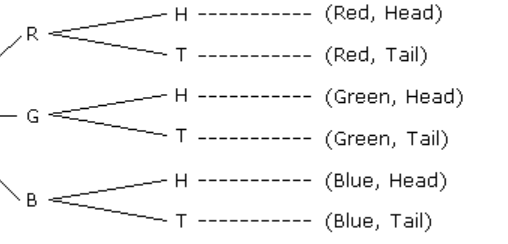
500
the use of multiplication to find the total outcomes possible.
Fundamental Counting Principle
500
A class has 20 boys and 12 girls. What is the percent chance that the teacher will choose a girl to answer a question?
answer: 12/32 or 3/8
Boys 20 + 12 girls = 32 class
girl/class 12/32 = 3/8
500
A spinner with equal sections of red, blue, green, and purple is spun while a number cube is rolled. What is the P (not blue and not a 3)
Answer: 15/24 or 5/8
P(not blue) 3/4 P(not 3) = 5/6
P(not blue and not a 3)= 3/4 x 5/6 = 15/24 = 5/8
R1 R2 R4 R5 R6
G1 G2 G4 G5 G6 15/24 = 5/8
P1 P2 P4 P5 P6
500
You have 3 quarters, 5 dimes and 2 nickels in your pocket.
What is the probability of picking a dime and then another dime without replacement?
Answer:
P(dime) = 5/10
P(dime, then dime): 5/10 x 4/9 (no repleacement)
20/90 = 2/9
500
A heart is randomly chosen from a deck of cards 7 out of 12 times. What is the theoretical probability?
What is 1/4?
P(heart) = 13/52 = 1/4
The information provided about the experimental results (7 out of 12 times) is not used for calculating the theoretical probability.
500
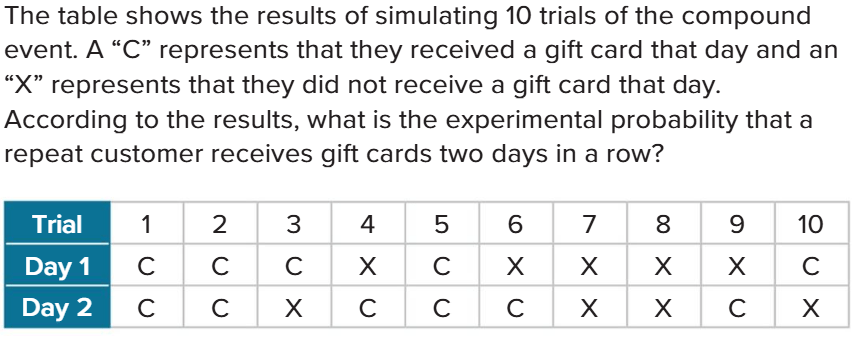
Answer: 3/10
There a 3 times out of 10 that a customer gets a gift card 2 days in a row (C,C)
Trial #1,2,5