Particle Model of Matter
Conservation of Mass
Properties of Matter
Combining Substances
Vocabulary
100
A particle is a very small piece. About how many times smaller is a particle than the smallest grain of sand?
About 10,000 times smaller
100
What does the law of conservation of mass say?
Mass cannot be created or destroyed.
100
Which property tells how much space an object takes up?
Volume
100
What does it mean to combine substances?
To mix two or more materials together
100
A type of mixture where one substance dissolves in another substance?
Solution
200
What is matter?
Anything that has mass and takes up space.
200
A student mixes baking soda and vinegar in a sealed bag. The bag inflates. What happens to the mass?
The mass stays the same
200
Name two properties of matter and describe them.
Example: Color describes how an object looks; texture describes how it feels
Other examples: shape, mass, hardness, magnetism, solubility
200
Which example shows a chemical reaction?
A. Mixing sand and water
B. Stirring sugar into water
C. Mixing baking soda and vinegar
D. Cutting paper in half
C. Mixing baking soda and vinegar
200
The process that scientists use to explore observations and answer questions?
Scientific Inquiry Process
300
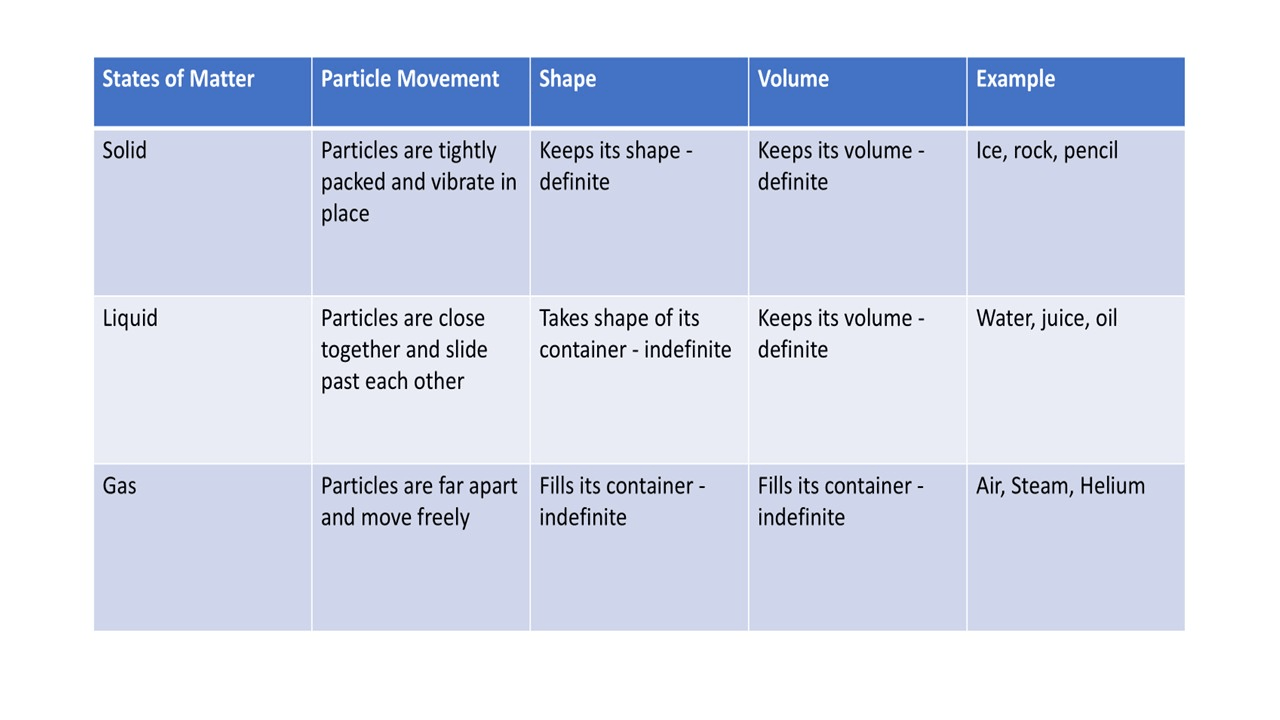
A __________ has particles that are tightly packed together.
A solid
300
Explain why the mass may appear to change during a reaction in an open container.
In an open container, gases can escape into the air, making it seem like mass was lost.
300
Why are properties of matter useful to scientists?
Properties of matter help scientists identify, compare, and classify matter.
300
When two substances are combined and no new substance forms, it is called a:
Physical change
300
Anything that takes up space and has weight?
Matter
400
A student heats a cup of water.
What happens to the particles in the water?
How does this help explain why the water might eventually turn into gas?
Heating causes particles to move faster. As the particles gain energy, they spread farther apart, which can cause the water to change into a gas.
400
True or False
Conservation of mass applies to physical and chemical changes.
True
400
Explain how mass and volume are different.
Mass is the amount of matter in an object, while volume is the amount of space it takes up.
400
1. A change where a new substance is formed?
2. A change in size, shape, or state?
3. Matter with particles that move freely?
4. A clue that a reaction occurred?
1. Chemical reaction
2. Physical reaction
3. Gas
4. Evidence
400
This property of matter describes whether a substance can dissolve in a solvent such as water.
Solubility
500
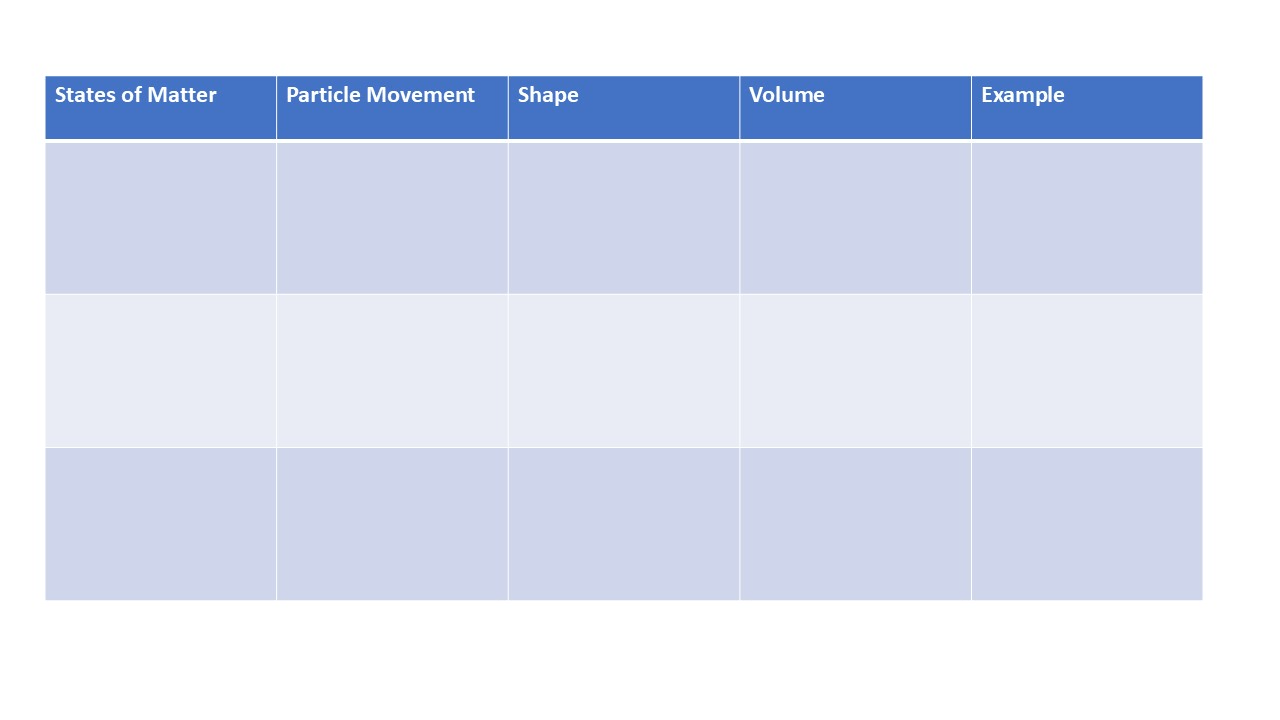
Fill in the blanks
500
Which tool is best used to measure mass?
Balance or scale
500
Two objects look the same but one feels heavier.
Which property is different?
How could you measure it?
The different property is density (or mass for the same volume), meaning one object packs more matter into the same space. (solid metal ball vs. a hollow plastic ball of the same size).
You can measure this difference using a balance scale (to compare mass)
500
Explain the difference between a physical change and a chemical reaction.
Describe two signs that show a chemical reaction may have occurred.
A physical change does not create a new substance, while a chemical reaction does.
Examples include gas bubbles, color change, temperature change, or forming a solid.
500
How heavy something is for its size, or how tightly packed its "stuff" (mass) is in the space it takes up (volume).
Density