What Are The Odds?
Hypothesis tests, Alpha Levels, Type I Errors, Oh My!
What (Mean) Difference Does It Make?
You Have to Be IndependenT
Aren't We Just a Pair(ed Samples T-Test)?
Would You Care for a Sample(-ing Distribution)?
100
The conceptual definition of conditional probability.
What is... The likelihood of one event occurring DEPENDS on the occurrence of some other event?
p(A┃B) = # of observations favoring A and B divided by # of observation favoring only B.
100
The assumptions for performing a Z-test.
What is...
1. Has a normal distribution.
2. The SD is unchanged (we know the population standard deviation as such).
3. Independent observations.
4. Randomized sample.
100
The assumptions for performing a single-sample T-test.
What is...
1. Approximates a normal distribution.
2. Estimated standard deviation.
3. One random sample of interval or ratio scores.
100
The assumptions for an independent-sample T-Test.
What is...
1. Approximates a normal distribution.
2. Observations within each sample are independent.
3. Homogeneity of variance. The two populations from which the samples are selected have equal variances.
100
The assumptions for a t-test with two related samples (within groups).
What is...
1. Observations within each group are independent.
2. Population of d-scores (difference scores) is normally distributed.
100
Define the 3 components of the Central Limit Theorem.
What is...
1. As N approaches infinity, our standard error decreases in magnitude, and our standard deviation = standard error.
2. As N approaches infinity, our mean will = mu
3. As sample size increases, shape of the distribution will approach normality.
200
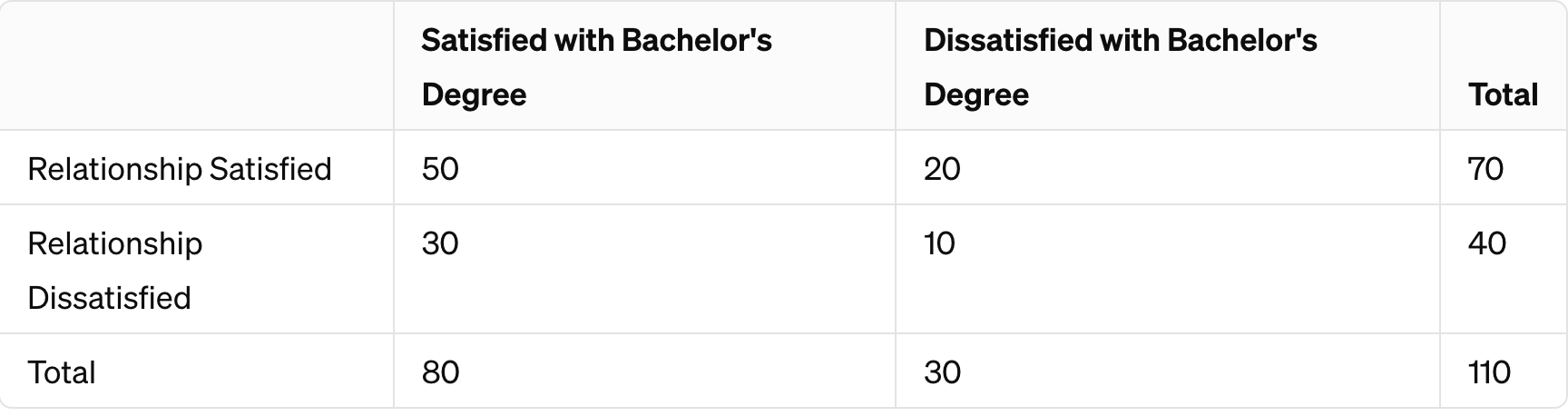
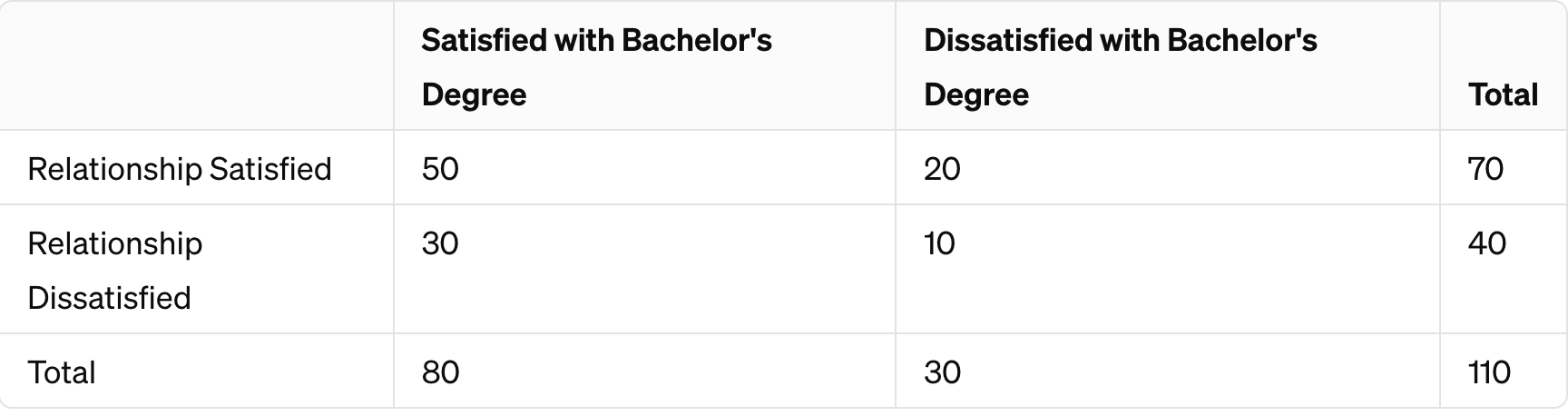
Tell me the likelihood that someone with a Bachelor's degree is satisfied given that they are satisfied in a relationship.
What is...
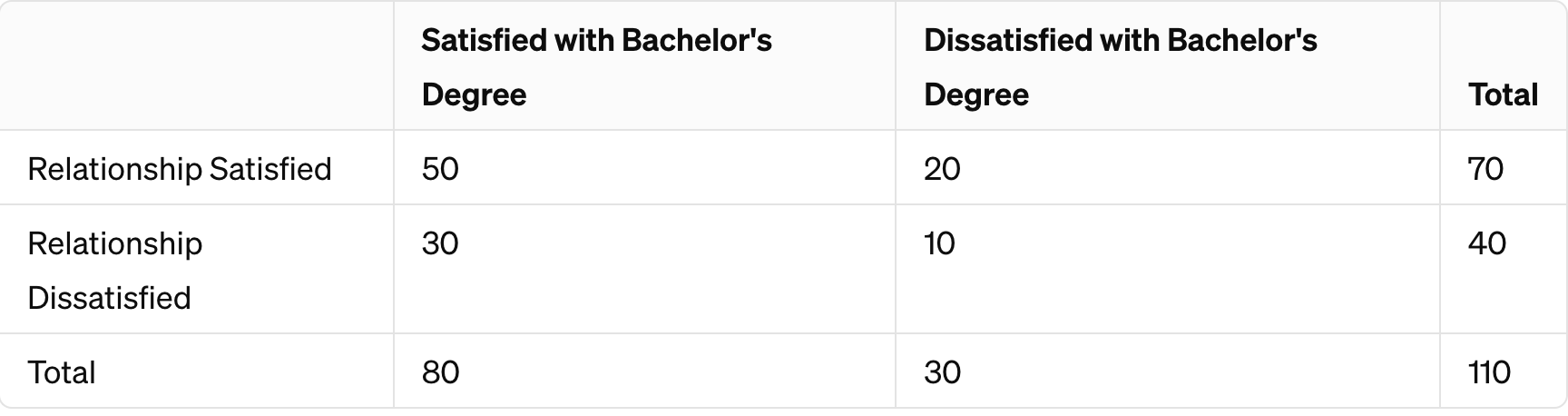
Satisfied with Bachelor's GIVEN satisfaction with Relationship = 50.
Satisfied with relationship only: 70.
p(A┃B) = 50/70 = 0.7142857
= 0.71% of those satisfied with Bachelor's degree given that they are also satisfied with relationship.
200
Tell me some of the factors that influence a hypothesis test.
What is...
1. Mean difference. If the size of the sample mean and pop mean is large = more likely there is a real treatment effect.
2. Magnitude of standard error. Larger standard error = more likely result is due to error/chance.
3. Number of scores in the sample. The more scores we have, the more representative it is of the population and will likely yield a significant result.
200
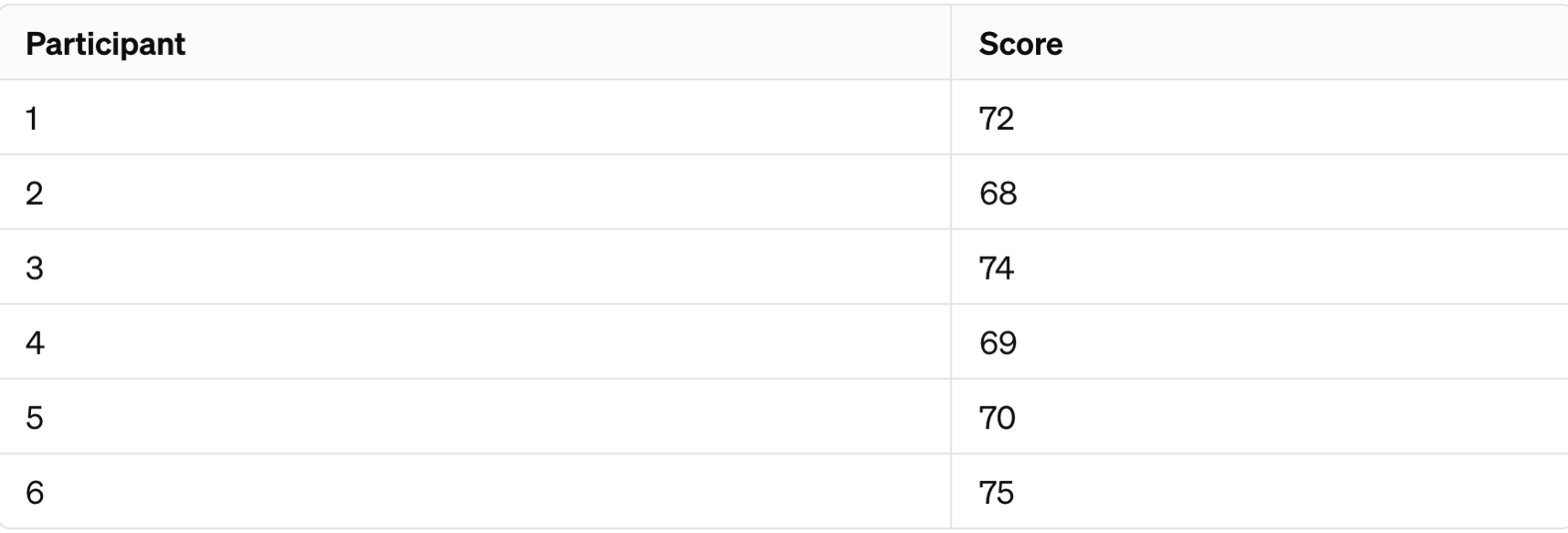
We have a sample of 6 students who took a practice test for an exam, and we want to see if their average score is different from the population mean of 70. Assume that the alpha level is 0.05.
First, decide if this is a one-tailed or two-tailed test. Then set up your null and alternative hypotheses, and solve for t. Remember to compare the computed value to the critical, tabled value of the t-distribution.
What is...
This is a two-tailed test. Nothing in the question indicates that we are looking for an increase or decrease; we're just seeing if there's a difference or an effect, overall.
For a two-tailed distribution, I set up my null and alternative hypotheses as
Null: μ = 70
Alternative: μ ≠ 70
Df: N - 1, which in this case would be 6 - 1 = 5. Using the t-distribution (in G&W appendix B, Table B.2):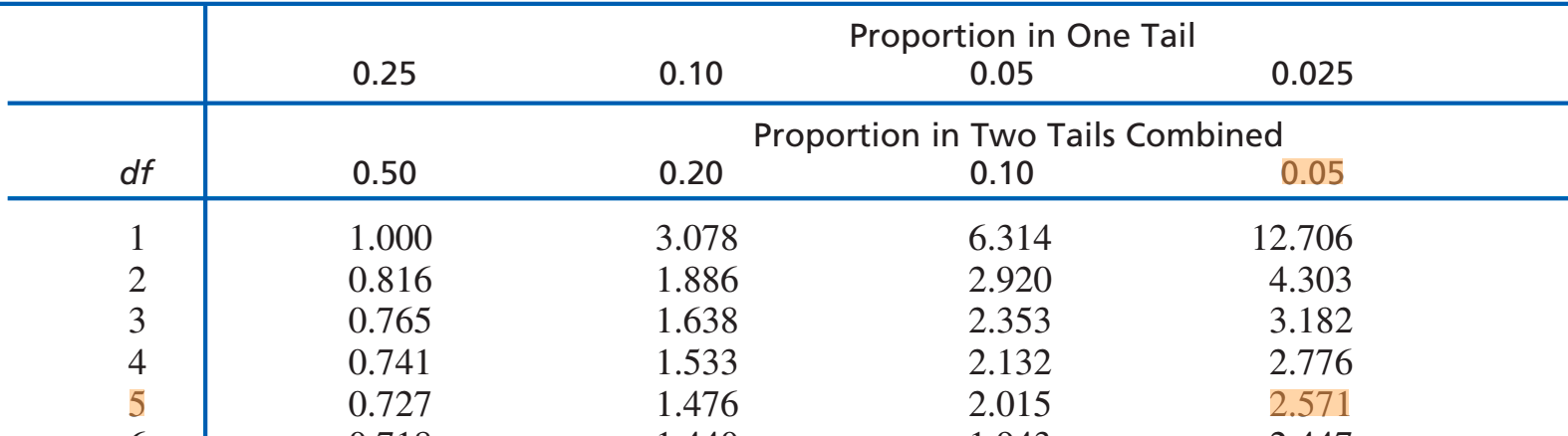
The critical value (CV) is +/-2.571.
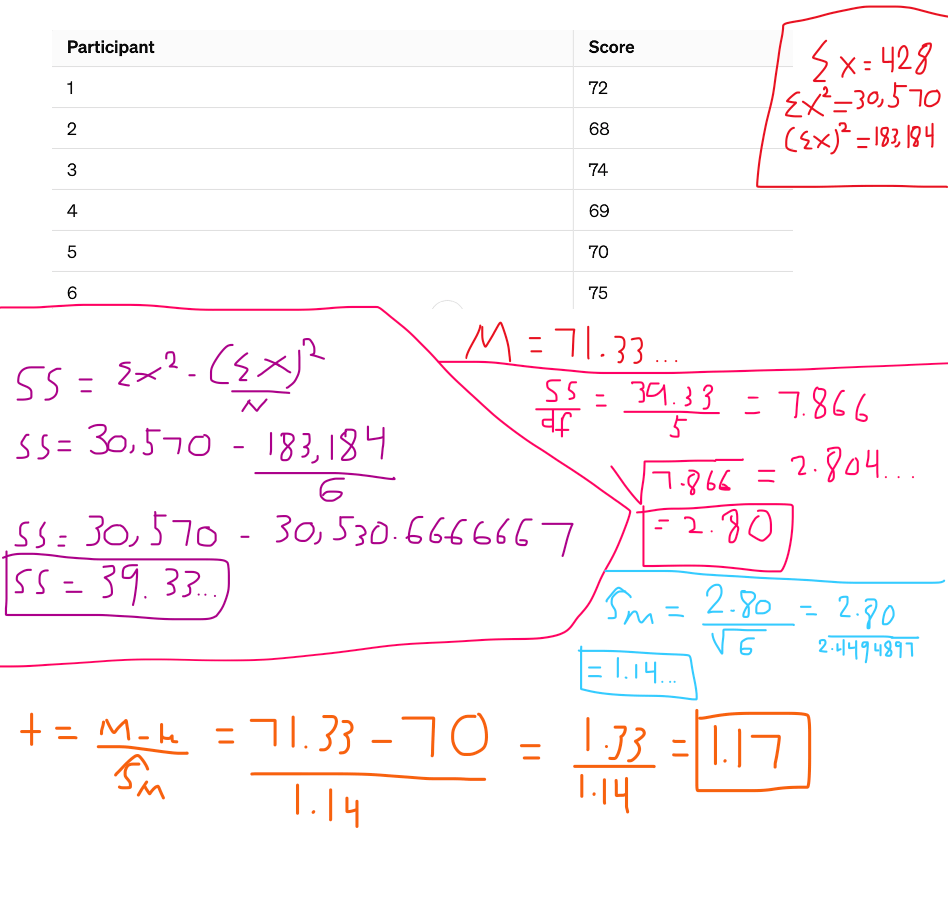
Ultimately, we fail to reject the null hypothesis, because the computed value of +1.17 falls in the region of retention and does not extend beyond our critical value needed for rejection +/-2.571
200
The conditions to perform an independent-samples t-test.
What is...
1. The IV can be quantitative or qualitative but must be between-subjects.
2. The DV is quantitative and at least interval level.
3. IV has two and ONLY two levels.
200
The conditions to perform a related-samples t-test.
What is...
1. The IV is within-subjects, quantitative or qualitative.
2. The DV is quantitative and at least interval level.
3. The IV has 2 and ONLY 2 levels.
200
Define the Law of Large Numbers.
What is...
The Law of Large numbers specifies that the bigger N (sample size) we have, the more likely it is that the sample mean will be close to the population mean. The error between the sample mean and population, as such, decreases.
300
Tell me the probability of someone being dissatisfied with a Bachelor's Degree AND their relationship.
What is...
P(A and B): # of events favoring both A and B divided by total # of observations. This is joint probability--the AND probability.
P(A and B) = 10/110
= 0.0909091
= 0.09% of people are dissatisfied with their Bachelor's Degree AND their relationship.
300
Two definitions of an alpha level (Yes, there are two!).
What is...
1. It defines the probability of committing a type I error.
2. It defines the critical region of values unlikely to be out in the tails if the null was true.
300
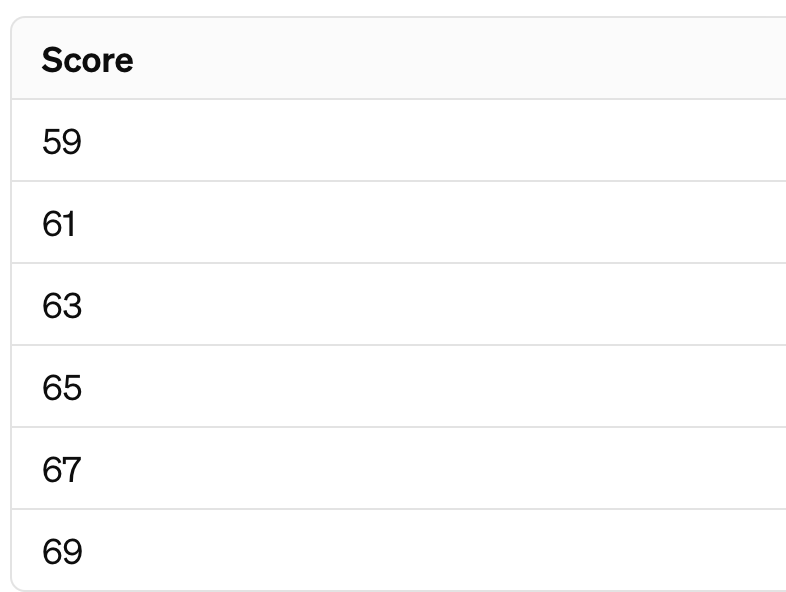
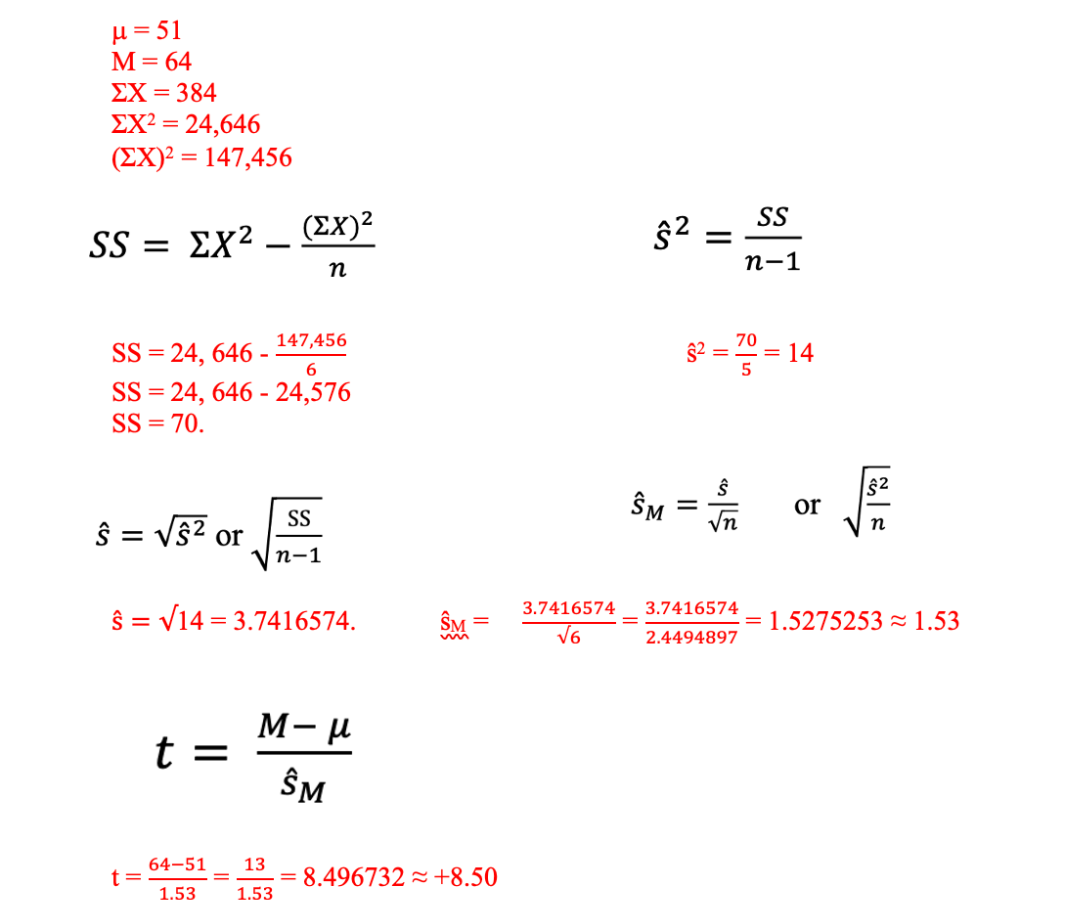
PART 1: We want to see the effects of caffeine given to sleep-deprived patients on attention. With a mu of 51, use the data below to calculate a single-sample t-test value. Assume that the alpha level is 0.05.
What is...
There is evidence of a treatment effect. From the sample mean of 64 to the population mean of 51, caffeine given to sleep-deprived patients increases their attention.
Work shown below:
300
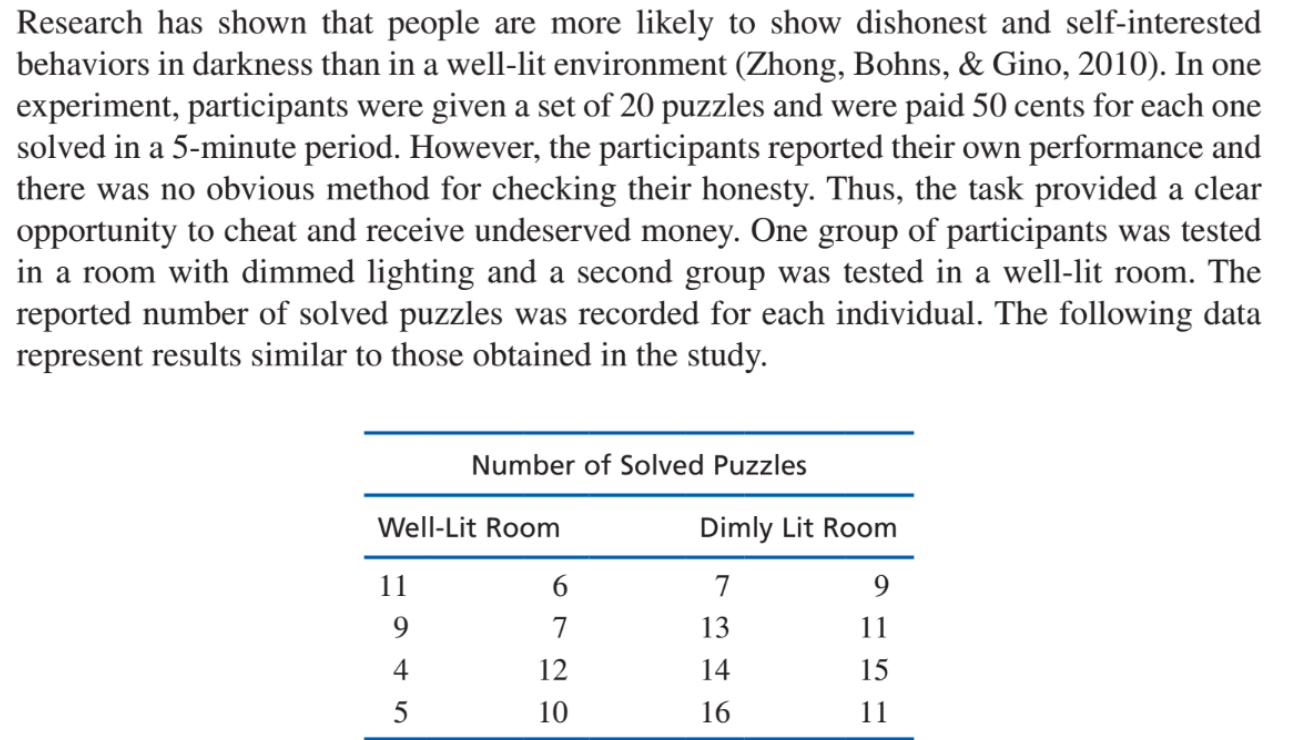
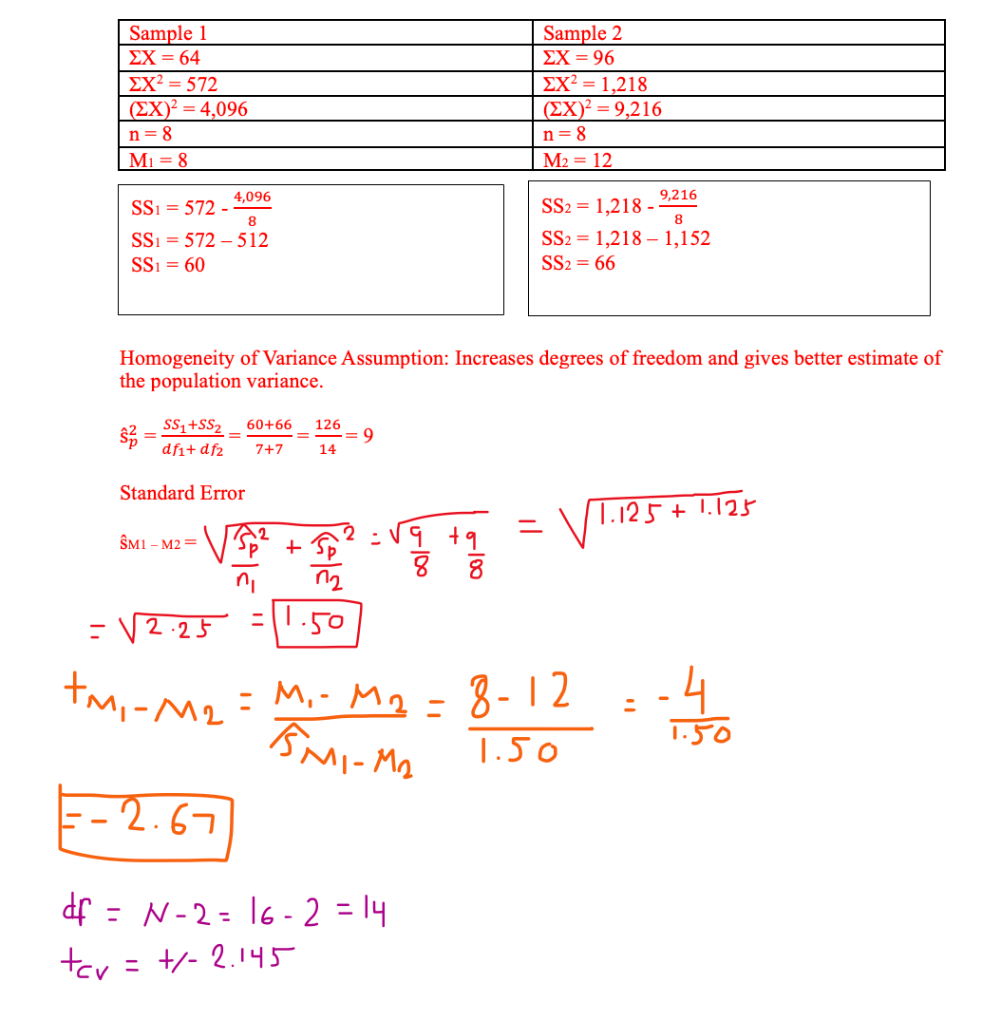
PART 1:
What is...
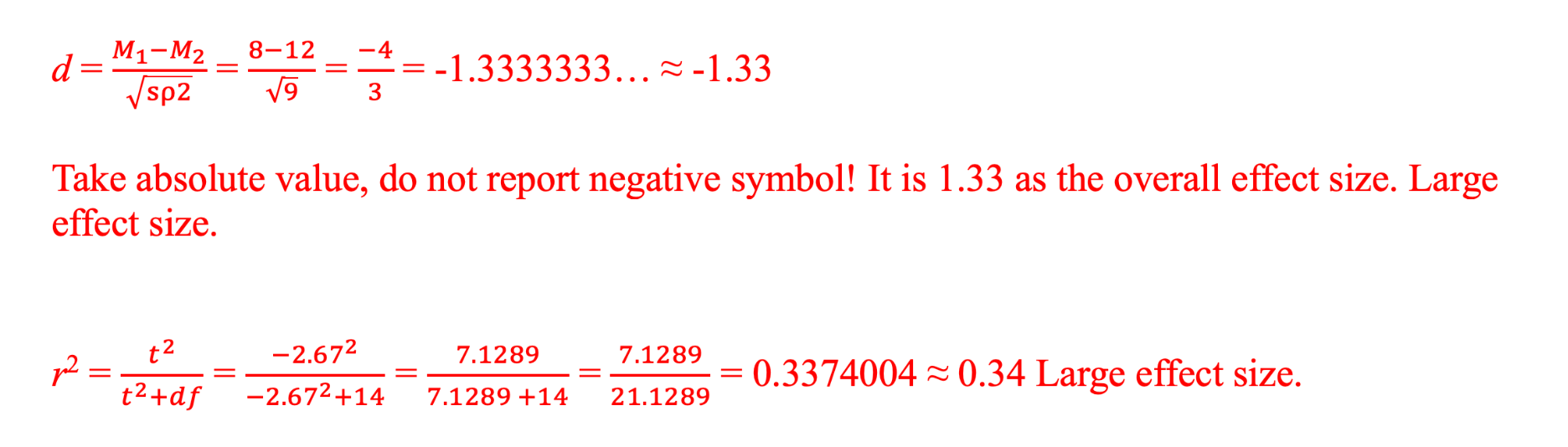
From the well-lit room (M = 8, SD = 2.93) to the dimly-lit room (M = 12, SD = 3.07), there is evidence that individuals in the well-lit room engage in less cheating. Work shown below:
300
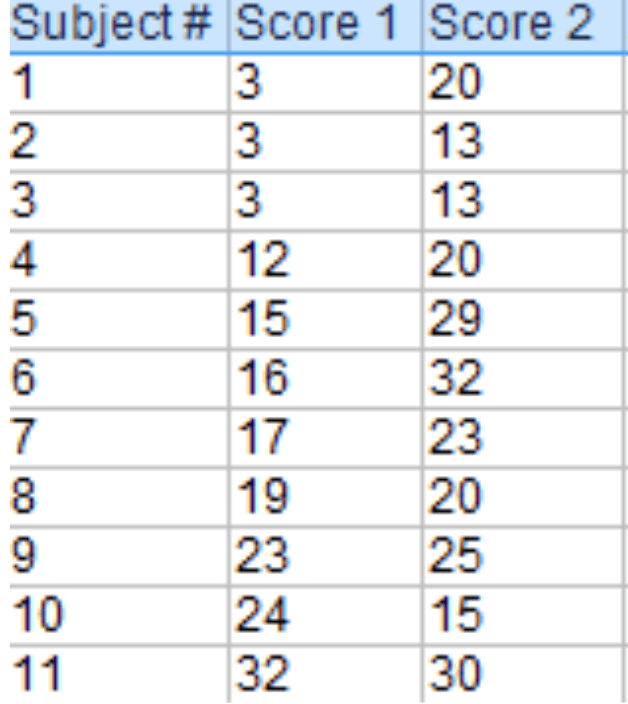
PART 1: Perform a related-samples t-test using the data below. Assume two-tailed and 0.05 as our alpha level.
What is...
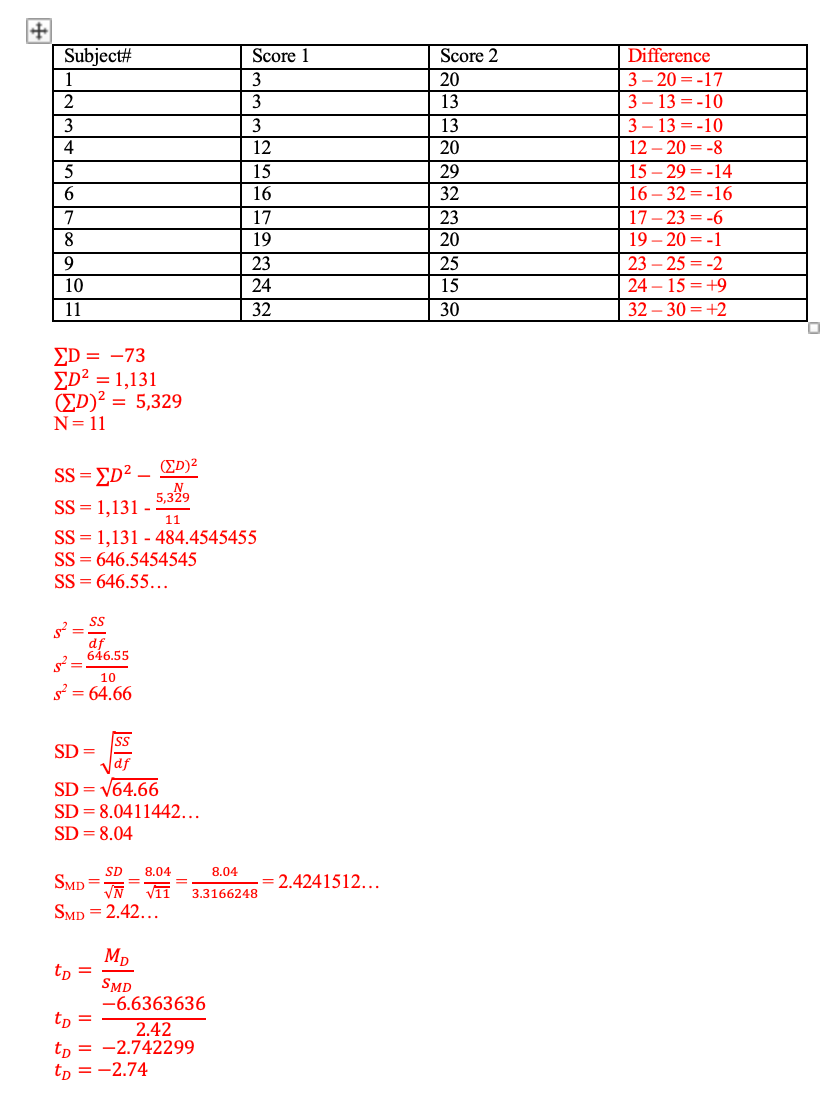
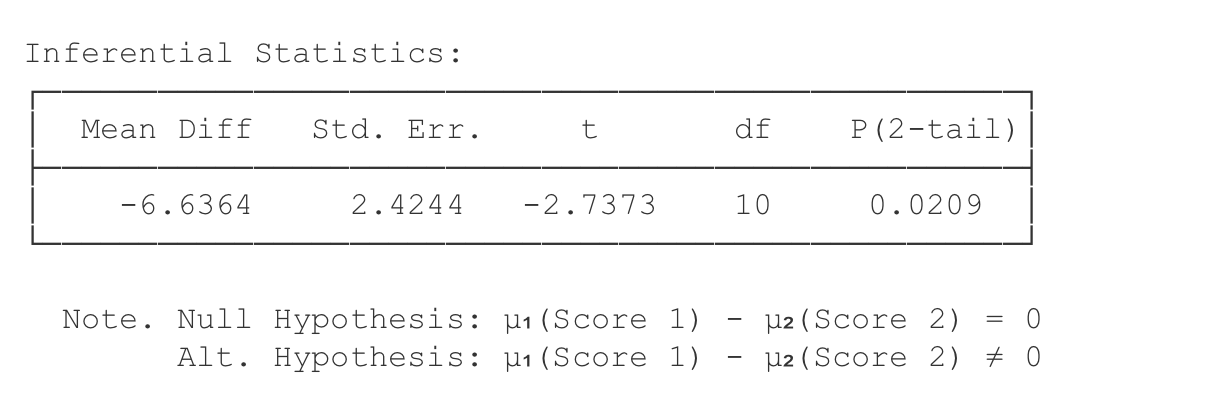
-2.74 is greater than the critical value needed for rejection (+/- 2.228) when degrees of freedom = 10 and our alpha level is at 0.05. We can reject the null hypothesis.
I also input the data into Stats HW Software (link in syllabus) and found the same result. Trust but verify, folks.
Also, don't sweat it if there's some minor rounding error. It's best only to round final answers, but it is a lot to write out or type out all the digits. Sometimes, I copy/paste directly from my computer calc, other times, I don't bother.
300
Define a sampling distribution.
What is...
A sampling distribution is a distribution of statistics obtained by selecting all the possible samples of a specific size from a population.
It tells us the sample-to-sample variability we can expect by chance or sampling error.
400
Tell me the probability that someone is satisfied in their relationship OR dissatisfied in their relationship.
What is...
p(A or B) = p(A) + p(B)
p(A or B) = 70 + 40 = 110.
This is the "or" probability. Events are mutually exclusive.
400
A beverage company claims that their new energy drink INCREASES concentration levels. To test this claim, a researcher conducts an experiment with 40 participants. The population mean concentration level consuming the drink was 60, with a standard deviation of 8. In the sample, the mean concentration level was 64. Assuming a significance level of 0.05, tell me if the researcher can conclude that the energy drink increases concentration levels.
What is...
Using one-tailed Z-test because we want to see an increase in concentration levels. This implies a directional hypothesis test (look out for those keywords). The CV in this case would be +1.65 when alpha level is at 0.05.
Our sample mean (M or x̄) = 64.
Our population mean (mu) = 60.
Population standard deviation = 8.
N = 40.
Standard error found by dividing the SD by the square root of N.
8/√40 = 8/6.3245553
= 1.2649111
= 1.26.
Z = M - mu divided by standard error.
Z = 64 - 60 /1.26
Z = 4/1.26
Z = 3.1746032
Z = +3.17
Since +3.17 is beyond the critical value needed for rejection (+1.65), we can conclude that there is a treatment effect. From the sample mean (64) to the population mean (60), there is evidence that the new energy drink increases concentration levels.
400
PART 2: Using the data from the previous question, since we have a significant t-value, go ahead and compute both Cohen's d and r2.
Be sure to interpret the strength of the effect size!
What is...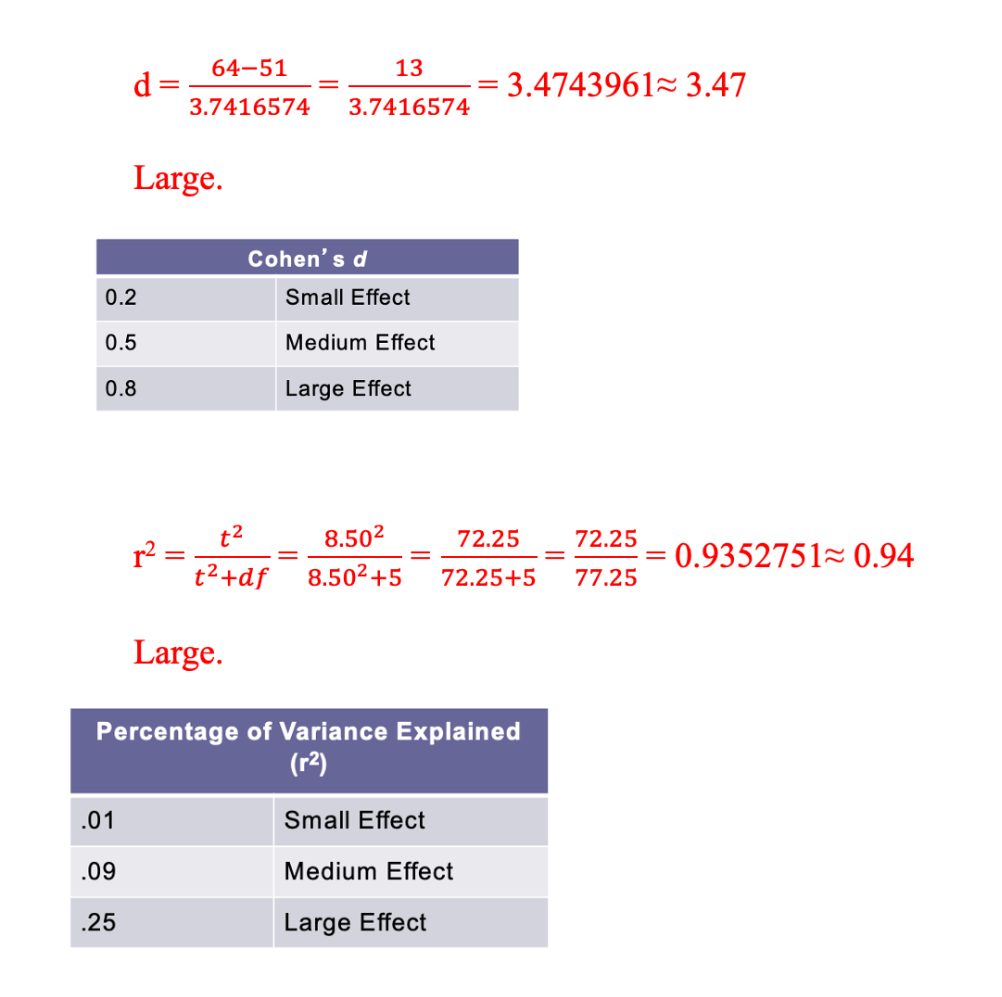
400
PART 2:
Since the previous question had a statistically significant result, go ahead and compute both Cohen's d and r2.
Be sure to interpret the strength of the effect size!
What is...
400
PART 2:
Since we determined the dependent t-test result was significant, go ahead and compute Cohen's d and r2.
What is...
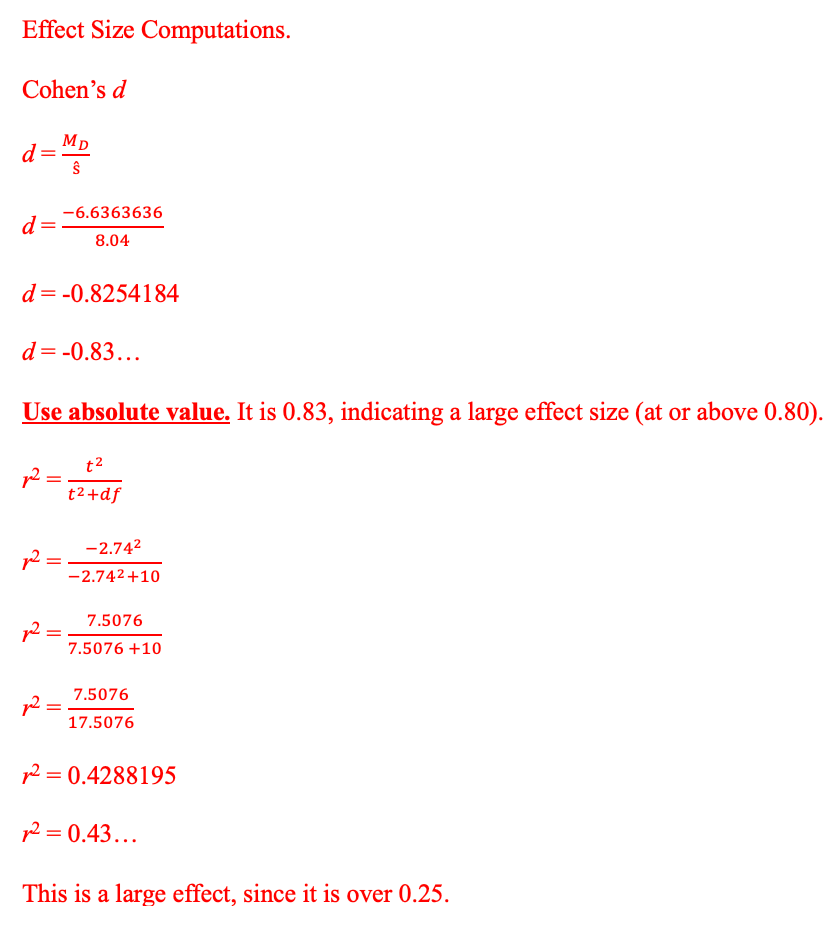
Double-checking with Stats HW Software: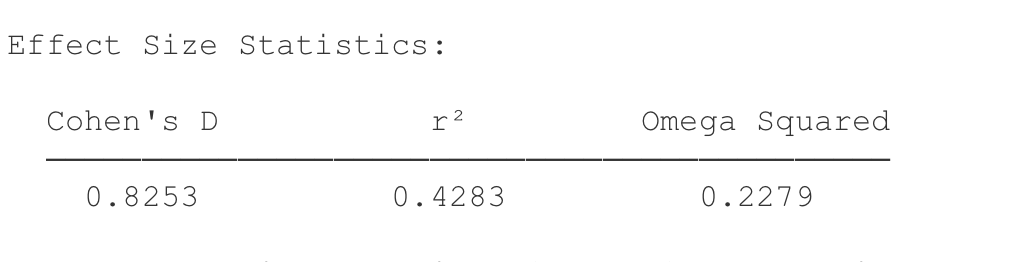
400
Define a distribution of sample means.
What is... the distribution of sample means over repeated sampling from a population?
500
In a psychology experiment, participants are asked to guess whether a card drawn from a deck is red or black. If a participant guesses for 10 cards, tell me the probability that they guess exactly 7 cards correctly.
Remember how to find mu, standard deviation, and to focus on the wording when it says "EXACTLY 7 cards." This will concern upper and lower real limits. Calculate carefully.
Mu =pn
SD = square root of npq.
X = 7.
What is...
The probability of guessing red or black is 0.5. There is a fifty-fifty chance of guessing here. The probability that they will guess correctly (p) is 0.5. The probability they will guess incorrectly is also 0.5 (q)
Number of trials = 10.
p * n (or pn) = 5. This is our mu.
SD = square root of (0.5)(10)(0.5) = 1.5811388. Rounded = 1.58.
p(7) right by chance = find the upper and lower limits of z score.
For URL: 7.5 - 5/1.58
URL: 2.5/1.58
URL: +1.58.
For LRL: 6.5 - 5/1.58
LRL: 1.5/1.58
LRL: +0.95.
Since these are on the same side as the mean, we subtract their respective column Ds to find the area.
Column D for 1.58 = .4429
Column D for 0.95 = .3289
Area: .4429 - .3289 = 0.114
0.114 * 100 = 11.4%.
500
Tell me one benefit and one disadvantage of having a conservative, small alpha level (such as .01).
What is...
It reduces the likelihood of committing a type 1 error. We are saying in this case that we are okay with making a type 1 error one percent of the time. However, on the flipside, a disadvantage would be that it extends the critical value needed for rejection further out into the tails, and as such, it makes it harder to reach significance.
An image might be helpful to demonstrate:
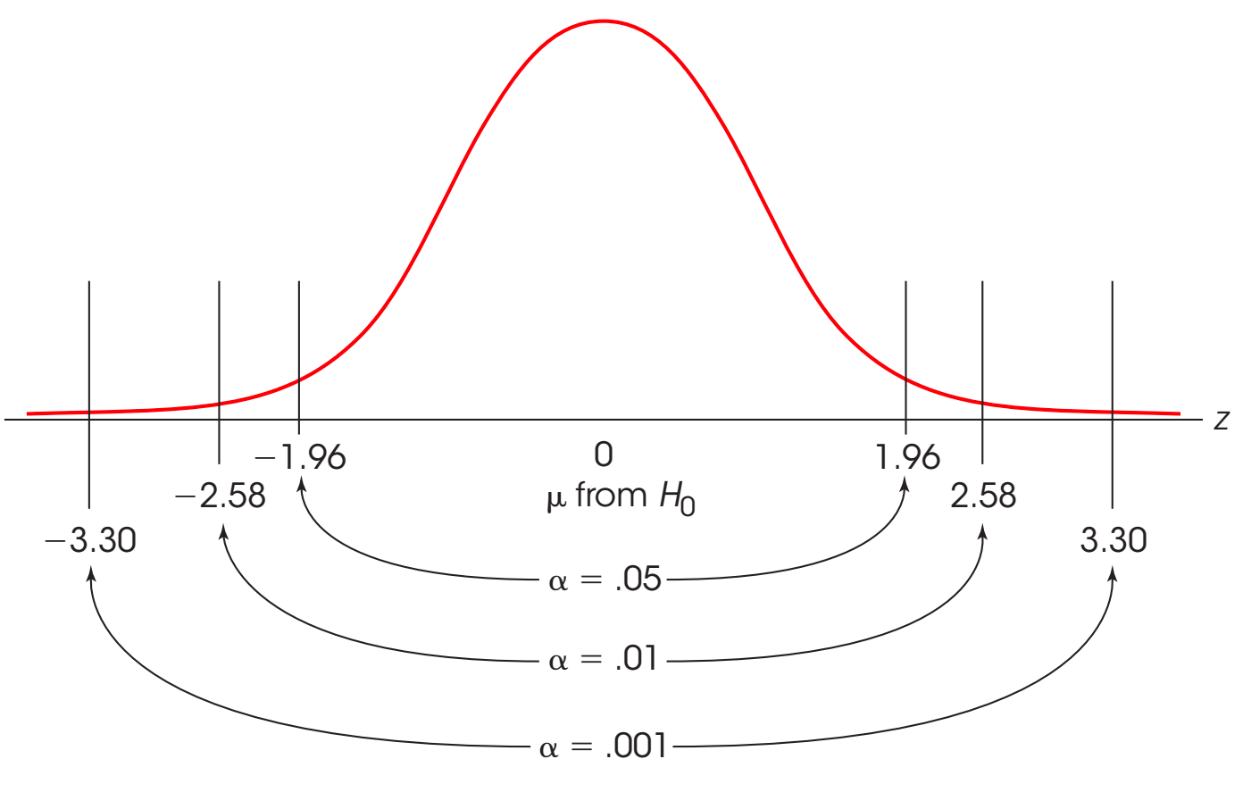
We see when the alpha level is at .01 and two tailed, the critical value needed for rejection becomes +/- 2.58 making it harder to reach than when it was at .05 and +/- 1.96.
500
Define conceptually both Cohen's D and r2. If you say they measure effect size, I will jump out the window.
What is...
Defining effect size in general: "A measure of effect size is intended to provide a measurement of the absolute magnitude of a treatment effect, independent of the size of the sample(s) being used." - Our holy savior, G&W.
Cohen's d standardizes the mean difference (or in other words, the mean difference is measured in terms of the standard deviation). The size of the sample has no bearing on Cohen's d.
r2 measures the variability of the treatment itself that is caused by the independent variable. It is asking the question, how much of the variability of the DV is due to the IV? r2 is slightly influenced by sample size.
500
Using the SPSS output below and ONLY the output, tell me if the independent t-test is significant (assume two-tailed and alpha level at 0.05).
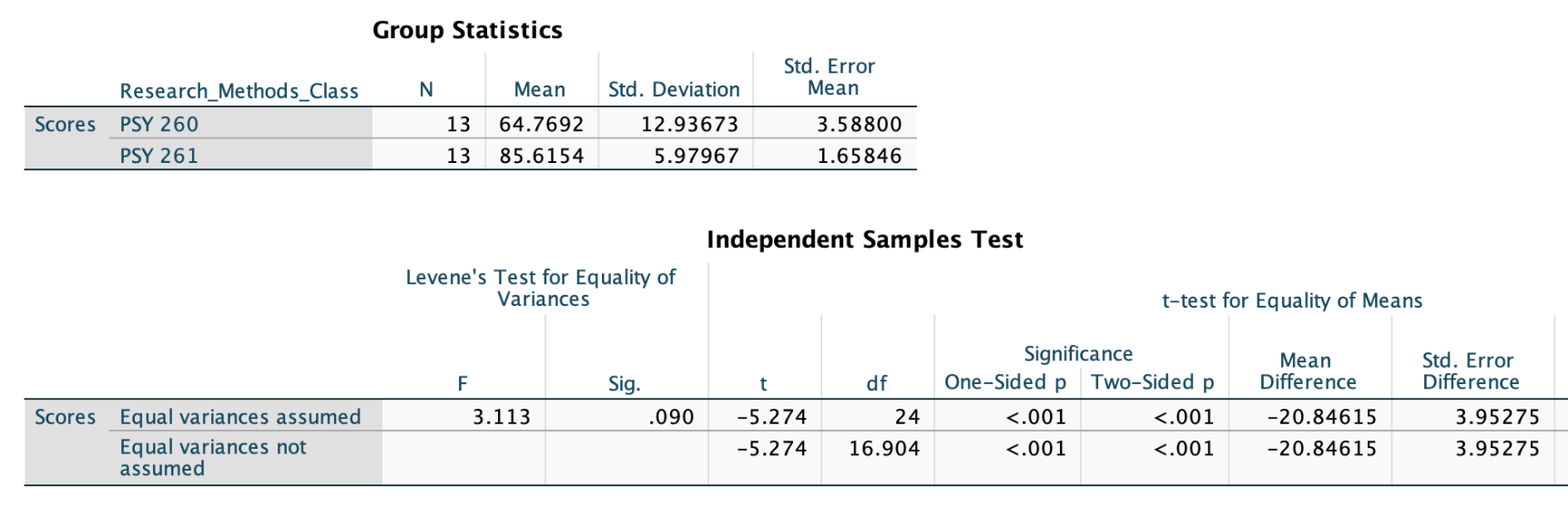
What is...
It is significant. When you look at the t-value, go right where it says significance. We see our p-value is less than .001.
500
List the 3 characteristics of the distribution of sample means.
What is...
1. Most sample means will have means close to mu.
2. The distribution of sample means should approximate a normal distribution.
3. Sample means from larger samples should be closer to the population mean (Law of Large Numbers).