Learning
Memory Functions
Memory
Sensation
Perception
100
In _____________, we learn by watching others and then imitating, or modeling, what they do or say.
observational learning
100
Memory is the set of processes used to _______, store, and retrieve information over different periods of time
(dive the definition of the word used to fill the blank)
Encoding- the input of information into the memory system
100
What is a memory-enhancing strategy
a technique to help make sure information goes from short-term memory to long-term memory
100
What is sensation?
Sensation is the result of a sensory receptor being stimulated.
100
What is perception?
Perception is the way that sensory information gets interpreted and how we consciously experience it.
200
What is the effect of prosocial modeling and antisocial modeling?
Prosocial modeling can prompt others to engage in helpful and healthy behaviors, while antisocial modeling can prompt others to engage in violent, aggressive, and unhealthy behaviors.
200
List and define the three types of encoding
1. Semantic Encoding- encoding of words and their meaning
2. Visual Encoding- encoding of images
3. Acoustic Encoding- encoding of sounds, words in particular
200
There are four popular memory memory-enhancing strategies. _________ is the conscious repetition of information to be remembered. __________ is when you organize information into manageable bits. __________ is a technique in which you think about the meaning of the new information and its relation to knowledge already stored in your memory. And ________ are memory aids that help us organize information for encoding.
1. Rehearsal
2. Chunking
3. Elaborative Rehearsal
4. Mnemonic devices
200
The conversion from sensory stimulus energy to action potential is known as ____________.
Transduction. (This is how cells send messages to the CNS.)
200
What is the phenomena behind becoming "noseblind"?
Sensory adaptation: the experience of not perceiving a present, constant stimuli after prolonged periods of exposure.
300
For each statement below identify if it is an example of a positive reinforcement, negative reinforcement, positive punishment, or negative punishment.
1. Anna spanks her child throwing the ball through the window.
2. An “A” on exam that you spent a lot of time studying for.
3. Gabe cleans his room so that his mom won’t yell at him.
4. Getting paid.
1. Positive Punishment
2. Positive Reinforcement
3. Negative Reinforcement
4. Positive Reinforcement
300
List and define the three stages of the Atkinson-Shiffrin (A-S) model of human memory.
1. Sensory Memory- storage of brief sensory events, such as sights, sounds, and tastes. It is very brief storage, up to a couple of seconds
2. Short-term Memory (STM)- a temporary storage system that processes incoming sensory memory; sometimes it is called working memory. Memory storage lasts about 20 seconds.
3. Long-term Memory- the continuous storage of information. The storage capacity of LTM has no limits.
300
Injury to this area leaves us unable to process new declarative memories.
Hippocampus
300
How is it possible for us to get messages that are presented below the threshold for conscious awareness? What are these messages called? Can we do anything with these messages?
Subliminal messages; a stimulus is present but does not reach an absolute threshold. Subliminal messages have little impact on us outside of laboratory settings-- evidence does not support that subliminal persuasion is possible.
300
List and describe the two types of processing involved with perception.
- Top-Down: perception that is driven by cognition; we apply what we know and expect (i.e., when you see a word in messy handwriting, you cannot read it until you're given context by the paragraph it is written in.)
- Bottom-Up: perceptions are built from sensory input; we piece together the information before we perceive it (i.e., flash a random picture on the screen)
400
Ryan was really looking forward to lunch because he had prepared a tuna salad sandwich. Unfortunately, the mayonnaise he used had been left out too long by his roommate, and had spoiled. Not long after eating the sandwich, Ryan felt sick and had to rush to the bathroom. Ever since that day, the mention of a tuna sandwich makes Ryan sick.
- What is the unconditioned stimulus?
- What is the unconditioned response?
- What is the neutral stimulus that becomes the conditioned stimulus?
- What is the conditioned response?
1. unconditioned stimulus: spoiled mayonnaise
2. unconditioned response: getting sick
3. neutral stimulus / conditioned stimulus: mention of tuna
4. conditioned response: feel nauseous
400
Compare and contrast implicit and explicit memory.
Both are types of long-term memory.
Explicit memories are memories we consciously try to remember and recall. Explicit memory is also called declarative memory and is subdivided into episodic memory (life events) and semantic memory (words, ideas, and concepts).
Implicit memories are memories that are not part of our consciousness; they are memories formed from behaviors. Implicit memory is also called non-declarative memory and includes procedural memory as well as things learned through classical conditioning.
400
1. What is the difference between source and organic amnesia?
Source amnesia (also called misattribution) is a type of memory distortion where the source of the memory is confused. Organic amnesia is usually the result of brain disease or head injury.
400
What are feature detectors, where are they located, and what do they respond to? Why are they necessary?
They are nerve cells in the visual cortex that respond to features of objects (i.e., shape, movement, angle). They allow us to experience and interpret whatever we may be seeing.
400
What are the Gestalt Grouping Principles? Draw an example of at least 3.
- When perceiving something, we tend to integrate pieces of information in to meaningful wholes. (The whole is different from the sum of its parts.)
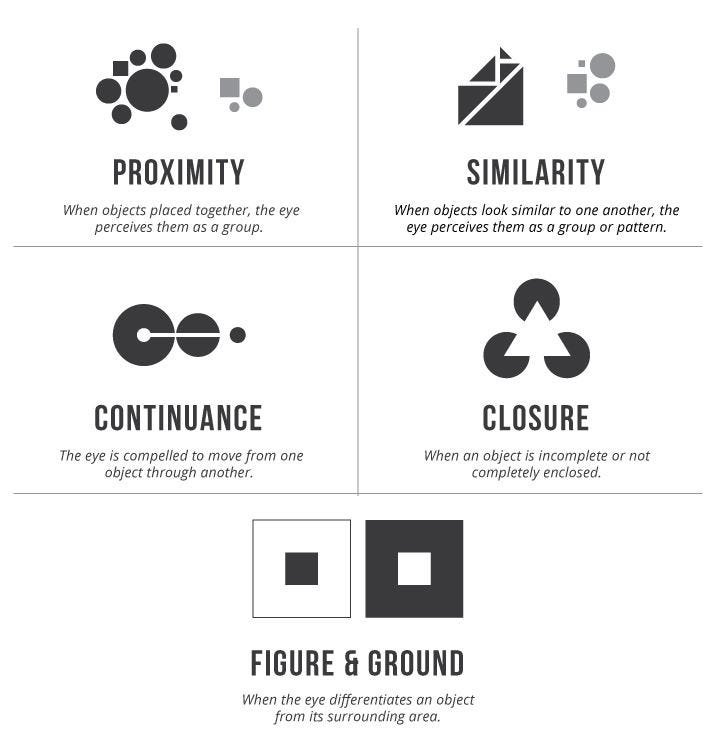

500
1. _________ was able to demonstrate Classical Conditioning with his experiments on ______.
2. _________ used a ________ (defined as _____________________) to demonstrate Operant Conditioning.
1. Ivan Pavlov, dogs
2. B. F. Skinner, Skinner Box (an operant conditioning chamber used to train animals such as rats and pigeons to perform certain behaviors, like pressing a lever. When the animals perform the desired behavior, they receive a reward: food or water)
500
List and define the three ways you can retrieve information out of your long-term memory storage system
1. Recall- accessing information without cues
2. Recognition- identifying previously learned information after encountering it again, usually in response to a cue
3. Relearning- learning information that was previously learned
500
1. That is the type of Amnesia experienced by Drew Barrymore in the movie 50 first dates?
2. Explain how it is different from the second main type of amnesia.
1. Anterograde Amnesia
2. The major difference between retrograde amnesia and anterograde amnesia is the following: Retrograde amnesia is the inability to recall past memories while anterograde amnesia is the inability to create new memories.
500
What is the absolute threshold? What is the difference threshold? What is Weber's Law?
The Absolute Threshold is the minimum amount of a stimulus required for a person to detect the stimulus 50 percent of the time.
The Difference Threshold is the smallest difference in stimulation that can be detected 50 percent of the time (sometimes called the Just Noticeable Difference or JND.) It depends on the strength of the stimulus. (i.e., when comparing two weak stimuli, such as two very slightly sweet liquids, you can detect a small difference in the amount of sweetness but when comparing two intense stimuli, such as two extremely sweet liquids, you can detect only a much bigger difference in the amount of sweetness.)
Weber's Law states that the change in a stimulus that will be just noticeable is a constant ratio of the original stimulus. (i.e., in a noisy room you must shout to be heard while a whisper works in a quiet room. And when you measure increment thresholds on various intensity backgrounds, the thresholds increase in proportion to the background.)
500
What are binocular and monocular cues? What are they used for? Give an example of each.
They are cues that we use for depth perception. Binocular cues rely on using both eyes to experience the world in 3D while monocular cues on rely on the use of one eye to experience the world in 2D.
- BC: binocular disparity or how we view the world differently in one eye versus the other.
- MC: liner perspective or two parallel and converging lines in a painting give us depth and let us perceive depth (also relative size, relative clarity, interposition, relative height, relative motion, light and shadow.)