The Science of Psychology
Brain and Behavior
Sensation & Perception
Consciousness
Learning
6
What is the definition of Psychology
The study of behavior and mental processes.
6
What is neuronal communication?
Neuronal communication is partly electrical and party chemical. Electrical within neurons and chemical between neurons at the synapse. The neural impulse travels through the neuron from the dendrites(the branches that come from the cell body) through the cell body(mechanism to keep cells alive) and then through the axon(tube filled with fluid that transmits electrical signal to other neurons).
6
What is bottom-up and top-down processing?
Solving with the senses with no prior information is bottom-up processing, solving with the brain using clues is top-down processing.
6
What are the meaning of the different brain waves?
Beta- Awake/Alert
Alpha- Relaxed/Drowsy
Theta(light sleep)- higher amp, slower frequency
Delta(deep sleep)- very high amp, slow frequency
6
What were the US(unconditioned stimulus), UR(unconditioned response), NS(neutral stimulus), CS(conditioned stimulus), CR(conditioned response) of the Pavlov experiment?
US- Food
UR- Caused the dogs mouths to water
NS- the clock did not cause the dogs mouth to water
CS- the clock controls when the food comes
CR- His mouth waters when the clock ticks
6
What are the names of all old school perspectives?
Structuralism- Wundt
Psychoanalysis- Frued
Behaviorism- Skinners
Humanism- Rogers
6
Identify all lobes of the brain
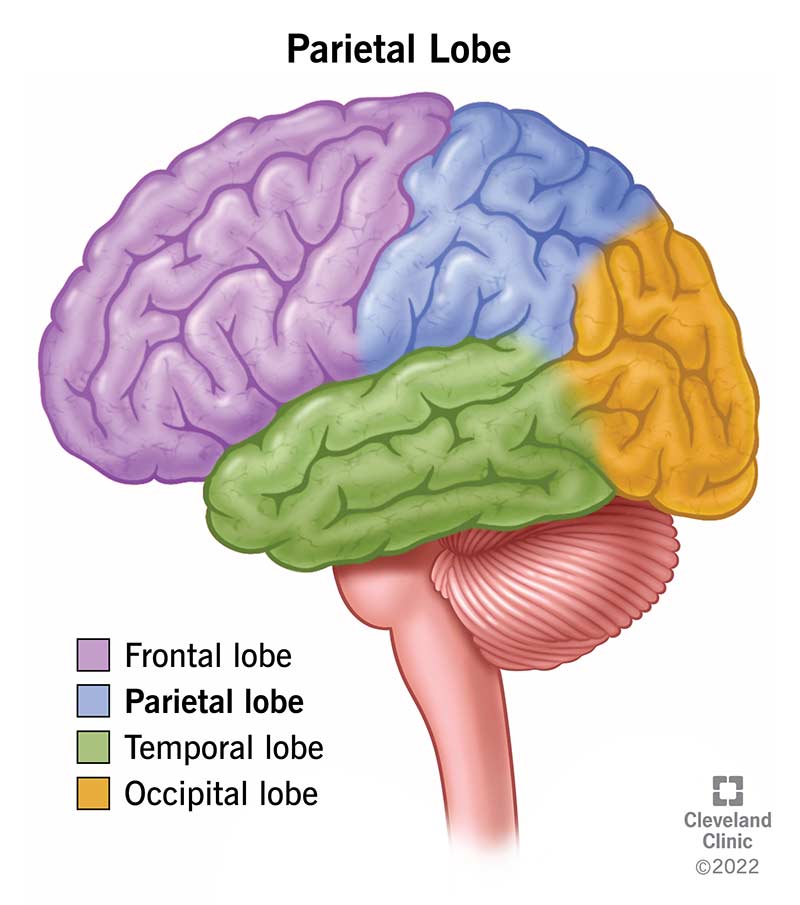
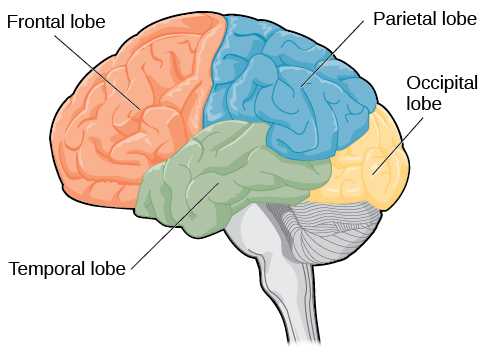
6
What are the structures and function of the eye?
Cornea- clear outer layer at the front of the eye
Retina- sensory receptors
Fovea- the center of the retina
6
Name all types of sleeping disorders.
Narcolepsy- randomly falling asleep
Sleep apnea- stop breathing in sleep
Sleepwalking/talking/eating.
Insomnia- struggle to fall asleep/stay asleep
Nightmares/terrors- bad dreams
Sleep Paralysis- Unable to move or speak while falling asleep or waking up
6
What is learned helplessness?
Know the definition and be able to identify an example.
6
Tell me the six modern perspectives and a brief explanation of them.
Biological/Neuroscience- Emphasizes the connection between behavior and biological functioning of the brain.
Cognitive- Emphasizes thinking, language, attention span, memory.
Positive- Emphasizes strength and success.
Multiculturalism- Emphasizes the influence of culture on behavior and mental processes.
Evolutionary- Emphasizes Charles Darwin theory of evolution like adaptive traits (survival of the fittest).
Biopsychological Theory- Emphasizes biological, psychological and social factors as influencers on behavior.
6
What are the structures and functions of the limbic system?
Thalamus (relay center)
Hypothalamus (body rhythms – temp, blood pressure)
Hippocampus (memory)
Amygdala (emotion, fear)
Basal ganglia (planning and production of movement)
6
What are the different types of thresholds?
Absolute threshold- minimum amount of energy an organism can detect.
Difference threshold- Amount of change added or removed.
6
What is the Circadian Rhythm?
The 24-hr biological cycle that regulates our pattern of sleep.
basically our sleep schedule.
6
Operant Conditioning is...
The consequences of behavior produce change in the probability of the occurrence of the behavior
6
Name the three types of research.
Descriptive (Observational, case studies, surveys)
Correlational
Experimental
6
Where is and what happens if damage is caused to FFA(Fusiform face area) and/or the Brocas(language area) Area?
FFA- Located in Temporal Lobe, if damaged prosopagnosia(unable to recognize faces) will be caused.
Brocas Area- Located in the Frontal Lobe, if damaged brocas aphasia(unable to put sentences together.
6
What is inattentional blindness? What is a example?
Something is not perceived even though a person is looking right at it.
The Gorilla experiment.
6
REM is...
Rapid Eye Movements (dreaming)
Non-REM is the stages 1-4.
6
Examples of Operant Conditioning are what?
Reinforcement-increasing behavior(positive: adding stimulus or negative: taking away stimulus), Punishment- decreasing behavior(positive or negative).
8
Identify the IV and DV of the example.
A study was conducted on sleep deprivation and cognitive performance on a problem-solving test. One group of subjects was deprived of 1 hour of sleep, the other group of subjects was deprived of 4 hours of sleep. Then they were given the problem-solving test.
IV: amount of sleep deprivation
DV: test results
8
What are the syphathetic and parasympathetic nervous systems knows as?
sympathetic- fight or flight response (anxious response).
parasympathetic- Rest and disgest response (relaxation response).
8
what is the trichromatic theory and opponent process theory?
trichromatic theory is about three friends creating colors, and opponent-process theory is about pairs of friends playing the opposite game to help you see colors in a special way!
8
What is tolerance, withdrawal and what drugs usually cause it?
Tolerance is needing a specific amount of drugs to achieve a specific effect.
Withdrawal is the physiological need for an addictive substance.
Drugs that usually cause it are...
Depressants- drugs that slow down the CNS activity (alchohol, tranquilizers, opiates).
Stimulants- drugs that increase the CNS activity (Caffeinee, nicotine, cocaine).
Hallucinogens- Drugs that modify the perceptual experiences (Marijuana, LSD, Mushrooms).
8
What are the different types of learning?
Observational learning- Replicating others.
Latent learning- Learning without realizing it.