iSpy
Sleepy Head
Lots of Random Stuff
Getting to Know You
I like to move it
Send (brain) Nudes
100
What visual field do the temporal FIBERS register?
Nasal Visual Field
100
Your doctor friend is telling you about a patient of theirs who was unconscious for 18 hours following an MVA witha GCS of 11, she describes his imaging as the "weirdest thing" she's ever seen. What severity of brain injury is this?
Moderate Brain Injury: GCS of 9-12, LOC 30 mins-24 hrs, and probable imaging abnormality
(Mild Brain Injury: GCS >/= 13, brief/no LOC, and normal imaging)
(Severe Brain Injury: GCS </= 8, LOC > 24 hrs, and very probably imaging abnormality)
100
This is an important clinical indicator of cerebral blood flow and therefore adequate oxygenation of the brain
Cerebral Perfusion Pressure (CPP)
100
This standardized observational instrument is designed to measure change in motor function in children with CP, it includes 5 domains of testing:
1. Lying and Rolling
2. Sitting
3. Crawling and Kneeling
4. Standing
5. Walking, Running, Jumping
Gross Motor Function Measure (GMFM)
Useful for: developing prognosis as it has predictive value to determine ultimate highest motor function
Validated for children between 6 mo - 16 years100
In which neuro condition (CP/CVA/TBI) are you most likely to see abnormal synergies?
CVA
(CP and TBI are less focal so may not be able to isolate but abnormal movements are not always in stereotyped abnormal synergies)
100
While a CT scan is a fast method to examine the brain and its structure (structure not function); what are some of the weaknesses of CT? (Name at least 1)
Poor spatial resolution (vs plane x-ray)
Difficult to discern btwn grey and white matter in brain
Requires the most radiation
Claustrophobia
Movement Distorts Signal
200
The L optic nerve contains information from which visual field?
R Nasal Visual Field
L Temporal Visual Field
200
This state refers to the recovery of eye opening with continued absence of observable signs of cognitively mediated behavior. The patient may exhibit some behaviors that can be construed as arising from partial consciousness (i.e. grunting/moaning or screaming without external stimulus/shedding tears).
Vegetative State
200
This standardized test measures 1 aspect of a transfer skill and provides a method to quantify functional LE strength and/or identifies movement strategies a patient uses to complete transitional movements
5 Times Sit to Stand
200
This scale is self-reported and stroke specific, it is designed to assess multidimensional stroke outcomes including strength, hand functioning, ADLs/IADLs, mobility, communication, emotion, memory, thinking, and participation.
Stroke Impact Scale
Useful for: tailoring rehab interventions to target the areas that are most important
High score = more functional
Low score = less functional
200
In terms of a motor exam, what qualities are expected in a patient with a cortical lesion (CVA/CP/TBI)?
Loss of Selective Muscle Activation (abnormal synergies, co-activation)
Motor Weakness (paresis)
Potential for Cognitive/Arousal Problems that Affect Movement
200
This form of imaging is more detailed than a CT and uses no radiation; however, it is more expensive and requires the patient stay still for at least 30 mins.
It is commonly used to detect brain abnormalities and diagnose soft tissue injuries
MRI
300
This term refers to the projection of optic fibers to the occipital cortex from the thalamus
Optic Radiation
300
Which standardized measure is an observational tool that measures attention related behaviors in brain injury; it is used for Rancho Level 4 or above. It is a 22 item measure scaled from 1 (definitely false) to 5 (definitely true).
Moss Attention Rating Scale
300
Your patient in acute care has a ventriculostomy, what are the PT indications?
DO NOT change position of HOB (unless nurse clamps/closes stopcock)
300
This measure is intended to assess what the person with the disability actually does despite the diagnosis/impairment, it is considered a measure of disability NOT a measure of impairment. It assess 6 areas of function:
1. Self Care
2. Sphincter Control
3. Transfers
4. Locomotion
5. Communication
6. Social Cognition
Functional Independence Measure (FIM)
Less used now - it has widely been replaced by a data set that uses Quality Indicators
WeeFIM: developed to measure need for assistance + severity of disability in children 6 mo - 7 yrs
300
This term refers to the activation of additional muscles, often agonists and antagonists, during functional movements. It is complicated by reflexive disinhibition
Co-activation
300
This form of neuro-imaging is portable, accessible, and fast; it can assess cervical and intracranial vasculature while providing information on blood flow.
What is this type of imaging?
Ultrasound
Contraindications:
- body habitus
- obscured ultrasound windows
400
What type of information is stored in the primary visual cortex vs the secondary visual cortex?
Primary Visual Cortex: size, shape, texture (simple processing)
Secondary Visual Cortex: colors, motion
400
Which standardized measure concerns itself with behavioral aspects of agitation during the acute phase of recovery; it is a 14 item tool scaled from 1 (behavior not present) to 4 (behavior present to an extreme degree) with subscales for disinhibition, aggression, and lability. The minimum score is 14 and the maximum score is 56.
Agitated Behavior Scale
400
Your patient is classified as a MaxA for rolling, what percentage of the work is your patient able to do?
MaxA: pt can perform 25-49% of task
ModA: pt can perform 50-74% of task
MinA: pt can perform >/= 75% of task
400
This standardized measure of motor control assesses joint ROM, pain, sensation, tone, motor function (motor control and coordination), and balance - the motor function portion of this exam has been studied separately and can be used independently.
Fugl-Meyer Assessment of Physical Performance (FMA)
A combined UE and LE motor function score of < 50 indicates severe motor impairment
50-84 = marked motor impairment
85-95 = moderate motor impairment
96-99 = slight motor impairment
400
Describe the typical presentation of a flexor synergy in the lower extremity
Most Common: hip flexion, ankle DF
Also occurring: hip abd, hip ER, knee flexion, ankle inversion, toe flexion400
In terms of MRI vs CT, why might a MRI be preferred/better than a CT?
Better for:
- subtle areas of tumor/infarct/demyelination/etc
- brainstem/cerebellar lesion
- old hemorrhage
- anatomic detail needed
500
Your patient is able to navigate in the environment with and without obstacles, they are expressing how easy the obstacles are but are unable to identify the individual items creating the obstacles (i.e. cones/pillows/canes). Which visual stream is likely involved?
Ventral Stream ("what" stream/conscious perception - recognition of visual objects + vision for perception)
500
Your patient with severe R sided motor control impairments is speaking with you when they suddenly use their R arm to itch their leg, when asked to repeat the task the patient is unable to comply. What is this called?
Ideomotor Apraxia: breakdown between concept and performance - it appears that information can't be transferred from areas of the brain that conceptualize movement to centers for execution. Individuals can carry out tasks habitually but unable to imitate/perform on command
500
What are the core measures for gait analysis? (name at least 2)
6 Minute Walk Test
10 Meter Walk Test
Berg Balance
Functional Gait Assessment (FGA)
Activities Specific Balance Confidence Scale
5 Times Sit to Stand
500
This assessment of movement is designed by a PT to provide quantitative exam of motor function in clients with a stroke. It is designed to be easy to administer in clinical setting (6-30 mins), does not require training, and it's free!
The 30 items on the assessment look at 3 domains:
- upper limbs movements
- lower limb movements
- basic mobility
Stroke Rehab Assessment of Movement (STREAM)
Predicts discharge destination following CVA
500
Describe the typical presentation of an extensor synergy of the Upper Extremity
Most Common: shoulder horizontal adduction and IR, forearm pronation
Also occurring: scapular protraction, elbow extension, wrist and finger extension
500
You are reviewing your patient's chart and come across the imaging results. The patient had an MRI done in which there is a focus on grey and white matter contrast, therefore the anatomical structures are emphasized.
Is this T1 or T2 weighted?T1
(T2 weighted MRI images are used to examine function)
600
Your patient has a lesion which is known to be affected the nasal fibers bilaterally; what do we name thus?
Bitemporal Hemianopia
600
In this range of Rancho Levels, patients have no to little responsiveness and require total assistance
Rancho Levels 1-3
600
Your TBI patient has a self-selected gait speed of 1.2 m/s, is his prognosis good or bad for return to running?
Good - self-selected walking speeds > 1.0 m/s greatly increases likelihood of running post TBI
600
This standardized measure of motor control is developed to examine upper extremity function in adults with neuro dysfunction.
It has 4 subscales including:
- grasp
- grip
- pinch
- gross movement
Action Research Arm Test (ARAT)
600
What factors must be met in order to conduct an MMT? (name at least 1)
Movement is isolated at all joints in a limb
Standardized positions can be achieved
MMT can be tolerated
600
This method of neuroimaging:
1. Is a probe of corticospinal excitability
2. Is used for transient perturbations for the study of brain-behavior
3. Is used to modulate corticospinal motor excitability
Transcranial Magnetic Stimulation (TMS)
- lower frequencies = safer (< 1 hz)- side effects = seizures and headaches
700
What visual field impairment is most common in stroke patients?
Homonymous Hemianopia
700
Perception is the integration of sensory impressions into information that is meaningful; name at least one type of perceptual disorders
Body Image/Schema Disorders: difficulty w awareness of body parts and their relationship to one another + environment (i.e. UNL)
Spatial Relation Disorders: difficulty in perceiving the relationship between the self and 2 or more objectsAgnosias: inability to recognize/make sense of incoming information despite intact sensory capacities
Apraxia: inability to carry out purposeful movement in presence of intact sensation, movement, and coordination
700
Are there more nasal fibers or more temporal fibers in the visual system?
Nasal Fibers
700
Which outcome measures are considered "complex walking tests"?
HiMat
TUG
FGA
DGI
700
What term refers to the ability to move 1 joint through a fraction of the available range
Fractionated
Selective: move 1 joint in any direction + able to combine that movement with any movement at other joint of that limb
Isolated: move 1 joint in any direction without any movements
700
Oh no! Your friend is describing a neuroimaging method that requires injecting a nucleotide to tag a substance and track brain activity
PET Scan
Advantages
- spatial resolution better than EEG
- quiet- can be selective w type of nucleotide you are interested in
Disadvantages
- isotopes must be synthesized on site
- invasive to pt + can't be repeated on pt
- short duration of action for testing
- poor spatial resolution compared to fMRI
800
You notice that your neuro patient's note describes a "pie in the sky" visual deficit, where is the lesion? (hint: draw it out)
Inferior Optic Radiation of the Contralateral Visual Pathway (#6)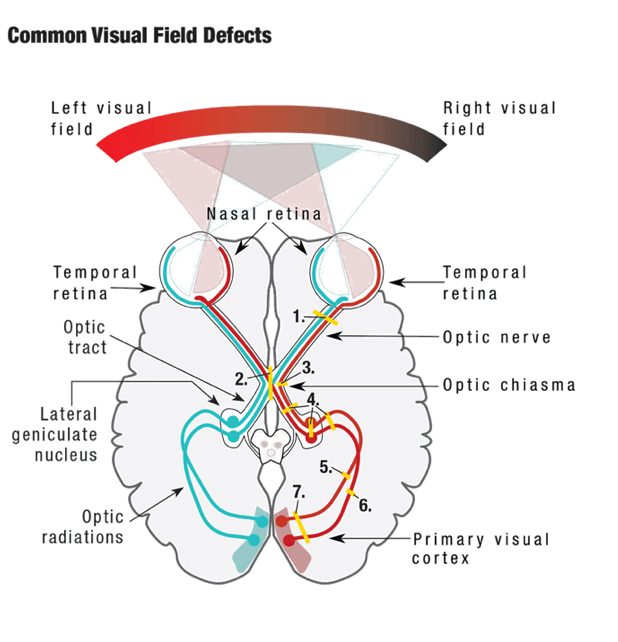
800
In this range of Rancho Levels, patients demonstrate appropriate behaviors with subsequently less assistance. They are still working on identifying their own limitations and need for assistance. A key milestone includes increased day-to-day memory and improving attention.
Rancho Levels 7-10
800
This term refers to a patient getting 'stuck' on a single word.
i.e. "why are you here?" stroke "what month is it?" stroke
Perseveration
800
Which of the following will invalidate a 10MWT?
A. Assistive device useB. Orthotic device use
C. Physical Assist to Walk
Physical Assist to Walk
normative data will not be valid for comparisons but it is okay if you are solely using the data to measure gait speed change in patient over time
800
The strengths of the FMA include:
- quantitative assessment
- extensively evaluated measure w good validity/reliability
- provides very specific information
But can you name at least one weakness?
Patients not put into homogeneous groups
Measures motor recovery but not functional recovery
Time consuming to administer (30-60 minutes)
800
This type of imaging is an indirect measure of neural activity, it uses technology to measure markers in microvascular blood flow of the brain as it relates to a patient performing a functional task - basically as a pt has neural activity, there is a significant difference in blood flow to areas of activity and corresponding oxygen consumption
fMRI