Week 1
Phases of Healing
& Aging
Phases of Healing
& Aging
What forces on the tibiofemoral joint would relate to pain with weight bearing activities, but not during open chain activities?
Answer: Compressive
Resource: Kisner pg 93
What type of infections do T-cells help protect against?
Answer: Bacteria, viruses, fungus, and cancer
Resource: Goodman & Fuller pg 85
What motions at the talocrural joint will cause an ATFL sprain?
Answer: Plantarflexion and inversion
Resource: Kisner pg 904
What joint is MOST commonly affected by gout?
Answer: The big toe (the first metatarsophalangeal (MTP) joint)
Resource: Goodman & Fuller pg 579
Name the presentations of each foot and what pathology these can both relate to.
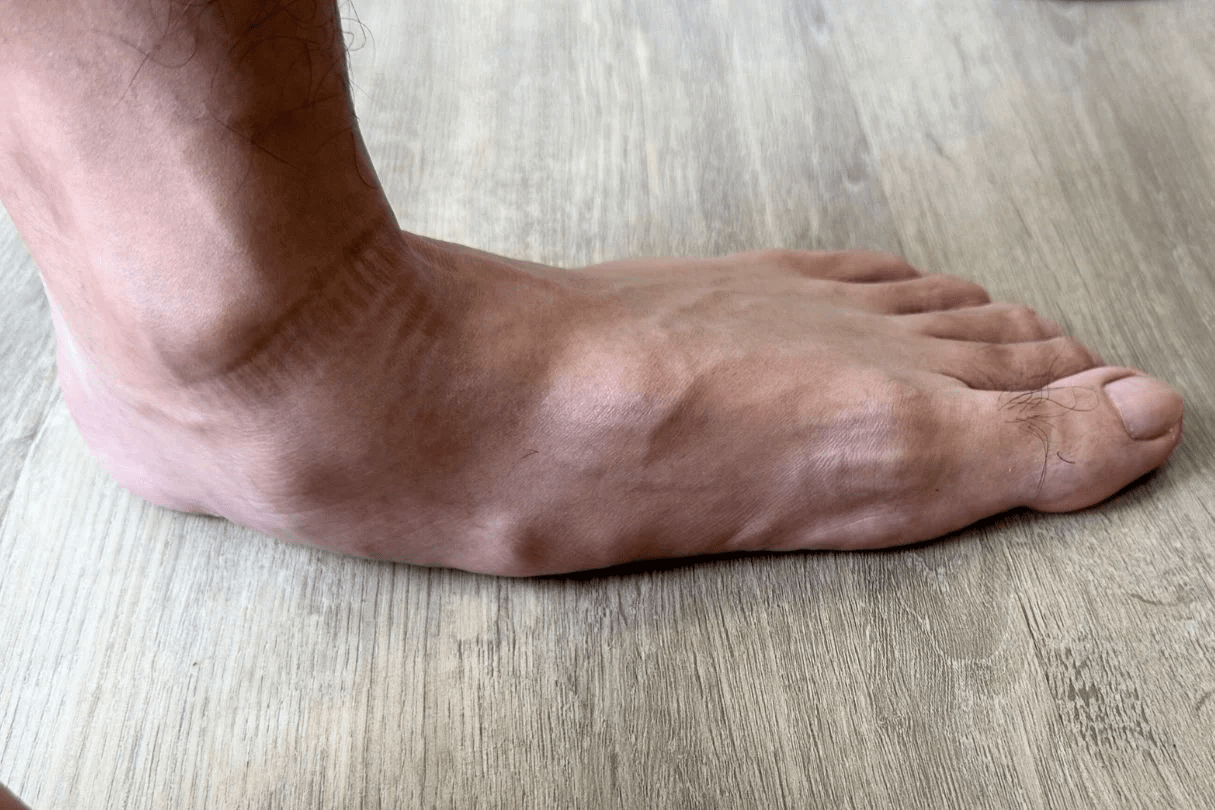
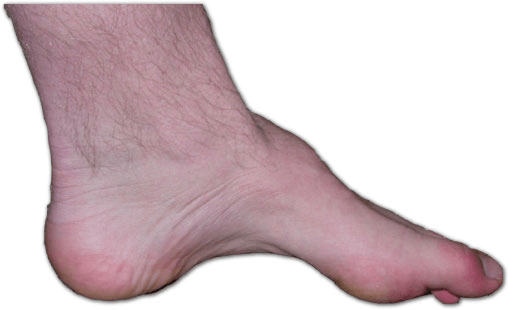
Pes planus and pes cavus, relating to plantar fasciitis.
Resource: Kisner pg 901
Tom, a 52-year-old accountant, complains of bilateral joint pain and swelling in his wrists and fingers. Lab results showed a positive autoantibodies factor. Question: What pathology is most likely affecting Tom?
Answer: Rheumatoid Arthritis
Resource: Goodman & Fuller pg 556
Name 2 unique characteristics of type 1 collagen?
Answer: The most common form of collagen, assembled as a thick bundle, longest and strongest, found in bones, tendons, and scar tissue
Resource: G&F pg 55
What are 3 signs and symptoms of type 1 hypersensitivity?
Systemic vasodilation, bronchospasm, wheezing, urticaria, increased mucus secretion, rhinorrhea, and swelling
Goodman & Fuller pg 100
What special test assesses for an Achilles tendon rupture?
Answer: Thompson test
Resource: Kisner pg 912
What motions at the spine do we want to avoid when working with patients that have osteoporosis?
Answer: Spinal flexion, side bending, or spinal rotation
Resource: Goodman & Fuller pg 538
Name the rash seen on the patient and what pathology it relates to.

Malar rash, seen with systemic lupus erythematosus
Resource: Goodman & Fuller pg 103
Linda, a 67-year-old retired chef, reports “deep” right knee pain and swelling that has gradually worsened over the past year, and makes “crunchy” noises with activity. What is the most likely diagnosis for Linda?
Answer: Osteoarthritis
Resource: Goodman & Fuller pg 558
Which of the following are signs (not symptoms)?
Tachycardia, edema, nausea, fatigue, erythema, chest pain, hypertension
Answer: Tachycardia, edema, erythema, hypertension
Resource: Goodman and Fuller pg 2
Name a characteristic clinical manifestation of each stage of lime disease.
Stage 1: Erythema migrans and flu like symptoms
Stage 2: Neurologic and cardiac signs
Stage 3: Arthritis of large joints and pain
Resource: Goodman & Fuller pg 132
What type of ROM and in what direction will cause the least amount of pain after a bicep brachii strain?
Answer: PROM into elbow and shoulder flexion
Resource: Kisner pg 333
What is the presentation of a Colles fracture?
Answer: Dorsal displacement of the hand due to a complete radial-ulnar fracture
Resource: Goodman & Fuller pg7.68E241
Name the skin rash seen in the image and state which pathology it relates to and which stage.
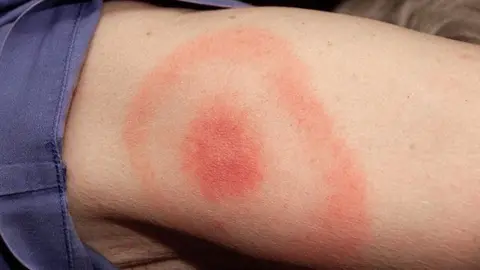
Erythema migrans seen in stage one of Lyme disease
Lena, a 38-year-old that is new to running, reports sharp heel pain that is worse with her first steps in the morning and after long periods of standing. Her doctor requested an x-ray as seen in the image. Question: What condition is Lena most likely experiencing?
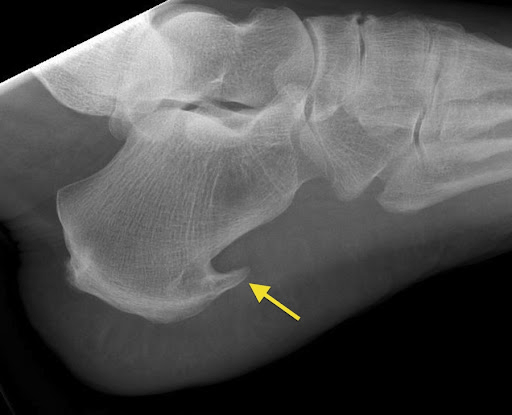
Answer: Plantar Fasciitis
Resource: Kisner pg 901
Name the 2 drug classes that assist with inflammation management that was covered in week 1.
Answer: Corticosteroids and NSAIDs
Resource: Goodman and Fuller pg 17
Which diagnostic clinical finding provides the MOST evidence for systemic lupus erythematosus?
Answer: A positive antinuclear antibody (ANA) test is the most sensitive diagnostic marker for SLE
Resource: Goodman & Fuller pg 102
Name 3 characteristics of grade 2 strains
Answer: Partial tearing, decreased ability to contract, pain, swelling, localized tenderness, pain increases with increased stress and palpation, moderate joint laxity
Resource: Kisner pg 333
Which joints does osteoarthritis typically affect, and why?
Answer: Large weight bearing joints. It’s a disorder of cartilage degeneration.
Resource: Goodman & Fuller pg 558
What pathology is seen in the image and what caused it?
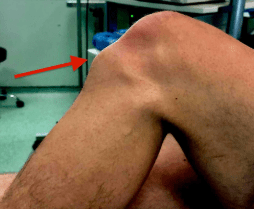
Osgood-Schlatter disease caused by continuous pull on the patellar tendon during adolescence
Resource: Goodman & Fuller pg 556
Maria, a 29-year-old female, presents with a 6-month history of persistent fatigue, arthralgia affecting her hands and knees, and a rash that worsens after minimal sun exposure. Question: What pathology does Maria most likely have?
Answer: Lupus
Resource: Goodman & Fuller pg 103
Define plastic deformation in the concepts of physical therapy.
Answer: “tissue strained into this range will have permanent deformation after the external load is released”
Resource: Kisner pg 93
According to the chain of transmission, what are the 5 the modes of transmission?
Answer: contact, airborne, droplet, vehicle, and vector borne
Resource: Goodman & Fuller pg 113
During midstance of gait, which characteristic is MOST associated with the development of plantar fasciitis?
Answer: Pronation
Resource: Kisner pg 901
Describe the 3 common finger deformities seen in rheumatoid arthritis and the specific positioning at the joints.
Swan neck: DIP flexion, PIP hyperextension
Boutonniere: DIP hyperextension, PIP flexion
Ulnar drift: Ulnar deviation at the MCP joints
Resource: Goodman & Fuller pg 564 and figure 17.23
What type of fracture is seen in the x-ray and which pathology does it correlate to the MOST and why?
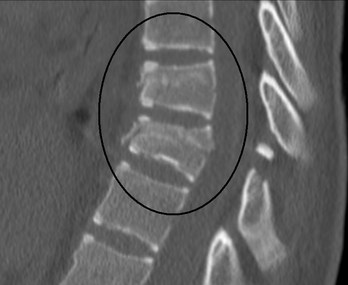
Anterior vertebral compression fracture from osteoporosis due to decreased bone mineral density.
Resource: Goodman & Fuller pg 538
Christine, a 40-year-old office worker, complains of bilateral widespread musculoskeletal pain, morning stiffness, and difficulty sleeping and concentrating for the last 6 months. Question: What is the most likely diagnosis for Christine?
Answer: Fibromyalgia
Resource: Goodman & Fuller pg 104
