Do you hear what I hear?
Lub Dub Club
Tapping into the Truth
PEP Talk
Beta-Way to Breathe
100
in IPPA what is the resonant phrase that we ask patients to say in order to determine the level of tactile fremitus?
"99"
100
What are the names of the heart valves?
aortic, pulmonic, tricuspid, and mitral
100
True or False?
Percussion can be performed during inspiration and expiration whereas Vibrations should only be performed during expiration
True
100
One cycle of using the PEP devices should include __ regular breaths, and __ king sized breaths
Regular breaths: 10
King sized breaths: 2
100
True or False, LVR can be performed in supine and semi-recumbent positions
True!
It is best done in sitting, but can be done insupine or semi-recumbent positions
200
When performing percussion as part of IPPA - what are the three types of sounds we can hear, and what do these mean?
Normal/resonant - heard over normal lungs
Dull - hard over solid organs or areas of consolidation
Hyper resonance - may be heard over areas of hyperinflation (emphysema) or a pneumothorax
200
True or False
The diaphragm of the stethoscope is used to hear low-pitched (low frequency sounds) whereas the bell of the stethoscope is used to hear high-pitched (high frequency sounds)
False Diaphragm is good for high-pitched high frequency sounds - S1 and S2
Bell is good for hearing low-pitched low frequency sounds - S2 and S3
200
What is the difference in frequency and amplitude of the forces applied during normal vibrations versus shaking?
Vibrations: gentle high frequency low amplitude force
Shaking: more vigorous larger amplitude low frequency force
200
True or False?
Huffing should be used during PEP either at the end of each cycle or when the patient feels that they have secretions
True
200
Where should the therapist place their hands on the patient to perform an abdominal thrust?
Landmark naval and place heel of one hand on abdomen just above the navel
300
True or False?
When checking thoracic expansions we expect to see larger changes in movement in the lower lobes compared to the upper and middle lobes
True
Reasoning: Gravity and Recoil: Lower lungs undergo greater volume changes during breathing than upper lungs due to gravity's effect on lung recoil.
300
Name the valves involved in creating the S1 'Lub' and S2 'Dub' sounds during the cardiac cycle
Bonus: What are the S3 and S4 heart sounds?
S1 - closure of mitral and tricuspid valves
S2 - closure of aortic and pulmonic valves
Bonus:
S3: Ventricular Gallop - During early diastole- normal in children and young adults, in older adults indicates volume overload due to congestive heart failure
S4: Atrial gallop - During late diastole - indicates cardiac disease/stiffening of ventricles
300
If using postural drainage positions for a patient you should have them in this position for __ to __ minutes per segment
If using postural drainage psoitions in conjuction with percussion and vibrations __ to __ minutes per segment may be sufficient
(1) 5-10 minutes per segment if PD on its own
(2) 3-5 minutes per segment if PD WITH percussions and vibrations
300
Which conditions are therapep and paripep most useful for (name one)?
Bonus: what is a condition that this device is not useful for and why?
Chronic conditions: cystic fibrosis, bronchiectasis, COPd patient if lots of secretions
Bonus: pneumonia and atelectasis - transient conditions so will go away - expensive to have patient buy these devices
300
For LVR it is recommended that the patient should recieve __ treatments per day, with one treatment being __ to __ max insufflations
For LVR it is recommended that the patient should recieve 4 treatments per day, with one treatment being 3 to 5 max insufflations
400
When performing lung auscultation, what are the number of points we should be listening to anteriorly, posteriorly, and laterally?
4 points anteriorly
2 points laterally
5 points poseriorly
400
What valves are impacted for systolic vs diastolic murmurs and what causes this?
Systolic murmur: aortic/pulmonic stenosis, mitral/tricuspid regurgitation
Diastolic murmur: aortic/pulmonic regurgitation, stenotic mitral/tricuspid
400
Which area is being percussed on this baby as shown in the photo below?
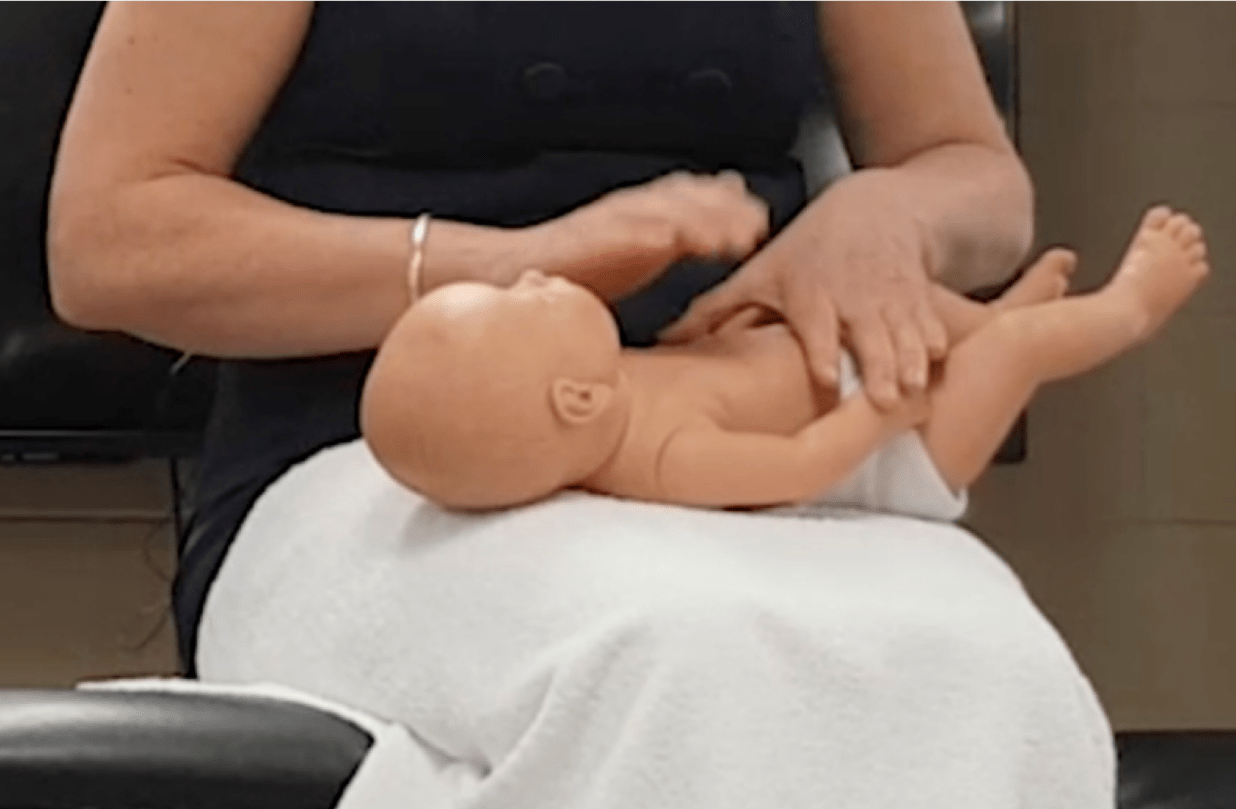
Anterior segment of upper and lower lobes
400
What phases in order are included in one cycle of active breathing?
Bonus: how many times should the cycle be repeated per day?
One cycle: Breathing Control --> Expansion ---> Huff --> Breathing control
Bonus: should be completed 2-3 times per day (20 minutes)
400
What are the three Assisted Cough Techniques that can be used to clear airways following the use of LVR
(1) Caregiver-assisted abdominal thrusts, (2)Caregiver assisted lateral costal compression (3)Client self assisted cough
500
What segment AND lobe is mark listening to in this picture? (Bonus: what would be the corresponding area on the other side?)
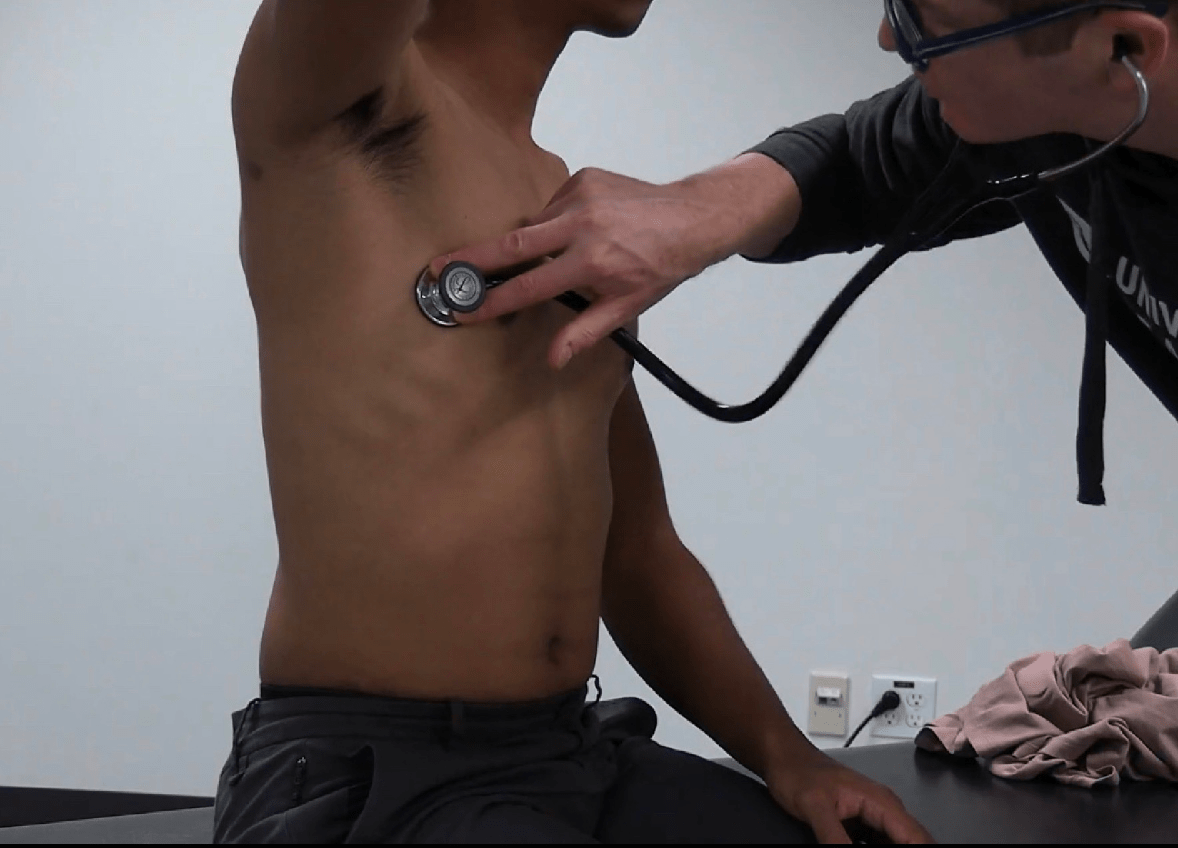
Listening to: Lateral segment of right middle lobe
Coresponding: Superior lingula of left upper lobe
500
Name the cardiac valve that corresponds to each letter on the picture (A-D). Also describe in words where this valve is located.
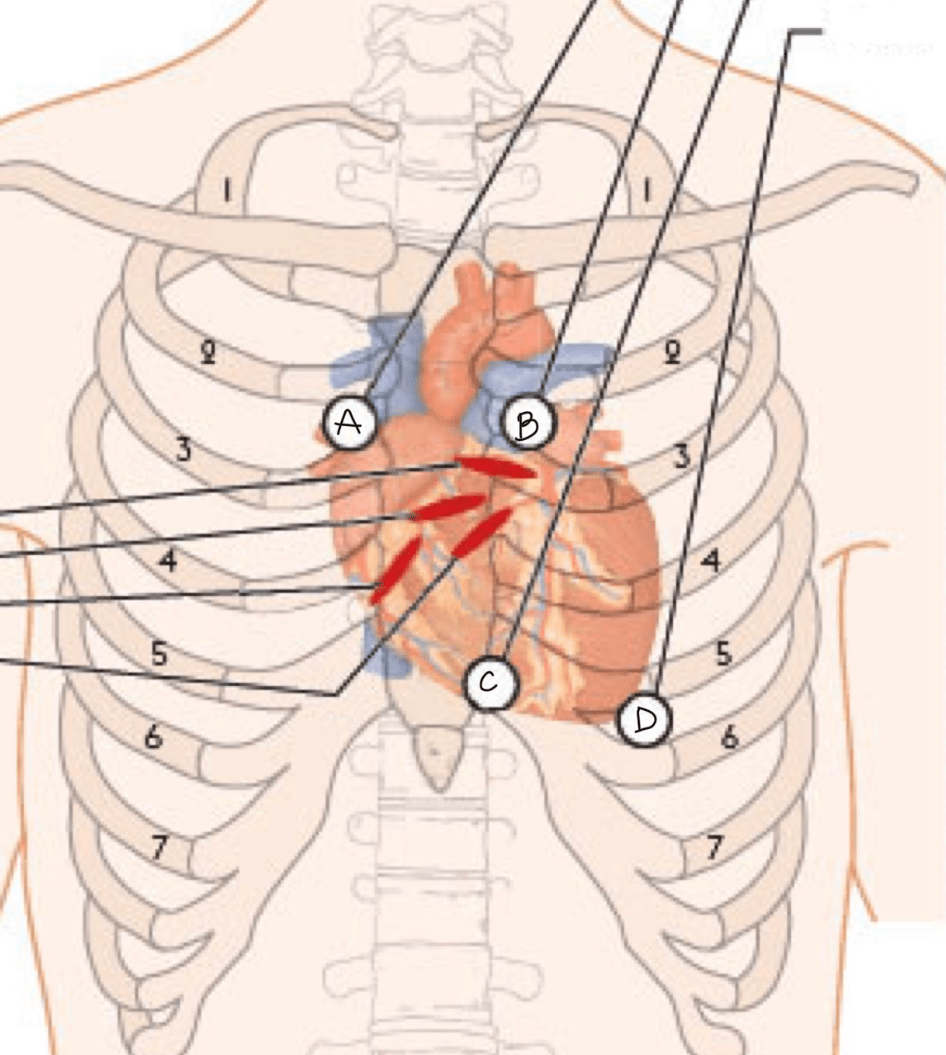
(A) Aortic valve - 2nd intercostal space at right sternal border
(B) Pulmonic valve - 2nd or 3rd intercostal space at left sternal border
(C) Tricuspid valve - 4th or 5th intercostal space at left sternal border
(D) Mitral valve - 5th intercostal space on left midclavicular line
500
Name three contraindications/precuations for performing percussions and vibrations
Over recent skin grafts or burns on thorax
Recently placed pacemaker
Pulmonary Tuberculosis
Lung contusions
Bronchospasm (gentle vibrations ok)
Osteomyelitis of ribs
Osteoporosis (gentle vibrations ok)
Coagulopathy - platelets less than 20 000
Rib metastases
Percussion on rib fractures (gentle vibrations okay with adequate analgesia)
500
Write the steps for one of the cleaning methods that can be used for the PEP devices
70% isopropyl acohol - soak 5 minutes, twice daily. Rinse with sterile water
3% hydrogen peroxide - soak for 30 minutes. Rinse with sterile water
Bleach: soak in solution 1 part bleach to 50 parts water for 3 minutes. Rinse with sterile water
Vinegar: 2 parts white vinegar with 3 parts distilled water for 20 minutes. Rinse with sterile water
500
What are the four contraindications for applying LVR to a patient?
Pregnancy, abdonimal aneurysm, Precent abdominal surgery (PEG Tube)
Acute upper GI Bleed