Standard Form
Vertex Form
Factored Form
More factored form
Graphs
100
The standard form of quadratics is ....
y=ax^2+bx+c
100
The vertex form of quadratics is ....
y=a(x-h)^2+k
100
The factored form of quadratics is .....
y=a(x-r1)(x-r2)
100
How do you find the axis of symmetry when given
y= a(x-r1)(x-r2)
(r1 + r2 )/2
100
Quadratic equations take the shape of a what when graphed.
u - shape or parabola
200
In standard form, how do you find the y-intercept?
(0,c)
200
How you find the vertex in this form
y = a (x - h)^2 + k
(h,k)
200
What are the roots for this quadratic
(x-2)(x-4)
r1 = (2,0) and r2 = (4,0)
200
What are the roots for the following equations
y = 3 (x - 2) (x + 4)
r1 = (2,0)
r2 = (-4,0)
200
What is the vertex ?

(3,-1)
300
How do you find the axis of symmetry when working with an equation in standard form?
x = -b/(2a)
300
The vertex of
-2 (x + 4)^2 + 2
(-4,2)
300
What is the axis of symmetry for this quadratic
y = (x - 1) (x+3)
x=-1
300
What is the axis of symmetry for the following
y = - (x-1) (x-5)
x = 3
300
Name the zeros of the function ?
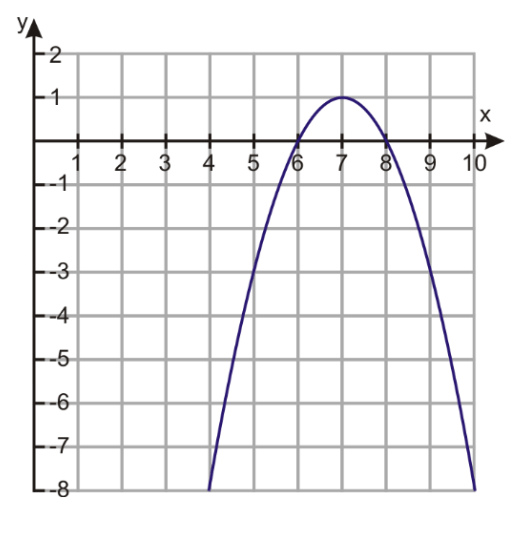
(6,0) and (8,0)
400
What is the y-intercept of the following function
y=3x2+4x-6
(0,-6)
400
Name all of the transformation(s) for this equation
-4 (x + 6)^2 - 4
1. vertical stretch by a factor of 4
2. vertical shift 4 units down
3. horizontal shift 6 units left
4. vertical reflection (flipped upside down)
400
What is the vertex for this quadratic?
y = (x - 1) (x+3)
(-1,-4)
400
What is the vertex for the following
y = (x+6)(x-2)
(-2,-16)
400
What are the zeros?
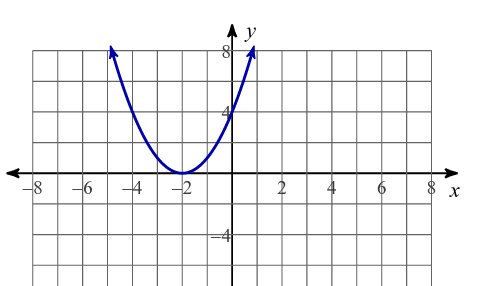
(-2,0)
500
What is the vertex for the following
y= x(x+4)
(-2,-4)
500
Write the equation in factored form for the following.
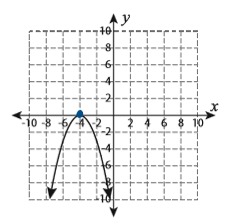
y = -(x+4)^2
500
Write the equation in factored form for this graph.
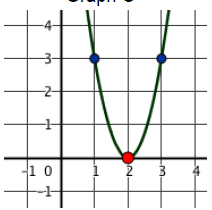
y = 3(x-2)2