Properties of Quadratics from a Graph
Properties of Quadratics from Equations
Quadratic Applications
Polynomial Properties/Graphs
Finding Roots of Polynomials
100
Where are the x- and y-intercepts of the quadratic?
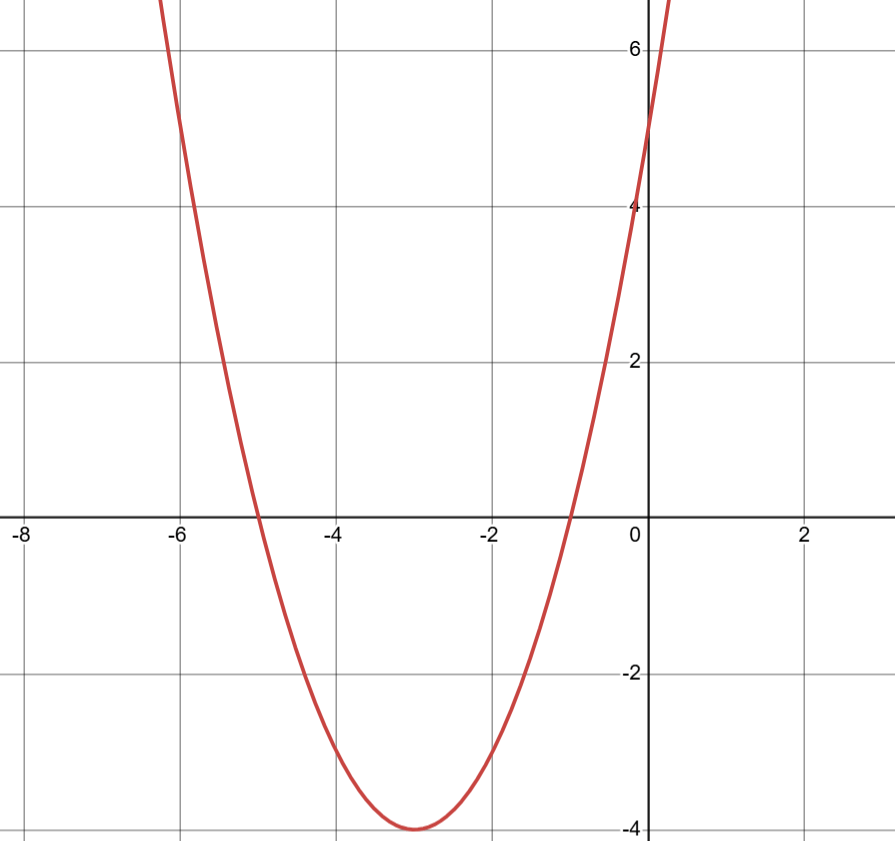
x=-5, -1
y=5
100
Without graphing, find the y-intercept of the quadratic
f(x)=2x^{2}+2x-24
y=-24
100
Use the scenario below to find at what height above the water basin the release nozzle is located.
A landscape architect is designing a large public fountain. The height, h (in feet), of the central water stream is determined by its horizontal distance, d (in feet), from the release nozzle. The stream is modeled by the following quadratic function:
h(d)=-0.1d^2+2d+5
5 feet high
100
Give the degree and leading coefficient of the polynomial
f(x)=-5x^4-x^3+6x^2-2x+1
Degree: 4
Leading Coefficient: -5
100
Use the Rational Zero Theorem to find all potential zeros of the polynomial
f(x)=2x^3-x^2+2x-1
Potential Zeros:
+-1, +-1/2
200
Is this quadratic concave up or down?

Concave Up
200
Find the axis of symmetric of the quadratic
f(x)=2x^{2}+2x-24
x=-0.5
200
Use the scenario below to find the horizontal distance the water has traveled when it reaches its maximum height.
A landscape architect is designing a large public fountain. The height, h (in feet), of the central water stream is determined by its horizontal distance, d (in feet), from the release nozzle. The stream is modeled by the following quadratic function:
h(d)=-0.1d^2+2d+5
Horizontal Distance: 10 feet
200
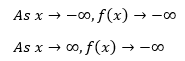
Describe the end behavior of the polynomial
f(x)=-1/3x(x-1)(x+6)^2
200
Use the Rational Zero Theorem to find all potential zeros of the polynomial
f(x)=3x^3+6x^2-15x-30
Potential Zeros:
+-1,+-1/3,+-2,+-2/3,+-3,+-5,+-5/3,+-6,+-10,+-10/3,+-30
300
Where is the vertex of the parabola?
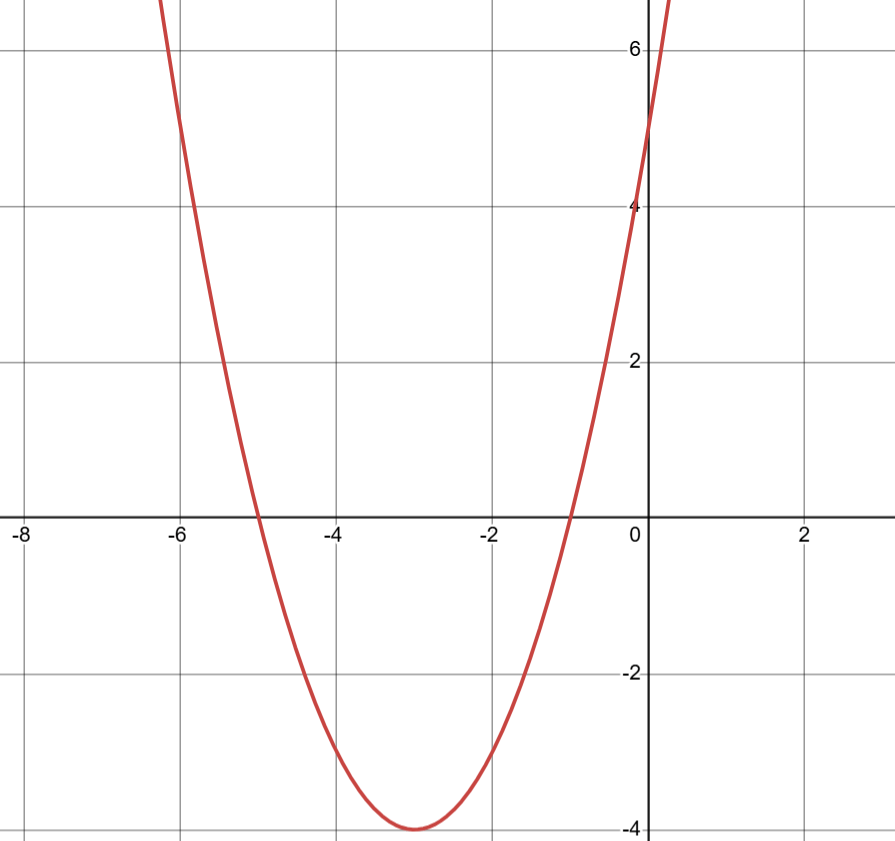
Vertex: (-3,-4)
300
Where is the vertex of the parabola
f(x)=2x^{2}+2x-24
(-0.5,-24.5)
300
Use the scenario below to find the maximum height the water reaches.
A landscape architect is designing a large public fountain. The height, h (in feet), of the central water stream is determined by its horizontal distance, d (in feet), from the release nozzle. The stream is modeled by the following quadratic function:
h(d)=-0.1d^2+2d+5
Maximum Height: 15 feet
300
Find the roots and multiplicities of each root for the polynomial
f(x)=-1/3x(x-1)(x+6)^2
x=0, m:1
x=1, m:1
x=-6, m:2
300
Find one zero of the polynomial using the Rational Zero Theorem.
f(x)=2x^3-4x^2-10x+20
x=2
x=+-sqrt5
400
Give the increasing and decreasing intervals of the parabola.

D: (-oo,-3]
I: [-3,oo)
400
Find the x-intercepts of the parabola
f(x)=2x^{2}+2x-24
x=-4,3
400
Use the scenario below to find how far from the release nozzle the water hits the water basin level.
A landscape architect is designing a large public fountain. The height, h (in feet), of the central water stream is determined by its horizontal distance, d (in feet), from the release nozzle. The stream is modeled by the following quadratic function:
h(d)=-0.1d^2+2d+5
22.247 feet
400
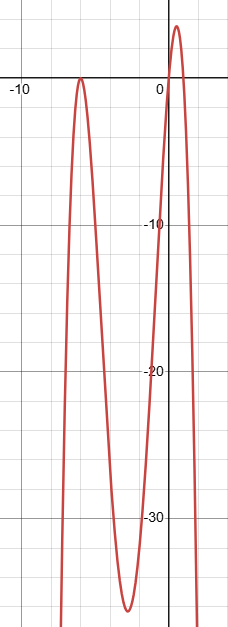
Graph the polynomial without a calculator.
f(x)=-1/3x(x-1)(x+6)^2
400
Find all zeros of the polynomial using the Rational Zero Theorem and Synthetic Division.
x^3+13x^2+57x+85
x=-5, -4+-i
500
Where is the axis of symmetry of this parabola?
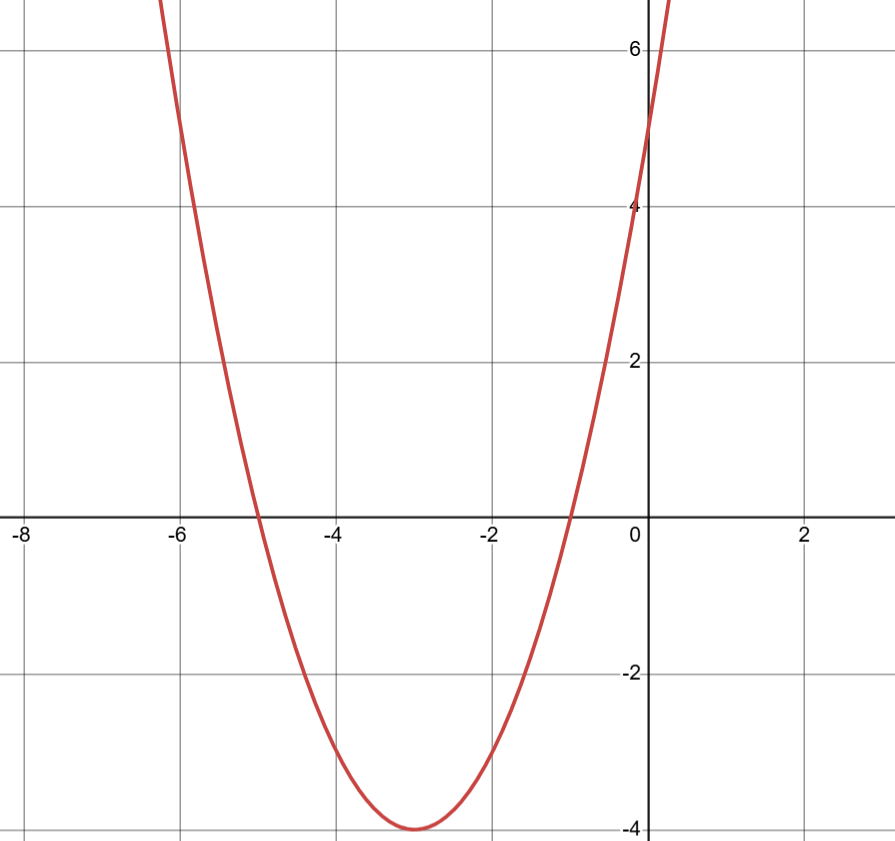
x=-3
500
Given the polynomial
f(x)=2x^{2}+2x-24
where is the y-intercept's symmetric (mirrored) point? Write your answer as an ordered pair.
(-1,-24)
500
Use the scenario below to find the clearance (space above their head) if a 6 foot tall person walks under the stream at a horizontal distance of 18 feet from the release nozzle.
A landscape architect is designing a large public fountain. The height, h (in feet), of the central water stream is determined by its horizontal distance, d (in feet), from the release nozzle. The stream is modeled by the following quadratic function:
h(d)=-0.1d^2+2d+5
Clearance Above Head: 2.6 feet
500
Find the equation for the polynomial shown below
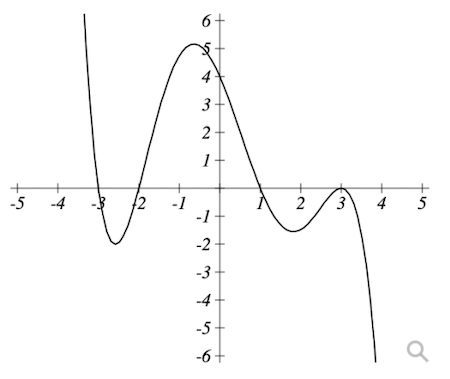
f(x)=-2/27(x+3)(x+2)(x-1)(x-3)^2
500
Find all zeros of the polynomial
f(x)=2x^4-x^3-5x^2+2x+2
x=-1/2,1,+-sqrt2