Graph 1
Graph 2
Standard to Vertex
Transformations
Linear vs. Quadratic
100
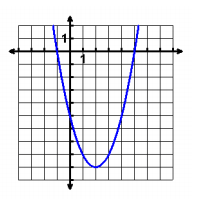 Find the x-intercept
What is (-1,0) and (5,0)?
100
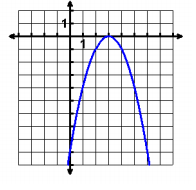 List the Absolute max for the curve
(3,0)
100
Give me the 3 steps for converting to vertex form from standard form:
1. Add/Subtract to make a perfect square
2. Factor Perfect Square
3. Add/Subtract the number back from step 1
100
What happens when you:
Add a K value
&
Subtract a H value?
(Give the directional movement)
Move up and to the right
100
Which function function includes ALL possible x and y values? (Linear or Quadratic)
Linear
200
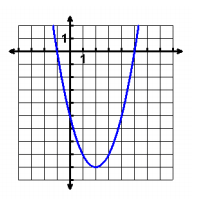 Find the y-intercepts.
(0,-5)
200
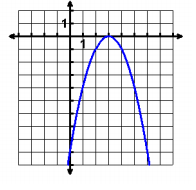 List how many times this graph crosses the x-axis
1
200
Convert from standard to vertex:
x2 + 4x +3
(x+2)2-1
200
What happens when you:
Make the function Negative
&
Multiply the function by a number Greater than 1
Reflection across the x-axis and a vertical stretch (compression)
200
Which function includes a vertex and axis of symmetry
Quadratic
300
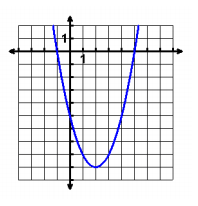 Find the Domain and Range
(- oo<x<+oo) and (-9<y<+oo)
300
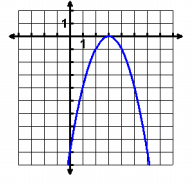 List the signs (both) used to represent this graphs end behavior
-oo and -oo
300
Convert from standard to vertex:
x2+6x+16
(x+3)2+7
300
Describe the transformations:
(x+2)2-3
Translate left 2 and down 3
300
Give the standard form for a Quadratic function and the Slope-intercept form for a linear function
ax2+bx+c (Quadratic)
y=mx+b (Linear)
400
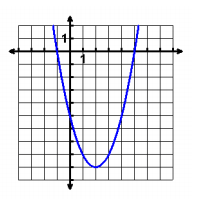
List the end behavior of this quadratic
What is
+oo
400
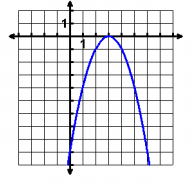 List the Range of this graph
-oo<y<0
400
Convert from standard to vertex:
-x2-8x-30
-(x+4)2+14
400
Describe the transformations:
-(x-5)2+14
Reflection across the x-axis, right 5, and up 14
400
What important graphical characteristic can you get from the Quadratic standard form? Linear slope-intercept form?
Don't forget to give the variables you got the information from!
Quadratic: Y-intercept (C value)
Linear: Slope (m) and y-intercept (b)
500
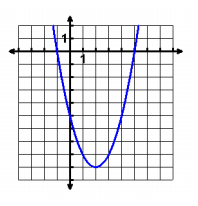 List the interval of increase for this quadratic.
What is
(2, +oo)
500
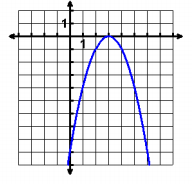 List the vertex and if it is a max or min
(3,0) and Max
500
Convert from standard to vertex, then give me the vertex coordinates:
x2+10x+12
(x+5)2-13
Vertex: (-5,-13)
500
Describe the transformations:
-0.2(x-4)2+3
Reflection across the x-axis, horizontal stretch by a factor of 0.2, right 4, and up 3
500
Who is the best ALGEBRA 1 teacher of ALL TIME?
Ms. Bullard!!!!!!
:)