Features of Parabolas
Roots or Zeros
Equations
Solutions
What are the factors?
100
The y-intercept of the equation below is:
y=3x^2+2x-5
y=-5
100
The roots of the quadratic equation below are:
y=(x+1)(x-3)
x=-1 and 3
100
The equation of a parabola with x-intercepts of -3 and -1 and a y-intercept of -3 is:
y=-(x+3)(x+1)
100
The number and nature of solutions of the following quadratic are?
2x^2-3x+6 = 0
There are no solutions
100
Given the graph, the equation of the parabola, in factorised form is:
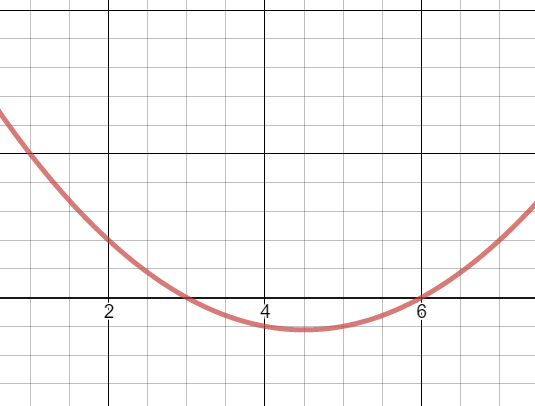
y=(x-3)(x-6)
200
The equation of the axis of symmetry for the equation below is:
y=(x-3)^2+4
x=3
200
The zeros or roots of the quadratic equation below would be:
y=x^2+4x-5
x=-5 and 1
200
The equation of a parabola that goes through the points (-2,0), (5,0) and (0,5) is:
y=-1/2(x+2)(x-5)
200
The number and nature of the solutions to the following quadratic equation are:
6x^2-3x-2 = 0
There are two irrational solutions
200
Given the zeros of a parabola are at x={-9,3}, the factors that would represent the quadratic equation are:
(x+9)(x-3)
300
The coordinates of the vertex for the equation below are:
y=2(x-3)^2+5
(3,5)
300
A description of the discriminant for the equation of the parabola below would be:
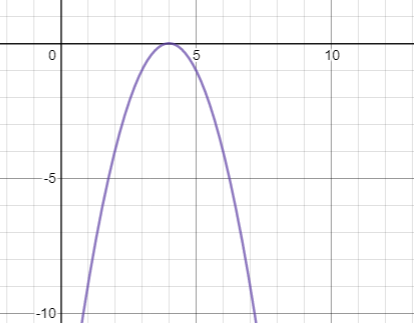
The discriminant would be zero
300
The equation of a parabola, in factorised form, that has x-intercepts of 1 and -3, and passes through the point (-2,-6) is:
y=2(x-1)(x+3)
300
The exact solutions of the quadratic equation below are:
0=-2x^{2}-2x+7
{(1+-sqrt15)/-2}
300
A possible equation, in factorised form, for the parabola drawn below is:
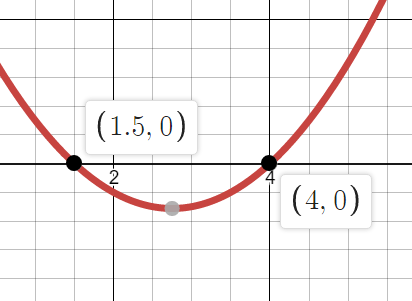
y=(2x-3)(x-4)
400
The axis of symmetry for the equation below is:
y=3x^2-20x+sqrt5
x=10/3
400
A description of the discriminant of the equation of the parabola below would be:

The discriminant of the equation would be negative.
400
The equation of a parabola, in vertex form, with a turning point at (4,2), which goes through (0,6) is:
y=1/4(x-4)^2+2
400
The number and nature of the zeros of the following quadratic, with reasons, are:
y=3x^2+5x-2
There are two rational solutions because the discriminant is both positive and a square number
400
The solutions to an equation are
x=1/8 and -2/7.
The equation, in factorised form, is:
(8x-1)(7x+2)=0
500
The coordinates of the vertex for the equation below are:
y=(x+1)(x-3)
(1,-4)
500
The roots or zeros of the quadratic equation given below would be:
y=(x-2)^2-8
x=2+-2sqrt2
500
The equation of a parabola, in turning point form, with turning point at (3,-1) and x-intercepts at (0,0) and (6,0) is:
y=1/9(x-3)^2-1
500
The exact values of the roots of the following equation are:
y=2x^{2}+10x-7
{(-5+-sqrt39)/2}
500
The factors of the quadratic equation below are:
y=(x+1)^2-9
(x-2)(x+4)