Physical Science
Earth Science
Space Science
Life Science
Nature of Science
100
An object has a mass of 50 g and a volume of 5 cm³. What is its density?
10 g/cm^3
100
Name the five major Earth spheres.
Atmosphere, hydrosphere, geosphere, biosphere, cryosphere
100
Put the following structures in order from smallest to largest:
Galaxy — Planet — Universe — Solar System — Moon
Moon → Planet → Solar System → Galaxy → Universe
100
Gerard listed four levels of structural organization in order from the smallest structure to the largest structure. Which list is correct?
A. cells, tissues, organ systems, organs
B. cells, tissues, organs, organ systems
C. tissues, cells, organ systems, organs
D. tissues, cells, organs, organ systems
B. cells, tissues, organs, organ systems
100
Two groups of scientists perform the same investigation using the same procedure but collect their own data. What is this an example of?
Replication
200
Aisha is using a computer model to explore what happens to the particles in water when it changes from a liquid to a gas. What will the model show about the motion of liquid vs the motion of gas particles?
The particles in a liquid can slide past each other, while the particles in a gas are free to move in all directions.
200
A student stands outside on a sunny day while holding a metal spoon in a pot of hot soup. The student feels heat from the Sun, the spoon becomes hot, and the soup circulates as warmer liquid rises and cooler liquid sinks.
Identify the type of heat transfer occurring in each situation using these words: Conduction, Convection, Radiation.
- Sun warming the student - Radiation
- Heat moving through the metal spoon- Conduction
- Warm and cool soup circulating in the pot- Convection
200
Why does the Moon appear to change shape throughout the month?
A. Earth’s shadow covers different parts of the Moon every night
B. The Moon produces different amounts of light
C. We see different portions of the Moon’s sunlit half as it orbits Earth
D. Clouds block parts of the Moon
We see different portions of the Moon’s sunlit half as it orbits Earth
200
Maintaining stable internal conditions in your body is called....?
Homeostasis
200
In an experiment, what is the independent variable?
The variable the scientist changes.
300
What is the difference between an element and a compound?
An element contains one type of atom.
A compound contains two or more different elements chemically bonded together.
300
Deforestation occurs when large areas of trees are cut down. Which of the following impacts on the environment would result from deforestation?
A. increased erosion B. colder temperatures
C. decreased carbon dioxide D. greater oxygen
Increased erosion
300
Why does Earth experience day and night?
A. Earth revolves around the Sun
B. Earth rotates on its axis
C. The Moon blocks the Sun
D. The Sun moves around Earth
B. Earth rotates on its axis
300
A tick feeds on a dog’s blood and benefits while the dog is harmed. What type of symbiotic relationship is this?
A. Mutualism
B. Commensalism
C. Parasitism
D. Competition
Parasitism
300
A student performs the same investigation three times using the same procedure. What is this called?
Repetition
400
Matt has a blue balloon and a red balloon that are the same volume but filled with different gases. The red balloon floats in air, but the blue balloon does not float in air. How does the density of the gas in the balloons compare to the density of the surrounding air?
The gas in the red balloon is less dense than air and the gas in the blue balloon is more dense than air.
400
Jessica is at the beach watching ocean waves. Which of these parts of the Earth system interacts with the hydrosphere to produce waves at the beach?
Atmosphere
400
Many historical models of the Solar System were geocentric. Which of these phrases describes a geocentric solar system?
A. the sun as a reference point
B. existing in a star system
C. Earth as a reference point
D. circular, orbital path of travel
C. Earth as a reference point
400
The correct order for the levels of Linnaeus’s classification system, from general to specific is:
A. Kingdom, species, class, order, family, genus, phylum
B. Kingdom, phylum, class, order, family, genus, species
C. Phylum, kingdom, class, order, family, genus, species
D. Species, genus, kingdom, family, order, class, phylum
Answer: B
Kingdom → Phylum → Class → Order → Family → Genus → Species
Memory Trick:King Philip Came Over For Great Soup
400
Which statement correctly compares a scientific law and a scientific theory?
Laws describe
Theories explain
500
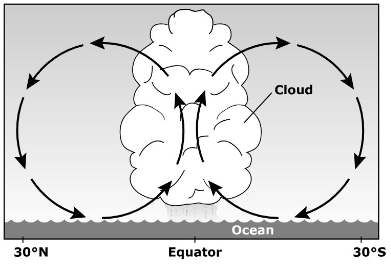 The diagram shows air circulation over the equator. Warm air rises near the equator, forms clouds, moves away from the equator, and eventually sinks. What process is mainly responsible for this large-scale movement of air?
Convection
500
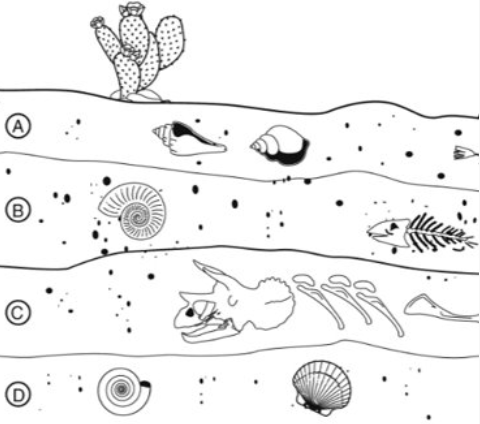
The diagram shows fossils found in different rock layers (A-D). Which statement is best supported by the evidence?
A. The shell fossil in Layer D is younger than the fish fossil in Layer B.
B. The fish fossil in Layer B lived before the organisms found in Layer A.
C. The organisms in Layer A lived before the organisms in Layer C.
D. All of the fossils lived at the same time.
B. The fish fossil in Layer B lived before the organisms found in Layer A.
According to the law of superposition, deeper rock layers are older than layers above them.
500
The water level at the beach changes during the day. What causes the different water levels?
A. Earth’s revolution
B. the Moon’s rotation
C. Earth’s magnetic field
D. the Moon’s gravitational pull
D. the Moon’s gravitational pull
500
A population of insects includes green and brown individuals. Birds can see the green insects more easily on dark tree bark. Over many generations, what would most likely happen?
Brown insects become more common, while green insects become less common.
500
Which statement best explains the difference between an experiment and an investigation?
A. Experiments always happen in a lab, while investigations happen outside
B. Experiments involve changing a variable to test cause and effect, while investigations can involve observing, measuring, or collecting data without manipulating variables
C. Investigations do not use evidence
D. Experiments are always more reliable than investigations
B. Experiments involve changing a variable to test cause and effect, while investigations can involve observing, measuring, or collecting data without manipulating variables.