Amniotic Fluid Basics
Fluid Regulation
Membranes & Abnormalities
Circulation & Doppler
Hydrops
100
What is the primary function of the amniotic fluid?
a.oxygen exchange
b. maintains temperature and protects fetus
c. produces hormones
d. forms placenta
b. Maintains temperature and protects fetus
100
Amniotic fluid volume depends on:
A. Only fetal urination
B. Only maternal hydration
C. Balance between production and removal
D. Placental thickness only
C. Balance between production and removal
100
What is the definition of PROM (Premature Rupture of Membranes)?
A. Rupture of membranes before 20 weeks
B. Rupture of membranes before the onset of labor
C. Rupture of membranes after delivery
D. Rupture of membranes during active labor
B. Rupture of membranes before the onset of labor
100
Hydrops caused by Rh incompatibility is classified as:
A. Nonimmune hydrops
B. Idiopathic hydrops
C. Immune hydrops
D. Cardiac hydrops
C. Immune hydrops
100
This condition is defined as abnormal fluid accumulation in at least two fetal compartments.
A. Polyhydramnios
B. Hydrops fetalis
C. Ascites
D. Oligohydramnios
B. Hydrops fetalis
200
By mid-pregnancy, the main source of amniotic fluid is:
A. Fetal urine
B. Maternal blood
C. Placenta
D. Yolk sac
A. Fetal urine
200
Normal AFI range:
A. 0–5 cm
B. 5–10 cm
C. 10–20 cm
D. 20–30 cm
C. 10-20 cm
200
Amniotic band syndrome is associated with:
A. Increased fluid only
B. Fetal malformations
C. Placental enlargement
D. Twin pregnancies only
B. Fetal malformations
200

A fetal ultrasound demonstrates ascites, pleural effusion, and skin edema. Maternal blood testing is negative for Rh incompatibility. What is the most likely diagnosis?
A. Immune hydrops fetalis
B. Nonimmune hydrops fetalis
C. Oligohydramnios
D. Amniotic band sequence
B. Nonimmune hydrops fetalis
200
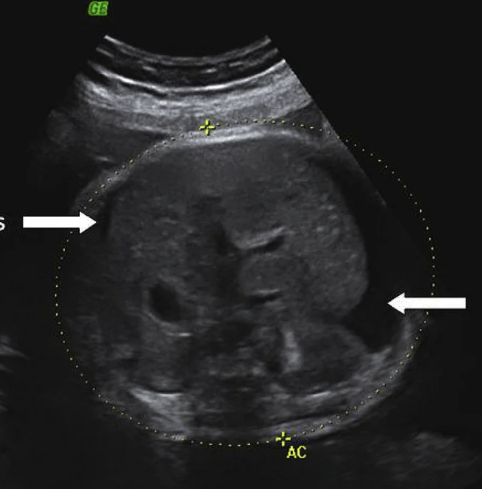
Anechoic fluid surrounding fetal abdominal organs is called:
A. Pleural effusion
B. Ascites
C. Pericardial effusion
D. Skin edema
B. Ascites
300
Which system reabsorbs swallowed amniotic fluid?
A. Cardiovascular
B. Gastrointestinal
C. Nervous
D. Lymphatic
B. Gastrointestinal
300
Fetal swallowing contributes to:
A. Increasing fluid volume
B. Decreasing fluid volume
C. Placental growth
D. Umbilical cord flow
B. Decreasing fluid volume
300

A thin, free-floating band is seen entangling a fetal limb. What is the most likely diagnosis?
A. Amniotic sheet
B. Placental septation
C. Amniotic band sequence
D. Uterine synechiae
C. Amniotic band sequence
300


A monochorionic twin pregnancy shows one twin with polyhydramnios and ascites, and the other with oligohydramnios. What is the diagnosis?
A. Immune hydrops
B. NIHF due to twin-to-twin transfusion syndrome
C. Amniotic band sequence
D. Placental insufficiency
B. NIHF due to twin-to-twin transfusion syndrome
300
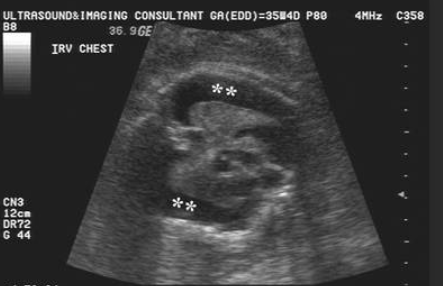
Anechoic fluid outlining the lungs or within the chest cavity is:
A. Ascites
B. Pericardial effusion
C. Pleural effusion
D. Amniotic band
C. Pleural effusion
C. Pleural effusion
400
In the image below, two fetal membranes are identified. Which structure represents the inner membrane directly surrounding the fetus?
A. Chorion
B. Decidua
C. Amnion
D.Synachae

C. Amnion
400
What percentage of fluid volume increase comes from sources other than urine production?
A. 10%
B. 25%
C. 40%
D. 60%
C. 40%
400

The image demonstrates a thick echogenic band within the amniotic cavity. What is the most likely diagnosis?
A. Amniotic band sequence
B. Amniotic sheet
C. Umbilical cord
D. Placental abruption
B. Amniotic sheet
400
Which Doppler study is used to evaluate fetal anemia in hydrops?
A. Umbilical vein
B. Renal artery
C. Middle cerebral artery (MCA)
D. Hepatic vein
C. Middle cerebral artery (MCA)
400
Skin edema in hydrops is typically diagnosed when thickness exceeds:
A. 2 mm
B. 3 mm
C. 5–6 mm
D. 10 mm
C. 5–6 mm
500
Identify label #1.
a.amniotic sac
b. amnion
c. chorionic sac
d. intervillous space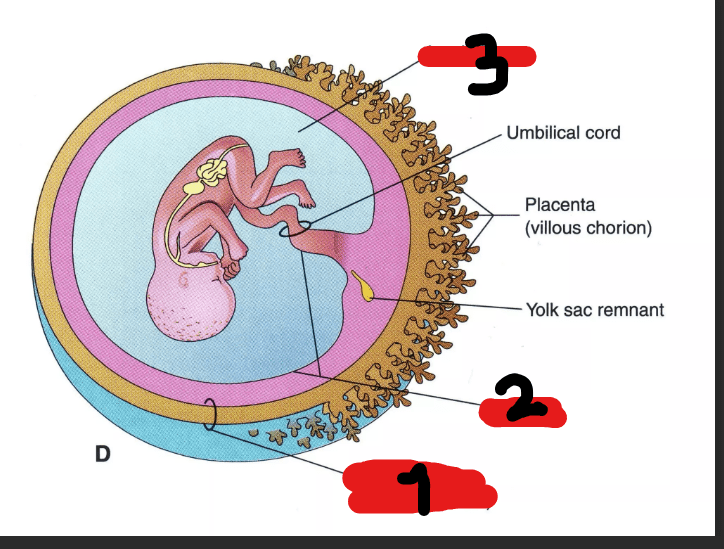
c. chorionic sac
500
The remaining 40% of amniotic fluid (not from fetal urination) primarily comes from which of the following sources?
A. Fetal lung secretions and membrane fluid exchange
B. Maternal oral fluid intake
C. Fetal gastrointestinal absorption
D. Placental blood flow only
A. Fetal lung secretions and membrane fluid exchange
500
Key differentiating feature between amniotic bands and sheets on ultrasound:
A. Sheets are thinner than bands
B. Bands are attached to uterine wall
C. Bands are free-floating and can entangle fetus
D. Sheets move independently of fetus
C. Bands are free-floating and can entangle fetus
500

A fetal ultrasound demonstrates a MCA. What is the most likely diagnosis?
A. Fetal hypoxia
B. Fetal anemia
C. Placental insufficiency
D. Normal Doppler finding
B. Fetal anemia
500
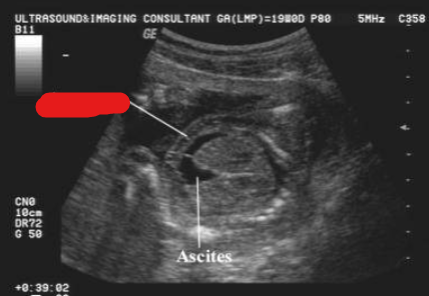
Massive, generalized fetal edema involving most of the body is termed:
A. Ascites
B. Anasarca
C. Hydramnios
D. Effusion syndrome
B. Anasarca