X-rays & Radiographs
Chest X-ray Parts
The Skeletal System
Bone Identification
Types of Joints
Bonus Category: Synovial Joint Examples
100
Technically, X-rays refer to the form of radiation used, while this term refers to the actual image produced (such as a chest film).
What is a radiograph?
100
This central, grayish structure on a chest radiograph is the heart.
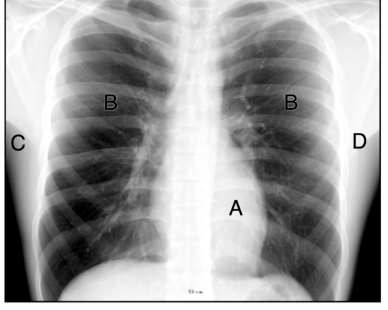
What is A?
100
This part of the skeleton includes the skull, vertebral column, sternum, and hyoid bone.
What is the axial skeleton?
100
This long bone of the upper arm.
What is the humerus?
100
These joints allow the greatest degree of movement and include ball-and-socket types.
What are synovial joints?
100
Shoulders and hips are this multiaxial type with the greatest range.
What is ball-and-socket?
200
In radiography, dense structures like bone absorb most of the X-ray beam, so few rays hit the film, causing this appearance on the final image.
What is white?
200
These large, dark areas on either side filled with air are the lungs.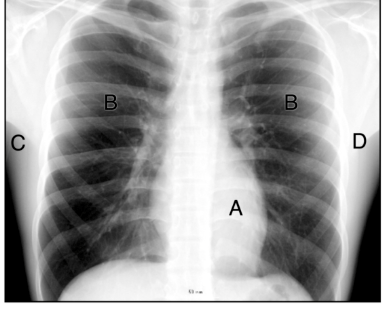
What are B?
200
This lighter, soft inner bone layer contains bone marrow.
What is spongy bone (or cancellous bone)?
200
Wrist bones are known as these.
What are the carpals?
200
These joints have limited movement, such as between vertebrae or ribs and sternum.
What are cartilaginous joints?
200
The base of the thumb is this type, allowing opposition.
What is a saddle joint?
300
Air-filled structures like the lungs allow most X-ray radiation to pass through and hit the film, so they appear this color on a radiograph.
What is black?
300
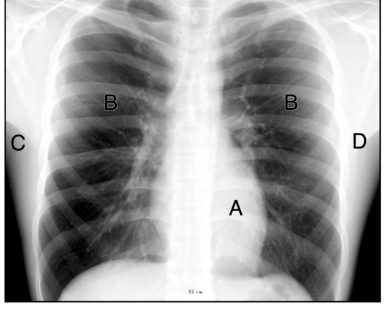 This This is the vertical, central white line.
What is spine?
300
This protective outer covering of bone contains blood vessels and provides nutrients.
What is the periosteum?
300
The bones of the fingers and toes are collectively called these.
What are the phalanges?
300
These joints allow no movement, like skull sutures.
What are fibrous joints?
300
Knuckles (metacarpophalangeal joints) are often this biaxial type.
What is an ellipsoidal (or condyloid) joint?
400
Muscle, fat, and fluid absorb some but not all X-rays, so they show up this color on an X-ray image.
What are shades of gray?
400
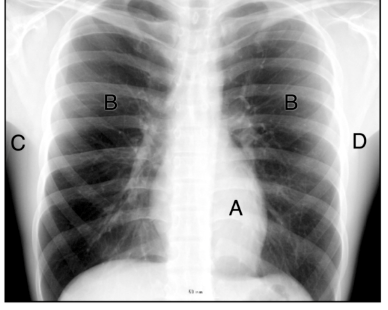 The dense area covering the entire lower region.
What is Diaphragm?
400
This space inside long bones stores bone marrow.
What is the medullary cavity?
400
This large pelvic bone.
What is the ilium?
400
This type of synovial joint allows flexion/extension only, like knees and elbows.
What is a hinge joint?
400
Gliding joints are found between these bones in the hands and feet for small sliding movements.
What are the carpals/tarsals)?
500
Surgical steel or metal implants absorb nearly all X-rays and appear this way due to very high density.
What is white?
500
On a standard PA chest radiograph, this side of the body appears on the right side of the image due to how the film is viewed.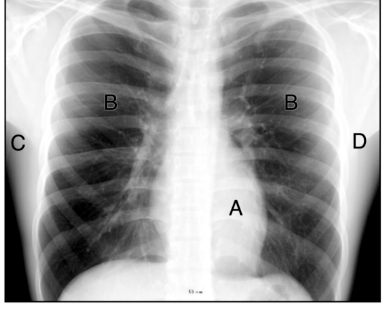
What is the left side of the body?
500
This plate in children's bones allows growth and eventually turns into solid bone.
What is the growth plate (or epiphyseal plate)?
500
This bone "floats" in the neck.
What is the hyoid bone?
500
This type allows swivel/rotation, like the proximal radioulnar joint for forearm pronation/supination.
What is a pivot joint?
500
This is Ms. Staunch's first name.
What is Christine?