Semester 1
more semester 1
also semester 1
Semester 2
more semester 2
also semester 2
100
What biomolecule serves as a fast source of energy?
carbohydrates
100
The process by which water moves through the cell membrane to balance out a high concentration of solutes.
osmosis
100
What type of cell is a chloroplast found in?
Eukaryote; plant cell
100
Describe commensalism.
A relationship where one species benefits from another species and that species is not harmed or helped.
100
What is the basic unit of life?
Cells
100
Both organisms benefit from this type of symbiotic relationship.
mutualism
200
What macromolecule is responsible for building, regulating, and maintaining your body?
Protein
200
Which type of movement across a cell's membrane requires energy supplied by ATP?
Active transport
200
movement of ions, and molecules across cell membranes without the need for energy input
passive transport (diffusion, facilitated diffusion, osmosis)
200
Name the term for:
Several populations in an area.
community
200
If the producers contain 10,000 Kcal, then how much energy will the secondary consumers contain?
100 Kcal
200
How much energy is passed on from one trophic level to the next?
10%
300
Name the term for the following definition:
The minimum quantity of energy that is required to activate atoms or molecules to a condition in which they undergo a specified reaction.
Activation energy
300
What is the function of the golgi body?
Modifies, sorts, and packages proteins to be shipped out in vesicles (looks like a WiFi signal)
300
What is the name of the process that produces gametes (sperm and egg cells) in animals?
Meiosis
300
Identify the term for the following definition:
a process where organisms better adapted to their environment tend to survive and reproduce more successfully
natural selection
300
Are viruses living or nonliving? WHY?
Nonliving; they cannot reproduce on their own...needs a host. (Does have DNA & evolve over time)
300
Define "Embryology".
Study of embryos to reveal evolutionary relationships.
400
What theory suggests that eukaryotic cells originated from a prokaryote engulfing another prokaryote?
Theory of Endosymbiosis / Endosymbiotic Theory
400
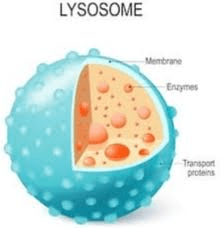 Function?
"Garbage man", breaks down waste using digestive enzymes.
400
What tool would be used to help scientists predict genetic conditions or ideal traits?
Punnett Squares
400
What is the most specific classification of an organism?
species
400
Which organisms have the most available energy in a food pyramid?
Producers
400
The legs of crocodiles and cats have similar bone structures and develop in a similar way which indicates a common ancestor. What are these considered?
homologous structures
500
What is the monomer of starch and glycogen?
Monosaccharides (single sugars)
500
How does ATP become ADP?
break off the 3rd phosphate group
500
Name parts A, B, and C labeled below:
A = substrates (reactants)
B = enzyme
C = product
500
What is the purpose of a cladogram?
To demonstrate potential evolutionary relationships with shared, observable characteristics
500
Which characteristic do all plants, animals, protists, and fungi have in common?
They are eukaryotic (have a nucleus)
500
What is the purpose of a phylogenetic tree?
To show the evolutionary relationship between different groups of organisms, scientists construct using evolutionary evidence & genetics
600
 Name & describe the 3 solutions.
1. Isotonic: Water moves equally in & out
2. Hypertonic; solute sucks water out, cell shrinks
3. Hypotonic; solute sucks water in, cell swells
600
State the Central Dogma of Protein Synthesis
DNA --> mRNA --> Protein
600
What is the Cellular Respiration equation?
C6H12O6 + 6O2 --> 6CO2 + 6H2O + 36/38 ATP
(GO --> COW!)
600
Identify (name) Name these 3 types of evolution:
#1: Unrelated species evolve similar traits.
#2: 2+ species descend from a common ancestor.
#3: Two species evolve in response to each other.
#1: Define "Convergent Evolution".
#2: Define "Divergent Evolution".
#3: Define "Coevolution".
600
Identify (name) each type of morphological evidence below:
#1: Similar structures due to common ancestry.
#2: Similar function, different evolutionary origin.
#3: Reduced, altered function, or nonfunctional remnants of structures in an organism.
#1: "Homologous Structures".
#2: "Analogous Structures".
#3: "Vestigial Structures".
600
Name all 8 levels of classification in order!
Domain, Kingdom, Phylum, Class, Order, Family, Genus, and Species.