Email
Letter
Memo/Note
Envelope
100
What is the purpose of the subject line in an email?
It condenses the contents of the message to allow the reader to decide if they want to read the message. It allows the reader to perform searches on Outlook.
100
Is this the correct format to write the addressee's information in a letter?
Mr. Brad Erickson, Pedagogical Advisor
Eastern Shores School Board
87, Canterbury Street Saint John,
NB E2L 2C7
No, the addressee's information should be single spaced, the title Pedagogical Advisor should be on the second line and there is no comma after the street address number.
100
You can write a memo when requesting information or action and you need your team to provide feedback, complete a task, or submit information.
Yes
100
What are the different ways to prepare the envelope that will protect the letter until it reaches its destination?
The recipient's address can be printed directly on the envelope, a label can be affixed to the envelope, or the main text of the letter itself can be displayed through the envelope window. It is also possible to create a large quantity of envelopes and labels using the mail merge function.
200
True or False. "We are sending a copy of the report you requested." is a good example for the subject line in an email.
False. Report on Equipment Leasing
200
True or False. The subject line in a letter is optional.
True
200
What is the format of a memo?
A structured format helps readers quickly grasp the message. Here’s what to include:
- Heading: The “TO,” “FROM,” “DATE,” and “SUBJECT” fields set the stage by summarizing who the memo is for, who it’s from, when it was written, and its purpose. A specific subject line like “New Office Safety Guidelines—Effective January 15” is much clearer than “Policy Update.”
- Introduction: Start with a brief overview of the memo’s purpose. For example, “This memo outlines the updated procedures for submitting expense reports starting next quarter.”
- Body: Provide all necessary details in a logical order. Use short paragraphs to explain key points and bullet points or lists to break down complex information, like steps to follow or important dates.
- Conclusion/Call to action: Summarize the main points and specify what you want readers to do next, such as “Please review the attached document and submit your feedback by Friday.”
How to Write a Memo: A Step-by-Step Guide (with Examples) | The Muse | The Muse
200
When sending a letter in Canada, how should you write the postal code?
Write POSTAL CODES in uppercase letters and separate the first 3 characters from the last 3 characters with 1 space. (No hyphens please. These can cause delays)
Addressing mail accurately | Canada Post
300
What should you do before you send an email?
Before hitting the send button, revise and proofread your email. Put yourself in your reader’s position and assess whether you’ve achieved the purpose you set out to achieve in the first place. Evaluate also if you’ve struck the appropriate tone and formality. After revising generally, always proofread an email. In any professional situation, but especially in important ones related to gaining and keeping employment, any typo or error related to spelling, grammar, or punctuation can cost you dearly. A poorly written email is insulting because it effectively says to the recipient: “You weren’t important enough for me to take the time to ensure that this email was properly written.” Worse, poor writing can cause miscommunication if it places the burden of interpretation on the reader to figure out what the writer meant to say if that’s not clear. If the recipient acts on misinterpretations and others base their actions on that action, you can soon find that even small errors can have damaging ripple effects that infuriate everyone involved.
300
Why is a Modified Block Style With Paragraph Indents considered similar to the Modified-Block Style?
The first line of each paragraph in the letter text is indented, from 0.63 cm to 1.26 cm, from the left margin.
300
What would be the subject line of this memo?
TO: All Employees
FROM: HR Department
DATE: January 5, 2025
SUBJECT: ???????
We’re excited to announce updates to our remote work policy, effective February 1, 2025. To better support work-life balance and flexibility, employees will now have the option to work remotely up to three days per week.
Please note the following key details:
- Eligible days: Monday through Friday, excluding mandatory in-office team meetings.
- Approval process: Submit your remote work request via the HR portal by January 25.
- Resources: Refer to the attached FAQs for setup and guidelines.
We believe this change will enhance productivity and job satisfaction. For any questions, contact the HR team at hr@company.com.
Updated Remote Work Policy
300
Describe the rule that should be followed for each of the letters indicated on the address label below
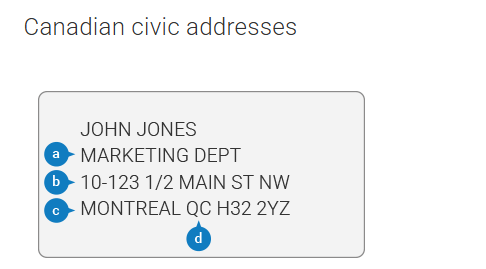
 Addressing mail accurately | Canada Post
400
True or False. If the sender's or recipient's name appears on the note, it must be preceded by their respective job title or administrative unit (e.g., Human Resources Manager).
True
400
What is the difference between mixed punctuation and open punctuation?
Up until now, this is the first punctuation style you've used: a colon after the salutation (or a comma when addressing the recipient by their first name) and a comma after the closing. However, the Open Punctuation style does not allow any punctuation in these two places within the letter.
400
How can you make your memo visually appealing and easy to read?
Choose a clean, professional font like Arial or Times New Roman in a readable size (11 or 12 points). To make your memo visually appealing and easy to read, leave plenty of white space by using clear paragraphs, line breaks, and appropriate margins. If your memo includes complex information, enhance clarity with visuals or attachments. Keep it concise—aim for one page whenever possible. For more detailed or complex memos, a second page (front and back) can be acceptable.
400
Describe the rule that should be followed for each of the letters indicated on the address label below
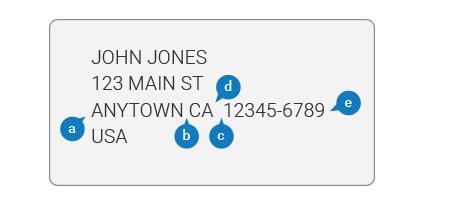
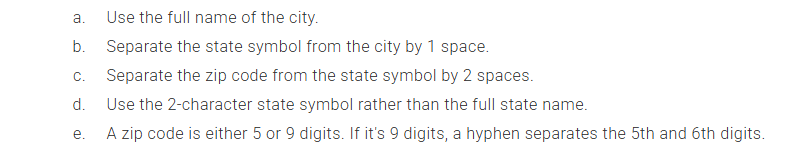 Addressing mail accurately | Canada Post
500
Fill in the blank.
You can respond to an email within _____ hours.
24.
Watch out for an emotional response—never reply in anger—but make a habit of replying to all emails within 24 hours, even if only to say that you will provide the requested information in 48 or 72 hours.
Chapter 6: Emails, Memos and Letters – Fundamentals of Business Communication
500
True or False. A common salutation may be “Dear Mr./Mrs./Ms. + (last name).” If you are unsure about titles (i.e., Mrs., Ms., Mr., Mx., Dr.), you may simply write the recipient’s name (e.g., “Dear Cameron Rai”) followed by a colon.
True.
Chapter 6: Emails, Memos and Letters – Fundamentals of Business Communication
500
Which one does not belong:
You can write a memo for:
- Policies (changes and new)
- Instructions
- Procedures
- External Communication
- Announcements
- Trip reports
External Communication
A memo (memorandum) is meant for professional, internal communication, so anything that doesn’t fit that purpose should be avoided. Here are the main types of communication that should NOT be in a memo:
1. Personal or Informal Communication
Memos are not the place for casual conversation, jokes, slang, or personal opinions unrelated to work.
- Avoid: “Hey guys,” humor, emojis, or storytelling
- Keep tone formal and businesslike
2. Emotional or Confrontational Messages
Memos shouldn’t be used to vent frustration, criticize individuals harshly, or handle sensitive conflicts.
- Avoid blame, anger, or accusations
- Sensitive issues are better handled in private conversations
3. Confidential or Highly Sensitive Information (unless secure)
If the memo is widely distributed, don’t include:
- Personal employee data
- Legal issues
- Financial details that require restricted access
4. Irrelevant or Unnecessary Details
Memos should be concise and focused.
- Avoid long background stories or unrelated information
- Stick to the purpose and key points
5. External Communication
Memos are for internal use only.
- Do not use a memo to communicate with customers, clients, or the public
- Use emails, letters, or reports for external audiences
6. Unclear or Vague Instructions
A memo should be direct and actionable.
- Avoid confusing language or incomplete information
- Readers should clearly understand what is expected
Chat GPT
500
Why should you write important details such as mailing or special notation or the attention line on the envelope and on the document?
If you think it would be more logical to write these details only on the envelope, you're right, but you must understand that a sealed letter often doesn't arrive directly on the recipient's desk. A receptionist or an administrative assistant is often responsible for processing the mail before forwarding to the recipient. For example,
depending on company policy, the envelope of a confidential letter is usually delivered directly to the recipient, unopened. If the marking doesn't appear on the letter, should it be removed from the envelope, the recipient would be unaware that it was sent via a special delivery method or that the receptionist shouldn't have opened it.