VOCABULARY
EVENTS
CONFLICTS
FREEDOM & RESISTANCE
Thinking like a Historian
100
During Reconstruction, what did President Andrew Johnson offer many former Confederates?
Amnesty or forgiveness, along with a restoration of their political rights
100
What agency was created by the federal government to help formerly enslaved and other people effected by the Civil War in 1895?
Freedmen's Bureau
100
Group of people who supported strong federal action to protect freedmen and reshape Southern government
Radical Republicans
100
Who freed the slaves?
The slaves!
100
Read the excerpt:
"Reconstruction was a social, economic, and political revolution. The process began during the Civil War, as enslaved people broke their bonds, escaped to freedom, and joined the U.S. Army and Navy to complete the destruction of the Confederacy."
Question: Which statement best explains the author's characterization of Reconstruction as a "revolution"?
A. Reconstruction replaced the U.S. government with a completely new political system.
B. Reconstruction involved changes to the social order, economic relationships, and political rights that had shaped American society.
C. Reconstruction was primarily a military effort to punish former Confederate soldiers.
D. Reconstruction successfully eliminated the racial inequalities that had existed before the Civil War.
B. Reconstruction involved changes to the social order, economic relationships, and political rights that had shaped American society.
200
2 part question:
1- Another name for white Southern Democrats who wanted to restore Democratic control of congress
2- Specific term for what they believed in
1- Redeemers
2- The Lost Cause
200
Put these events in Chronological Order:
A. Compromise of 1877
B. Democrats take back the house
C. Ratification of the 15th Amendment
D. Andrew Johnson's Impeachment
D, C, B, A
200
Political party that emphasized states rights and opposed federal intervention during this era
Democrats
200
List two examples of Black Americans taking advantage of their freedom during reconstruction
- Attending & establishing schools
- Reuniting families separated by slavery
- seeking paid employment
- Purchased land
- Voting and participating in politics
200
"Black people resisted this violence and sometimes mounted armed resistance, but the combination of vigilante violence, state and federal refusal to defend Black rights, and widespread disenfranchisement was impossible to overcome."
Question: Which conclusion is best supported by the excerpt?
A. Black Americans failed to resist white supremacist violence because they lacked political goals.
B. The end of Reconstruction resulted primarily from disagreements among Black political leaders.
C. White supremacist violence alone explains why Reconstruction's achievements were undermined.
D. The decline of Black political power resulted from the combined effects of organized violence, inadequate government protection, and restrictions on voting.
D. The decline of Black political power resulted from the combined effects of organized violence, inadequate government protection, and restrictions on voting.
300
Two terms for the period that followed Reconstruction, characterized by disenfranchisement of African Americans, violence, and segregation
Jim Crow era, Redemption era
300
What was the 14th amendment and what does it guarantee
Birthright citizenship: If you are born on US soil, you are a citizen and guaranteed equal protection under the law
300
What two branches of government were frequently in conflict during this era?
Executive and Legislative
300
List an example of the expansion of freedom for Black Americans, and a specific attempt to restrict this freedom
Answers may vary but can include:
15th amendment --> voter restriction & intimidation
13th amendment --> sharecropping
abolition --> black codes
300
"Many white Southerners wanted to undo the progress of Reconstruction and reestablish the antebellum social order rooted in white social, political, and economic supremacy."
Question: Which additional piece of evidence would BEST support the author's argument?
A. Some Southern states passed laws restricting Black voting, while white supremacist groups used violence to intimidate Black voters and political organizers.
B. Many formerly enslaved people sought to reunite with relatives after emancipation.
C. Congress passed the 14th Amendment to establish birthright citizenship.
D. Black communities established churches and organized social gatherings during Reconstruction.
A. Some Southern states passed laws restricting Black voting, while white supremacist groups used violence to intimidate Black voters and political organizers.
400
Name three specific pre-requisites created to subvert/undermine the 15th amendment
- Poll taxes
- Literacy Tests
- Grandfather Clauses
400
What major event was the precursor to the Military Reconstruction Act of 1867?
The New Orleans Massacre
400
What group of people is depicted in this image? What are they advocating for/against?
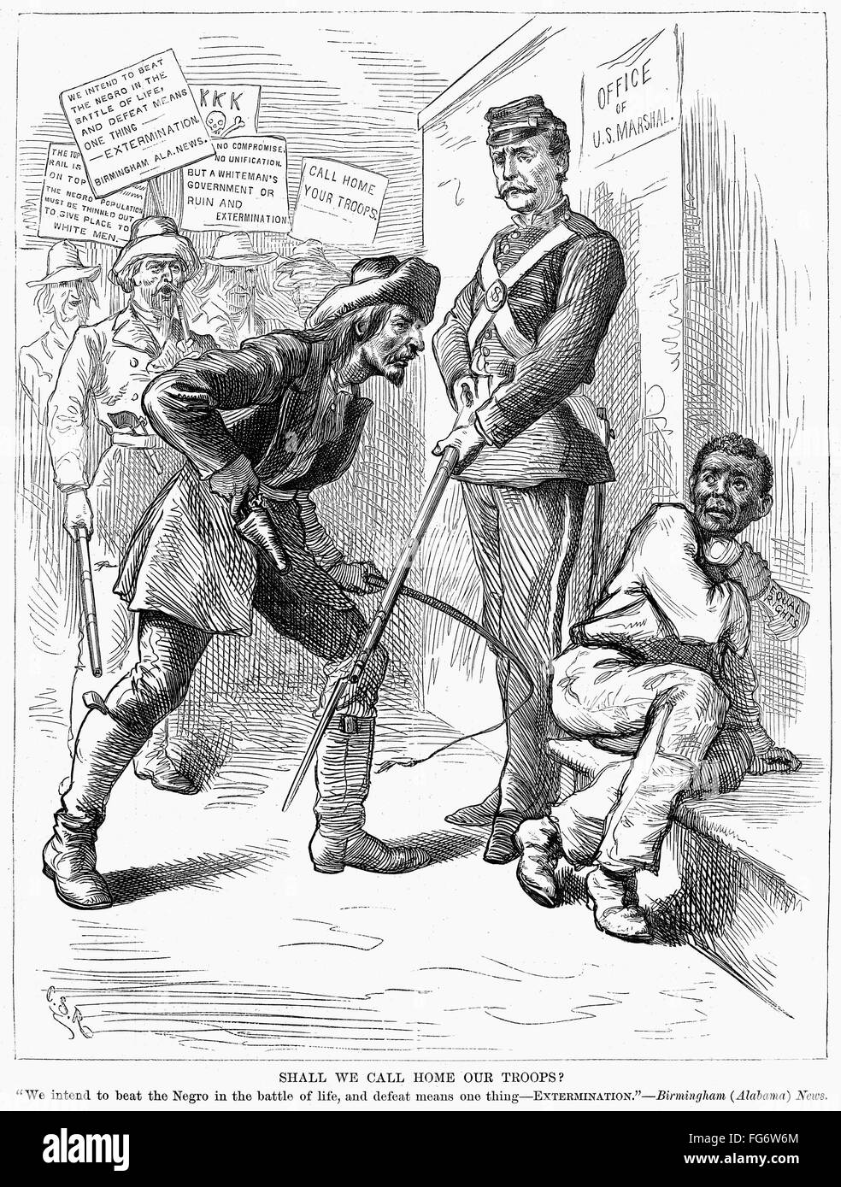
Redeemers
Advocating for white supremacy
Advocating against federal intervention
400
Name the three Reconstruction Amendments and what they did
13- Abolition of slavery (except as punishment for a crime)
14- Birthright citizenship
15- Black male suffrage
400
"The constitutional changes enacted during this era created a framework that, nearly a century later, during the Civil Rights Movement, Americans used to dismantle legalized white supremacy in the South. Yet, soon after their initial enactment, the Supreme Court interpreted the amendments extremely narrowly and Congress retreated from its commitment to using them to protect Black people and democracy itself from white supremacist terrorism."
Question: Which statement best explains the relationship between constitutional rights and the experiences of Black Americans described in the excerpt?
A. Constitutional amendments automatically guarantee that all citizens can exercise their rights without interference.
B. Constitutional rights were unimportant because state governments had complete authority over citizenship.
C. The Reconstruction Amendments applied only to the former Confederate states and therefore had no national significance.
D. Constitutional protections can establish important rights, but their effectiveness depends partly on how courts interpret them and whether the government enforces them.
D. Constitutional protections can establish important rights, but their effectiveness depends partly on how courts interpret them and whether the government enforces them.
500
In 1894, Fredrick Douglas said:
"It is due to the folly of endeavoring to retain the new wine of liberty in the old bottles of slavery."
Give 3 specific examples of the "old bottles of slavery" in the post Reconstruction Era
Possible examples
- Sharecropping
- Voter restriction laws
- No African American in southern congress for 70 years
- Convict Lease System
500
2 part question:
1- What is the name of the event that marked the end of Reconstruction?
2- What action was taken during this event that showed it had come to an end?
1- Compromise of 1877
2- President Hayes removed all remaining federal troops from Southern states
500
Name two specific things the Reconstruction Acts of 1867 did
- Divided the Southern states into 5 military districts
- Required Ratification of the 14th amendment
- Forced Southern governments to rewrite their constitutions
500
In the late 1870s, what group of people's priorities began to shift as they lost interest in the racial goals of Reconstruction?
White Northerners / Northern Republicans
500
"Newly emancipated African Americans who sought to win a semblance of autonomy and self-determination guided the course of Reconstruction and pushed to expand the frontiers of civil and political equality. Yet, faced with Black political and economic advances, a white supremacist counterrevolution succeeded in destroying many of these fragile advances."
Question: The above response argues that Reconstruction failed because the federal government did not give formerly enslaved people enough rights. Which response BEST challenges the author's interpretation?
A. Reconstruction was successful because Black Americans legally, Black Americans had rights they did not have before the era.
B. Reconstruction failed only because Black Americans were unwilling to participate in politics.
C. Black Americans' played an active role in shaping democracy, before, during, and after the Reconstruction era, influencing the rights and liberties that we benefit from to this day.
D. The interpretation is incorrect because the federal government never played a role in expanding Black Americans' rights.
C. Black Americans' played an active role in shaping democracy, before, during, and after the Reconstruction era, influencing the rights and liberties that we benefit from to this day.