Glomerular Filtration
Reabsorption of Salt and Water
Water and Electrolyte Regulation
Renal Acid-Base Regulation
Potluck
100
Two processes by which substances can enter the renal tubules: ___________ and ______________.
filtration and secretion
100
In the epithelial cells of the proximal tubule, the Na+/K+ pumps are located on the ___________ surface.
A. luminal (apical)
B. basolateral
C. both
D. none
B. basolateral
100
The area of the brain that plays a major role in water and electrolyte balance is the _________ .
a.cerebral cortex
b.medulla
c.thalamus
d.hypothalamus
d.hypothalamus
100
The major urinary buffer is _____.
phosphate buffer system
100
Amphoteric molecules are molecules that can __________ .
a.act as either an acid or a base
b.stimulate water conservation
c.stimulate the reabsorption of sodium
d.stimulate the excretion of hydrogen ions
a.act as either an acid or a base
200
A medication that increases urinary output is called a ___________ . Removal of extra fluid in this manner is likely to ___________-crease blood pressure.
diuretic ; decrease
200
Solute concentration in the medulla may reach a maximum of ________ mOsm as compared to _______ mOsm in the cortex.
A. 1200; 300
B. 300; 1200
C. 100; 1200
D. 1200; 100
A. 1200; 300
200
Which of the following is a stimulus for thirst?
a.Salivation
b.Decreased plasma volume
c.Decreased ECF osmolarity
d.Sensation of thirst
b.Decreased plasma volume
200
The kidneys help regulate a low blood pH by excreting _________ and reabsorbing __________.
H+ ; bicarbonate
200
If the blood pH lowers, what change would you expect from the respiratory system?
a)The respiration rate would increase.
b)The respiration rate would decrease.
c)The respiration rate would remain unchanged.
d)The respiration rate would be erratic.
a)The respiration rate would increase.
300
Which of the following is filtered most readily by the glomerular capillaries?
A. Red blood cells.
B. Albumin.
C. Glucose.
D. All of these.
C. Glucose.
300
The activation of the sympathetic nervous system tends to cause constriction of the afferent arteriole. The resulting __-crease in GFR leads to __-creased urine output.
decrease; decreased
300
Match the chemical agent to its appropriate function
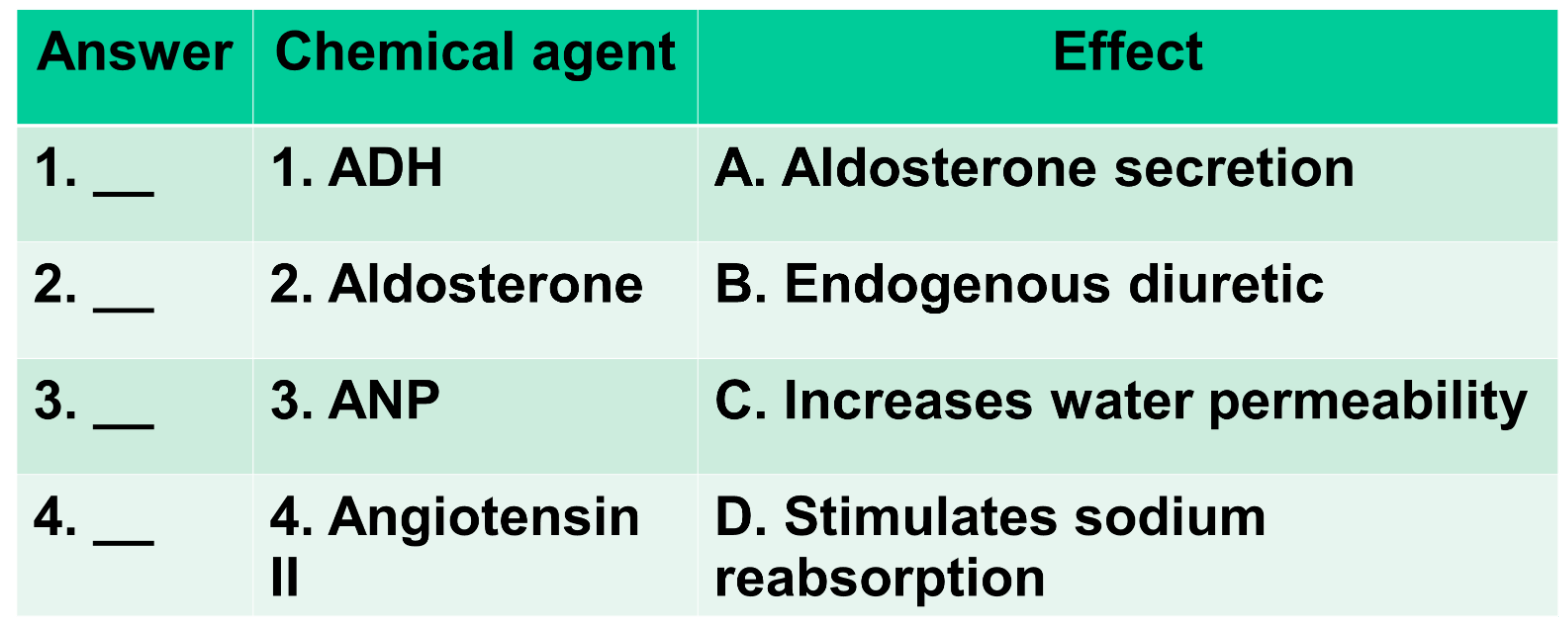
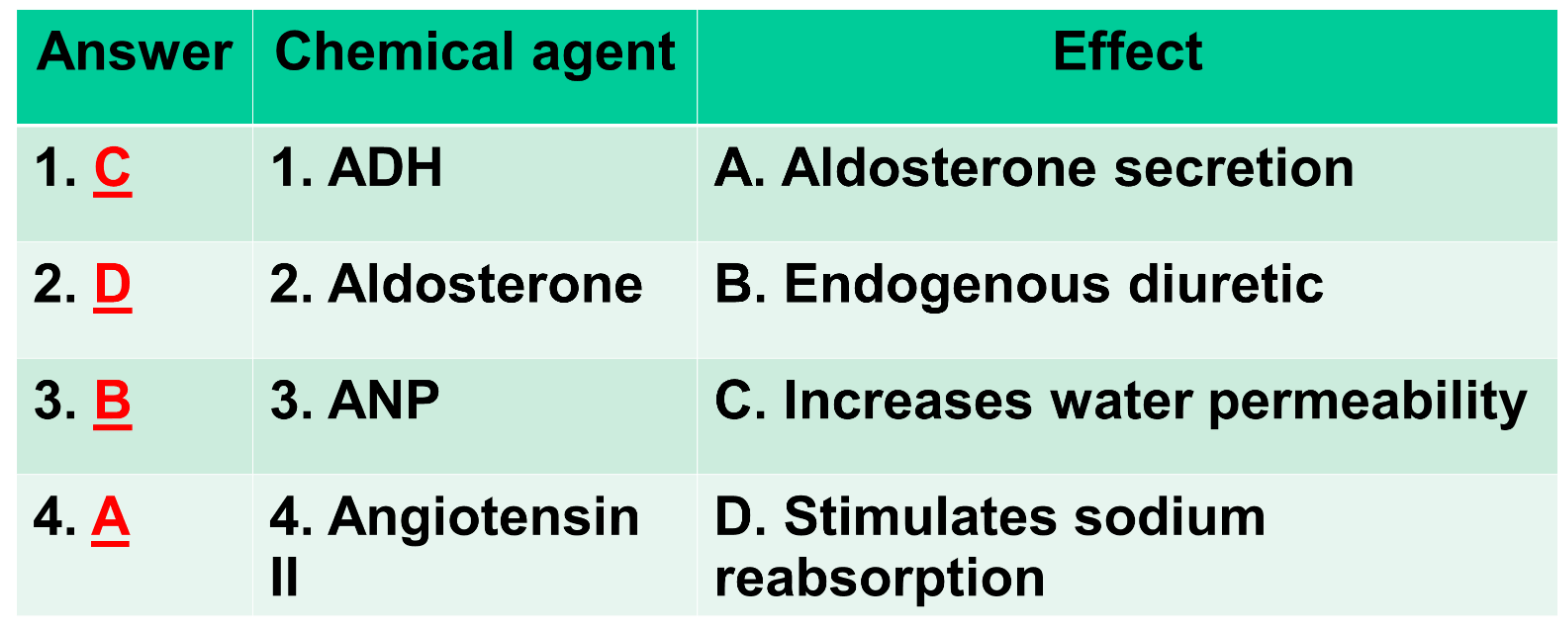
300
Where are the Type A and B intercalated cells found?
a.proximal convoluted tubule
b.distal convoluted tubule
c.Nephron loop
d.collecting duct
e. both b and d
e. both b and d (DCT and collecting duct)
300
ANP promotes which of the following?
a.ADH release
b.Aldosterone release
c.Vasoconstriction
d.Sodium excretion
d.Sodium excretion
400
Determine the net filtration pressure (NFP) of the patient whose pressure values are shown below.
Glomerular blood hydrostatic pressure = 45 mm Hg.
Blood colloid osmotic pressure = 30 mm Hg and
Capsular filtrate hydrostatic pressure = 12 mm Hg.
NFP = +3 mm Hg.
400
In the loop of Henle,
A. The ascending limb is very permeable to water.
B. The filtrate in the descending limb becomes more and more hypotonic.
C. Sodium and chloride ions are actively transported out of the ascending limb.
D. B and C
C. Sodium and chloride ions are actively transported out of the ascending limb.
400
Increased plasma K+ concentration causes an increase in the production of
A. Renin.
B. Angiotensin II.
C. Aldosterone.
D. ADH.
C. Aldosterone.
400
Which buffer system acts the fastest to restore pH changes?
a. chemical
b. respiratory
c. renal
a. chemical
400
At plasma concentrations of glucose higher than the transport maximum (Tm), the
A.reabsorption rate of glucose equals the filtration rate of glucose.
B. excretion rate of glucose equals the filtration rate of glucose.
C. excretion rate of glucose increases with increasing plasma glucose concentrations.
C. excretion rate of glucose increases with increasing plasma glucose concentrations.
500
Which of the following is NOT true about filtration? (You may choose more than 1)
I. The filtration rate of a non-renal capillary is greater than a glomerular capillary.
II. Constriction of the efferent arteriole has no effect on the glomerular filtration rate.
III. The filtration barrier filters based on size and charge.
I, II
500
Urea is
A. Actively secreted in the distal convoluted tubule.
B. Actively reabsorbed in the proximal convoluted tubule.
C. Passively reabsorbed in the proximal convoluted tubule.
D. Passively reabsorbed in the distal convoluted tubule.
C. Passively reabsorbed in the proximal convoluted tubule.
500
Substance X can be found in the glomerular filtrate and the peritubular capillaries, but not in the urine. Which of the following best describes the renal handling of substance X?
A. filtration and reabsorption
B. secretion and excretion
C. filtration and excretion
D. filtration, reabsorption, secretion, & excretion
A. filtration and reabsorption
500
Hyperventilation leads to __________ .
a.respiratory acidosis
b.respiratory alkalosis
c.metabolic acidosis
d.respiratory compensation
b.respiratory alkalosis
500
A decrease in the osmolarity of the extracellular fluid would cause water to __________ .
a.move into the cells
b.move into the interstitial fluid
c.move into the blood
d.move into the lymph
a.move into the cells