General ideas and SLA terminology
L1 and L2 development
Cognitive-psychological approaches to SLA
Individual differences
Practice and noticing
100
True or false. L1 refers to one's most dominant language.
False. L1 is the first language (or languages) acquired since birth to 3 years of age.
100
True or false. Children acquiring any language have uniform, predictable stages of L1 acquisition.
True. See below.
Womb – 6 months - Perception and cooing (4 months)
6 – 8 months - Babbling (CV); nasals, glides, stops [ma-ma-ma]
9 – 18 months - Single words representing a sentence (“ball”)
18 – 24 months - Two-word stage (“ball me”)
24 – 30 months - Telegraphic stage (“get ball me”)
30+ months - Multiword stage; great variation of development amongst children;
4 - 6 years - Acquisition of basic L1 grammar and phonology
100
The 3 subfields in within the Psychological approaches to SLA subfield are:
1. Neurolinguistics
2. Learning / cognitive processes
3. Individual differences.
100
What is some evidence that adults learn language more quickly than children?
Research has shown that when in an immersive environment, adults can reach advanced high / superior proficiency in less time than a monolingual child.
Older adoptees also acquire language more quickly when comparing the number of hours.
100
Noticing is...
the specific moment when an L2 learner consciously becomes aware of a particular L2 feature in the input as relevant for learning. It is crucial for processing.
200
What is the difference between a first language and one's primary language?
A first language (or languages) is the system that someone started learning from birth - 3 years of age. A primary language is one's dominant language at a given time. Sometimes the L1 and primary languages are the same, but sometimes they are not.
200
What are the final states of L1 and L2 development?
L1 = native competence
L2 = multilingual competence
200
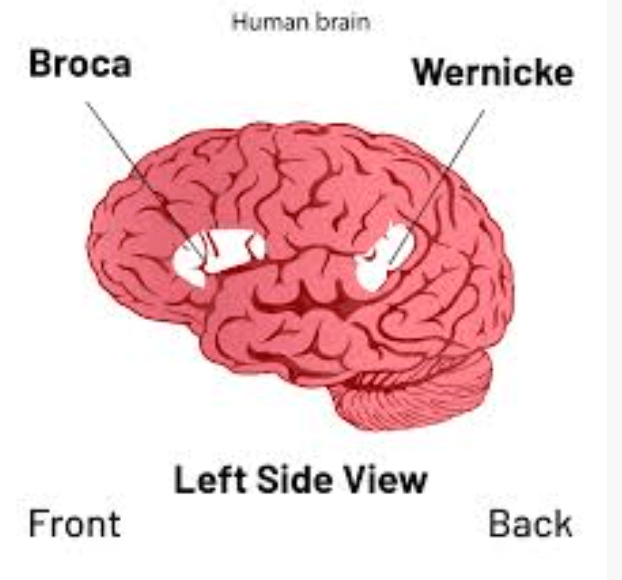
Traditionally researchers have identified the following areas in the brain as because heavily involved in language. (But we know that it is much more complicated than this with advances in tech.)
Wernicke's area - For speech comprehension and code interpretation
Broca's area - For speech production
200
What is L2 WTC? Describe it.
Willingness to communicate in a second (additional) language. It is very different fro L1 WTC. It is one's readiness to engage in using the L2 in a particular situation. L2 WTC predicts actual language use. A lack of anxiety and high perceived ability are strong predictors of high levels of L2 WTC.
Also, L2 anxiety "is a situation-specific-type anxiety uniquely provoked by using a less dominant language (L2) and not simply a case of general anxiety transferred to the language classroom or to bilingual situations" (see Anna Clare, Caitlin, Lauren, and EJ's presentation).
200
Repetition is...
...effective in helping L2 learners produce more accurate, fluent, and complex output.
•For novice L2 speakers – it helps with accuracy, fluency
•For more advanced L2 speakers – it helps with accuracy, complexity
300
True or false. The definition of learning is the change in cognitive structure based on one's experience. This can be a conscious process that involves explicit learning in a formal setting.
True
300
What are some of the facilitating conditions of L2 development?
Feedback, aptitude, motivation, instructional techniques, (anxiety, etc.)
300
How are brain lateralization and brain plasticity related? How is lateralization related to languages (L1 and L2)?
With lateralization (or, an increased specialization of a skill in the brain), there tends to be less plasticity (the brain’s ability to change throughout life).
L1 = often certain skills are lateralized - LEFT - phonology, morphology, synatx; RIGHT - Nonverbal, Visuospatial info, Intonation, Nonliteral meaning, Ambiguity, Pragmatic abilities, Lexical knowledge
L2 = often right hemisphere is involved
300
Researchers have distinguished between L2 motivation that focuses in one specific personal goals (e.g., I want to travel, I want to get a good job using my L2) and goals that are more community and culturally oriented (e.g., I want to interact and integrate with the L2 culture). What are these types of motivation called?
Instrumental and integrative. Integrative motivation predicts more advanced L2 proficiency.
300
Ample opportunities for L2 output is necessary because...
...it helps increase L2 fluency, L2 learners try out and experiment with language, they can reflect on L2 produce, and notice gaps in L2 communication.
Output = the linguistic production of the L2 learner (signed, spoken, written).
400
Who was the linguist that went against B. F. Skinner and behaviorism to explain that all humans have the innate capacity to acquire language and that we are predisposed for this ability.
Noam Chomsky
400
True or false. Children use their child grammar as their L1 system is developing while older L2 learners use their interlanguage system (or learner language) as they progress toward the target language.
True.
400
Coordinate bilingualism describe the storage of the L1 and L2 as...
separate systems, which were learned in two different contexts (which is more rare than compound and subordinate).
Compound - two systems together
Subordinate - L2 accessed/ filtered through L1
400
If an L2 learner has a field independence cognitive style, they will be able to do this better.
Analyze language, conjugate verbs, do well on tests, accuracy with grammar.
A field dependent learner sees the whole picture, and would typically perform better at communicative tasks and interpreting messages.
400
Input enhancement is...
...when the text of a particular L2 form is highlighted, bolded, italicized so it is more noticed by the L2 learner. Only if the L2 learner notices, is IE effective. Glossing with repeated exposures of L2 forms is the most effective IE strategy as documented in SLA research.
500
True or false. Sequential bilingualism is usually within the scope of SLA, as opposed to simultaneous bilingualism.
True.
500
Do both L1 and L2 development have "innate capacity" as part of their initial states?
Sort of. L1 speakers have an innate capacity to acquire languages, but there is debate in the field regarding if L2 speakers start with some sort of innate ability. Some believe there is a genetic predisposition, some do not ascribe to this belief.
500
Information Processing is a cognitive model that describes that SLA occurs when...
learners move from take input and make it intake; they go from conscious to automatized processing and after restructuring the knowledge they have (by making associations). This frees us space for higher-order and more complex processing, which leads to increased proficiency.
500
True or false. A learner's L1 reading level correlates to higher degrees of success in L2 learning.
True. See information about L2 aptitude.
500
Planning is helpful to L2 learners because...
...it frees up cognitive resources to allow students to have the bandwidth to notice forms.
...it enhances accuracy, fluency, and complexity (but sometimes with more complex language the accuracy decreases).