Scatter plots
Exponents
Solving Equations
Volume
Pythagorean Theorem
100
The three types of associations
Positive, negative and no association.
100
Any number to the zero power is
one
100
The value of the variable:
2x - 1 = 13
x = 7
100
What is the formula for finding the volume of a cone?
one third Pi r squared h
100
The side opposite the right angle is called
hypotenuse
200
Shows the average trends in data.
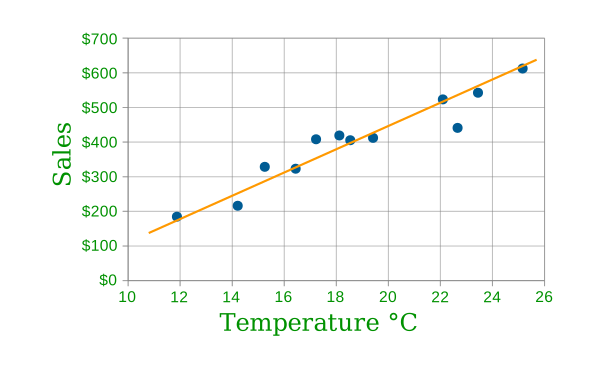
The Line of Best Fit.
200
True or False: a Power of a Product is similar to the distributive property.

true
200
The value of the variable:
1/2x+10=40
x = 60
200
What is the formula for finding the volume of a cylinder?
Pi r squared h
200
The two shorter sides of a right triangle are called
legs
300
If one variable increases as the other variable increases, this is described as a ____ association.
positive
300
Power of a power means to _____ the exponents
(a^m)^n
multiply
300
The value of the variable:
2(x +10) = 50
x = 15
300
What is the formula for finding the volume of a sphere?
four thirds Pi r cubed
300
The little box inside the right triangle tells you three things; they are:
I'm a right angle
I measure 90 degrees OR
I'm opposite the hypotenuse
400
If there is no trend between the variables, then we say there is ____ association.
no
400
Power of a quotient means to _____ the exponents
10^7/10^3
subtract
400
The value of the variable:
3(x + 10) = 3x + 2
No Solution.
400
can the volume of a cylinder ever be the same as a cone?
YES
400
TRUE or FALSE: in a right triangle, the sum of the squares of the legs is "equal to" the hypotenuse.
FALSE
500
IF one variable increases as the other variable decreases, then we say the association is
negative
500
Product of Powers means to _____ the exponents if the bases are alike
add
500
The value of the variable:
1/2(4x-20)=2x-10
All real numbers, because 2x - 10 = 2x- 10
500
Why is volume measured in cubic measurements?
it is three dimensions
500
What is the Pythagorean theorem?
A squared plus B squared equals C squared.
a^2+b^2=c^2