Cancer Basics
The Cell Cycle
Who Gets Cancer?
DNA Structure
More DNA
100
this type of tumor is cancerous and can spread to other parts of the body
MALIGNANT
100
This phase involves the replication of DNA
S
100
These people have more cells, therefore have more total cell divisions and a higher risk of cancer
Taller and/or bigger people
100
The "rungs" of the DNA ladder are made of these chemicals
nitrogen bases
100
where transcription happens
the nucleus of the cell
200
Cancer cells under the microscope have these characteristics
bigger, abnormal shape, larger nucleus, clump together
200
This phase involves growth
G1 and G2
200
True or False: People with dark skin never get cancer
False. People with more melanin in their skin are at a LOWER risk of cancer, but their risk is not 0%
200
The "sides" of the DNA ladder are made of these chemicals
sugars and phosphates
200
three nitrogen bases on a tRNA molecule that match with a codon is called a(n)
anticodon
300
Cancer cells have lots of these in their DNA
mutations
300
Another name for cell division
mitosis
300
True or False: Whales and elephants have a higher risk of cancer than all other mammals.
False - they have more copies of the p53 gene and so are BETTER protected against cancer
300
The term for the shape of the DNA molecule
double helix
300
These are the four nitrogen bases in RNA
Adenine (A), Uracil (U), Cytosine (C), Guanine (G)
400
Name 2 types of cells in the body that are more prone to become cancerous and explain WHY
white blood cells, colon cells, basically any frequently-dividing type of cell. The more frequency a cell divides, the greater the chance of mutations.
400
If a cell DOESN'T pass a checkpoint, what could happen?
1) It could receive a signal to self-destruct (apoptosis) or 2) It could go into a resting state (G0) until conditions improve
400
How does age relate to your risk of getting cancer, and WHY?
The older you are, the higher your chance of developing cancer because your cells have gone through more cell divisions in your lifetime than someone who is younger.
400
the force that holds nitrogen bases together in the middle of the DNA molecule
hydrogen bonds
400
this process happens at the ribosome
translation
500
Name a reason that cells need to divide
to repair injured or worn out cells, to help the body grow, or cells needs to divide if they get too big
500
Give an example of what condition(s) must be met in order for a cell to pass a checkpoint
- The DNA can't be damaged
- The cell must be big enough
- The cell must have enough nutrients
- The cell must have enough organelles & proteins
500
A person who has a gene mutation in their BRCA1 or BRCA2 genes is at a higher risk of developing what type of cancer?
breast cancer and/or ovarian cancer
500
this term refers to the process of duplicating or copying chromosomes / genetic material; occurs during the S phase of the cell cycle
DNA replication
500
this term refers to a unit of DNA that includes a nitrogen base, a sugar and a phosphate. (Shown in the box below)
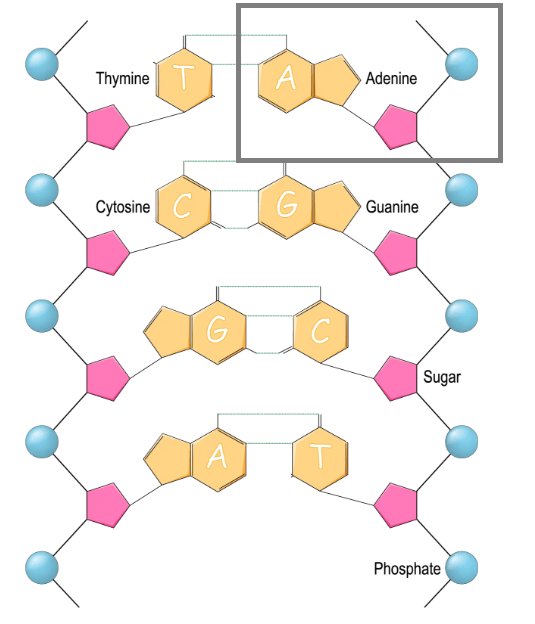
nucleotide