Climate vs Weather
Factors that influence climate
Greenhouse effect
Effects of global warming
Experimental design
100
This refers to the short-term condition of the atmosphere
Weather
100
What feature of the Earth is in primarily responsible for the Earth's Seasons?
Earth's tilt and curvature
100
List some greenhouse gases (4 of them)
Methane (CH4), Carbon dioxide (CO2), Nitrous oxide (N2O), Water vapour (H2O), Ozone (O3). Any 4
100
What is the definition of the permafrost
Land/soil that has been frozen all year round (for more than two years).
100
What is the variable that you deliberately change (usually presented on the x axis)?
Independent variable
200
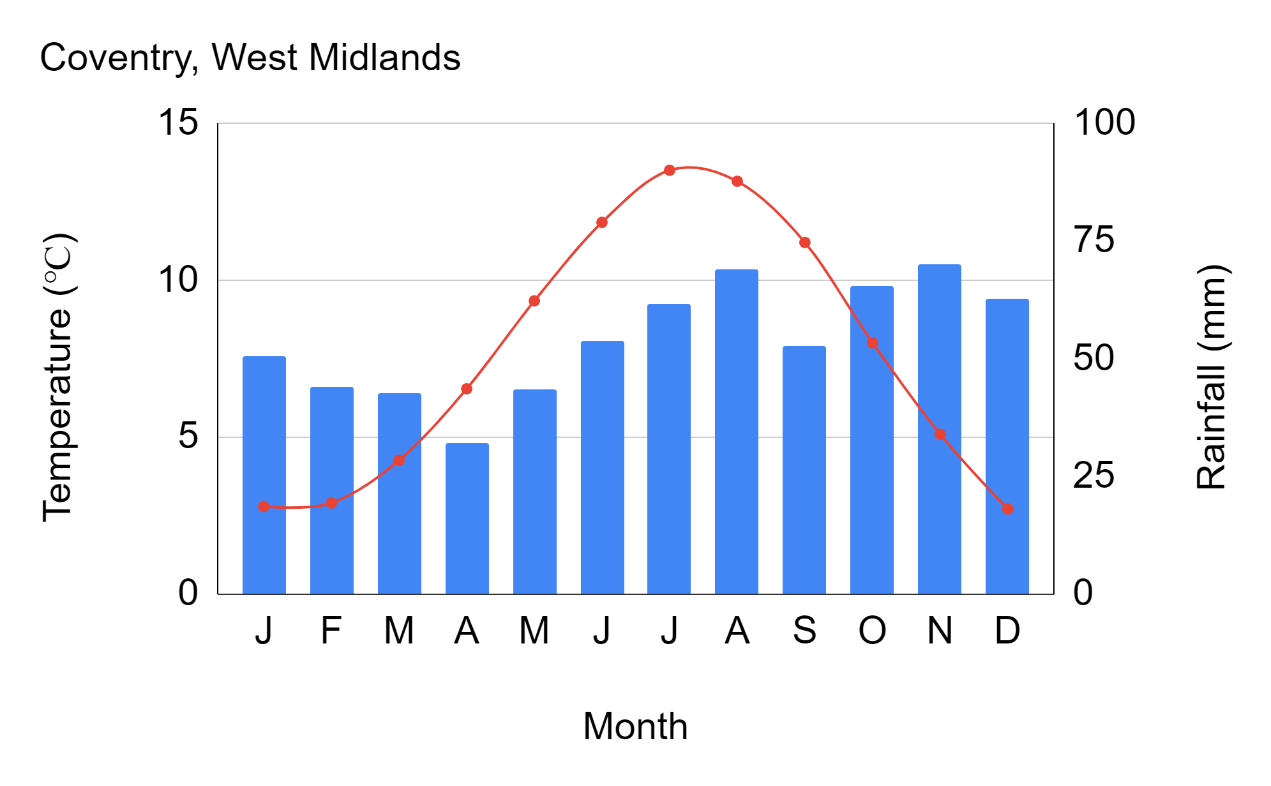
What months have the lowest rainfall?
April
200
Coastal areas often have milder temperatures than inland areas because water _____________.
has a higher specific heat capacity
200
Define enhanced greenhouse effect
Accelerated warming of Earth due to anthropogenic (human-caused) emissions of greenhouse gases like methane and carbon dioxide, e.g., combustion of fossil fuels
200
Explain how desertification and global warming is linked (in your explanation define desertification and use the term "positive feedback".
Desertification is the process by which soil degrades and vegetation in drylands decreases due to human activities.
Plants are net carbon sinks, so when vegetation decreases, less carbon is removed from the atmosphere. More CO₂ stays in the air, enhancing the greenhouse effect and trapping more heat. This extra warming increases drought, which causes even more vegetation loss — a positive feedback loop
200
In an experiment testing how temperature affects the rate of evaporation, what is the independent variable?
temperature (or amount of heat)
300
A student notices that this week has been hotter than last week. She remembers that climate looks at trends over time, so she concludes this must be evidence of climate change. Explain why her conclusion is incorrect.
Her conclusion is incorrect because she is only comparing two weeks of weather data, which is still short-term weather, not climate. Climate change is identified using long-term patterns in weather over many years or decades, not just a hotter week.
300
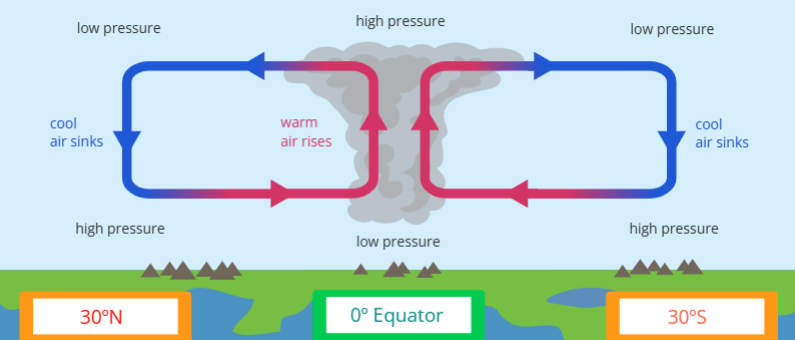 The diagram shows convection cells around the equator, describe how this creates the climate zone of rainforest and deserts.
Warm, moist air rises at the equator, cools, and condenses to form heavy rainfall, creating rainforests. The air then moves away, sinks around 30° north and south, warms up, and becomes dry, which creates deserts.
300
Is the greenhouse effect caused because greenhouse gases trap incoming sunlight? Explain.
No. Most incoming sunlight passes through the atmosphere. There are some that are reflected by reflective snow and clouds. Greenhouse gases trap infrared radiation that is re-radiated by Earth’s surface (terrestrial radiation).
300
A student says, “Global warming only affects temperature.” Is this true? Explain.
Global warming also causes sea levels to rise, disrupts ocean currents, leads to more extreme weather, increases drought and desertification, thaws permafrost, and makes the oceans more acidic (lower pH)
300
In an experiment, you wanted to measure how much volume of water is displaced by placing a block of ice cube (10ml) in it.
Here are the results: 8.2 ml, 8.3 ml, 8.1 ml.
Is your result precise, accurate, or both? In your response, define precision and accuracy as well.
The measurement is precise but not accurate.
Accuracy refers to how close a measurement is to the true or accepted value. In this case, the volume displaced is much less than the ice cube placed, so the result is not accurate.
Precision refers to how close a set of measurements are to each other. The results collected are quite similar with the range of 0.2 ml.
400
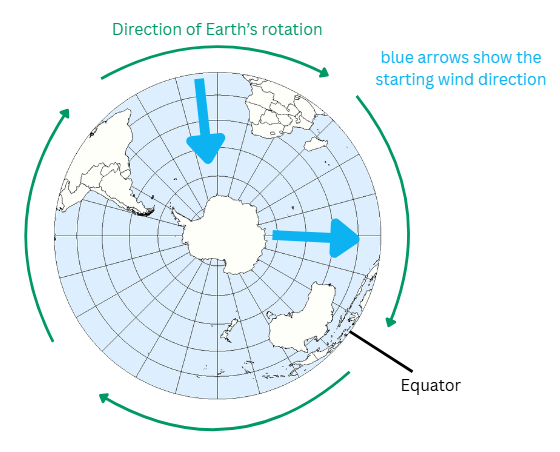
Draw the curved wind directions for the two wind patterns shown. Explain your answer using the definition of the Coriolis effect.
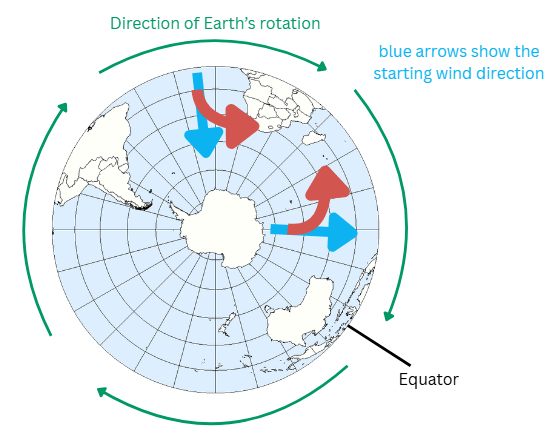
Note: This view is of the southern hemisphere. Wind or currents moving from the equator towards the poles (north or south) will curve eastward, while wind or currents moving from the poles towards the equator will curve westward. This is caused by the Coriolis effect, which deflects the paths of wind and ocean currents as they move between places with different rotational speeds. The Earth rotates faster at the equator than it does at the poles, so moving air or water maintains the speed of its starting latitude and appears to curve when it reaches regions rotating at a different speed.
400
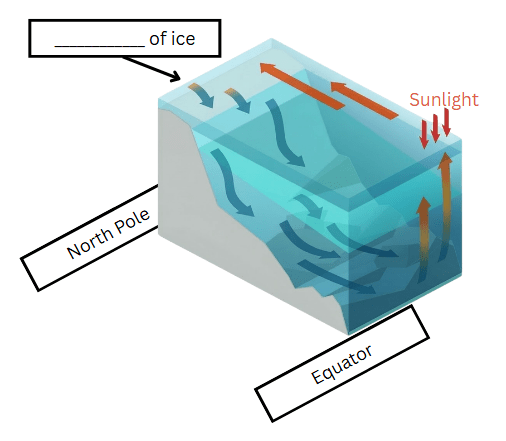 Fill in the missing blank and define what thermohaline circulation means.
Freezing of ice (leaves salt behind since ice is only fresh water) causing the water around to be saltier and denser.
Thermohaline circulation is the movement of deep-ocean current driven by density differences that drives the global conveyor belt. It is controlled by temperature and salinity. Cold and salty water sinks in the polar regions. As the water moves towards the equator, it starts to warm up and become less salty and thus rise.
400
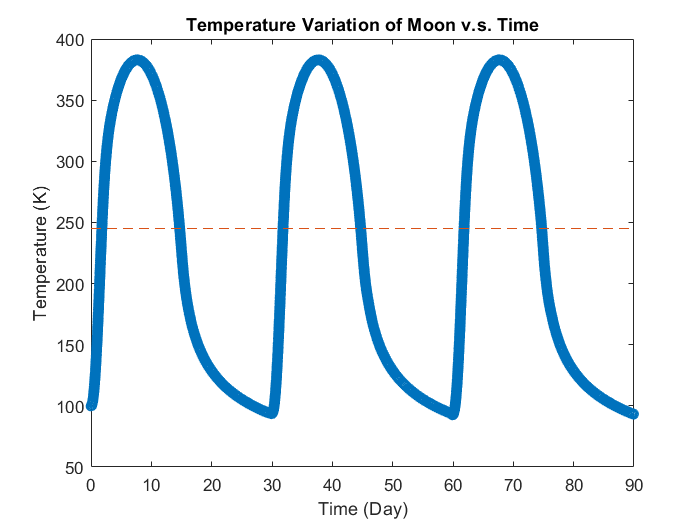
This graph shows you the temperature of a single location on the moon across 90 days (3 months). Can you explain the pattern you notice and use the word greenhouse gas in your explanation.
The graph shows temperature being very hot for about two weeks and then very cold for about two weeks. This happens because the Moon has no atmosphere and no greenhouse gas to trap heat. So, when the Sun is shining on that location, it heats up very quickly, and when the Sun sets, the heat escapes straight into space and the temperature drops just as quickly.
Bonus point: Mention the lack of ozone and clouds means that light is actually going to be absorbed more, causing it to heat up a lot when the location is in sunlight.
400
Does melting glaciers affect sea level? What other effect does melting ice have on the ocean beside sea level?
Land ice adds extra water to the ocean when it melts increasing sea level. Melting ice adds fresh water (low salinity) to the ocean which can affect the thermohaline circulation of the ocean (disrupting the global conveyor belt).
Note: sea ice melting does not change sea level as much since the ice is already floating and has already displaced the water.
400
Why is it important to only change one variable at a time? What are the variables that you don't change called?
Changing only one variable at a time (the independent variable) ensures a fair test, allowing you to directly link changes in the result (dependent variable) to that independent variable.
The other variables kept constant are called controlled variables, and they ensure that any changes in the dependent variable are caused by the changing independent variable only. This improves the experiment's validity and accuracy.
500
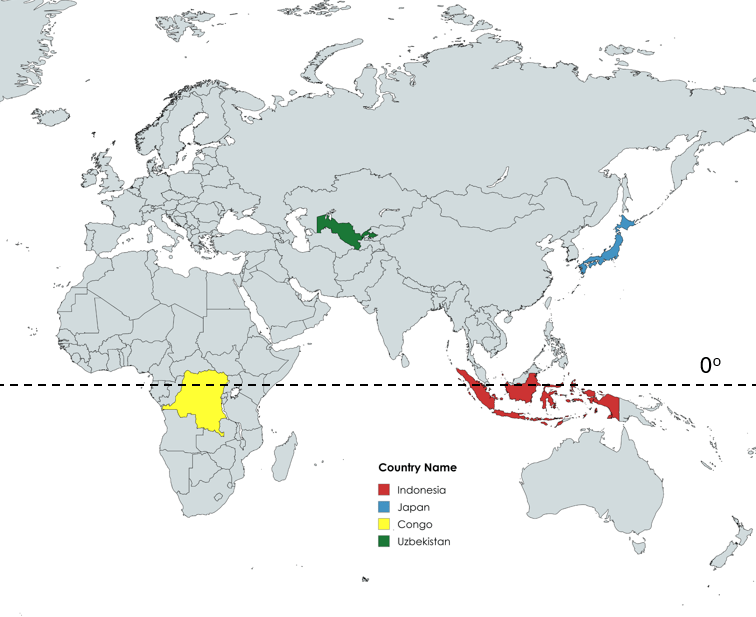
Identify whether the following statements are true or false and briefly explain why
a. Japan would have a larger temperature range than Indonesia throughout the year
b. Uzbekistan would experience more rain than Indonesia
c. Congo would experience very cold nights and very hot days since it is a continental country
a. True Japan has four seasons with hot summers and cold winters. Indonesia is near the equator, so temperatures stay almost the same all year.
b. False Uzbekistan is mostly arid with very low rainfall. Indonesia is tropical and receives heavy rain year‑round.
c. False Even though Congo is a continental country, it is in the tropics with a lot of clouds. The clouds reflect sunlight during the day and traps infrared during night to help regulate temperature to keep it relatively mild
500
Explain why the polar regions, such as the Arctic and Antarctica, are much colder than most other places on Earth.
The poles are much colder because of their high latitude, which means they receive less direct sunlight. The Sun’s rays hit at a lower angle, so the energy is spread over a larger area and provides less heating. In addition, the ice and snow at the poles have a high albedo, so they reflect a lot of incoming solar radiation back into space instead of absorbing it.
500
Explain how clouds can both increase and decrease Earth’s temperature at different times of day.
During the day, clouds can decrease temperature by reflecting some of the Sun’s incoming radiation back into space because they have a high albedo. During the night, clouds can increase temperature by trapping some of Earth’s outgoing infrared radiation. This happens because clouds contain water vapour and water droplets, which help keep heat in the atmosphere.
500
Explain what ocean acidification is and what causes it. Why is ocean acidification harmful to organisms such as corals and shellfish?
use the term carbon sink in your answer
Ocean acidification is the process where the ocean becomes more acidic because it absorbs more CO2 from the atmosphere. The ocean acts as a carbon sink, meaning it takes in and stores some of the CO2 from the atmosphere. When this CO2 dissolves in seawater, it forms carbonic acid (which lowers the ocean's pH)
Ocean acidification is harmful to organisms such as corals and shellfish because it makes it more difficult for them to build and maintain their calcium carbonate shells and skeletons. This can also disrupt ocean ecosystems.
500
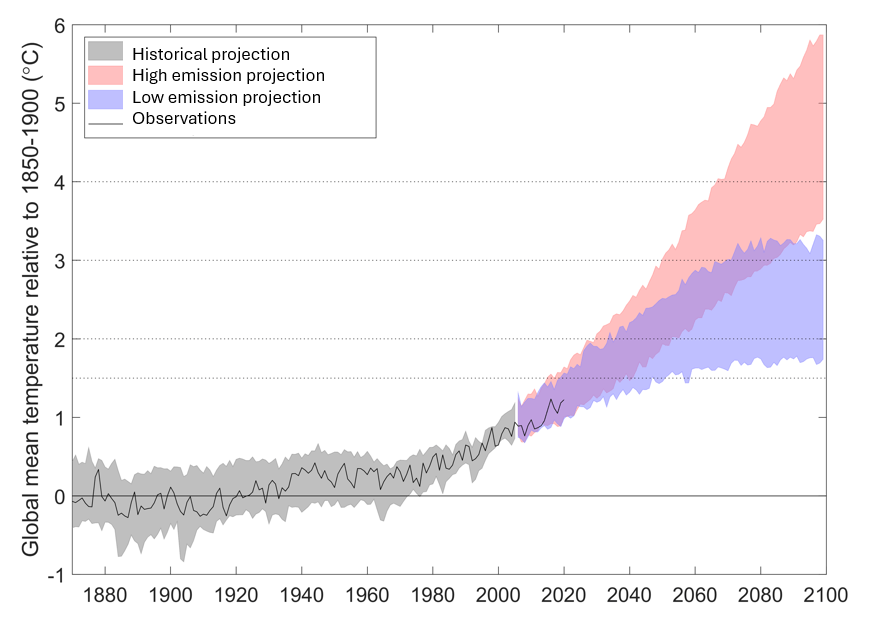
Is this climate model accurate? Explain how you can tell from the graph.
If all three projections come from the same experimenter running the model multiple times, is the model precise in the year 2000? Explain your reasoning.
If the three lines come from different experimenters using different models, can you determine whether the model is precise? Why or why not?
1. Yes. You can tell because the historical model line closely matches the observed past temperatures—so it hits the “true” values.
2. Yes. In 2000 the different runs sit very close together, so repeated trials give almost the same result → high precision.
3. No. The spread now shows how different models disagree, not how repeatable any one model is, so you can’t judge precision. Precision is about how repeatable the results are.