The 2 Nucleic Acids for All Living Organisms
Transcription
Translation
Diagrams
True or False
100
This nitrogenous base is only used in RNA
Uracil
100
This site needs to be found along the DNA strand in order for RNA polymerase to bind and start synthesizing
promoter/promoter sequence
100
This type of RNA is a subunit of the ribosome and reads the codon in order to match it to the proper anti-codon
rRNA/ribosomal RNA
100
What process is depicted in this diagram?
Transcription
100
RNA and DNA are both nucleic acids that form a double helix.
False, DNA is a double helix, RNA is a single helix
200
RNA and DNA are made up of the monomers; nucleotides which bond together to form ___________ _________
Nucleic Acids
200
This enzyme is responsible for adding free nucleotides to the growing mRNA chain
RNA polymerase
200
The end product of translation is ______________
polypeptide chain/protein
200
What process is shown in the diagram below?

Translation
200
The 3 base sequence that is attached to the tRNA is called the codon sequence.
False, the 3 base sequence on tRNA is the anticodon.
300
The "backbone" of DNA and RNA are made up of ____________ and ____________
Sugar and phosphate
300
Copying the genetic code of DNA in order to instruct protein synthesis is done by which molecule?
mRNA
300
Which amino acid is produced from the codon CCU?
Proline
300
What is the anticodon sequence that is shown in the diagram below?
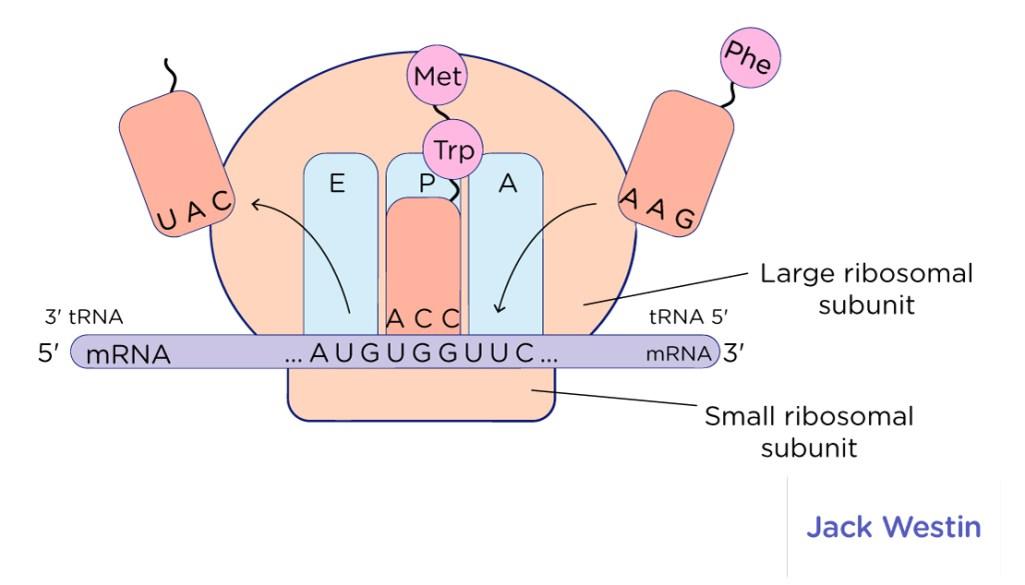
ACC
300
The leading strand is what synthesizes the mRNA strand
False, it is made by the template strand.
400
This sugar is only found in RNA
Ribose
400
These pieces are spliced out of the mRNA to give a final processed mRNA strand
Introns
400
Which codon is always used as the starting codon for translation?
Methionine
400
What is the established belief that is shown with the diagram below?
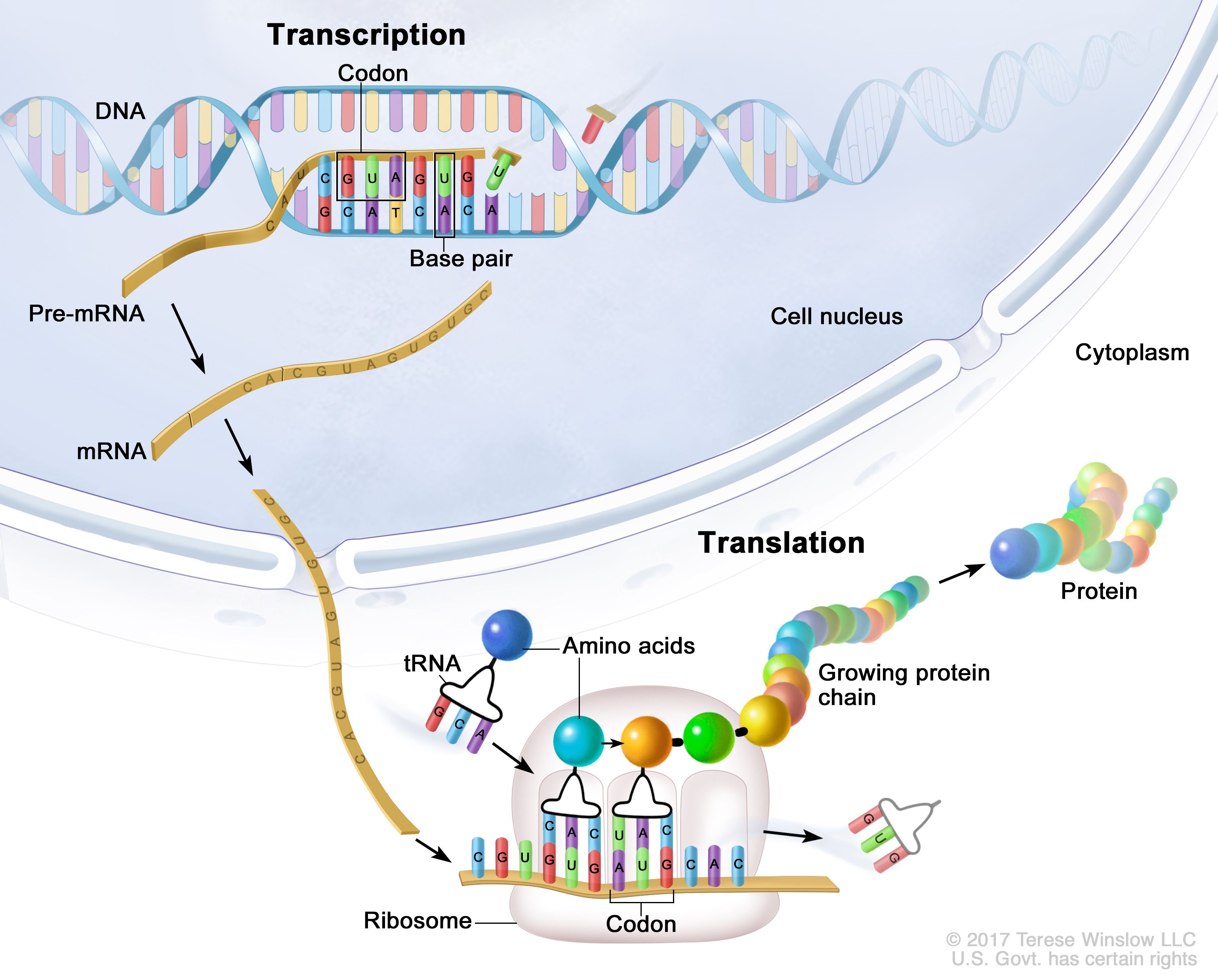
DNA to RNA to protein/Central Dogma of Biology
400
Translation occurs in the nucleus.
False, translation occurs in the cytoplasm, transcription occurs in the nucleus.
500
What are the 3 different types of RNA?
messenger RNA (mRNA)
transfer RNA (tRNA)
ribosomal RNA (rRNA)
500
These bonds are broken in the DNA in order to perform transcription, they are reformed after transcription is complete
Hydrogen bonds
500
The amino acids produced in translation bond together through _________ bonds to form a polypeptide chain.
peptide
500
What is the chain called that is produced when amino acids form peptide bonds?

Polypeptide chain
500
The anticodon is a 3 base code found on the mRNA strand that specifies which amino acid is added to the growing amino acid chain.
False
1000
List 3 differences between DNA and RNA.
1. Different sugars. DNA=deoxyribose, RNA=ribose
2. Structure: DNA=double stranded, RNA=single stranded
3. Nitrogenous bases: DNA=A, C, G, T, RNA=A, C, G, U
1000
What does the processed mRNA strand need to pass through in order to leave the nucleus and enter the cytoplasm?
Nuclear Pore
1000
Which 3 base sequence is read to specify the amino acid that attaches to the tRNA molecule?
Codon, found on mRNA strand
1000
 What biological theory is being represented in this diagram? DNA-->RNA-->Protein.
Central Dogma of Biology
1000
rRNA is a subunit of the ribosome that reads the codon to determine which amino acid is added to the polypeptide chain.
True