Significant Figures and Calculations
Sci Notation, Metric Conversions, Density
Properties of Matter
Elements, Compounds, Mixtures
Physical/Chemical Properties + Changes
Wild Card
100
70,000.90 min
is how many significant figures?
7
100
How many meters are in 1 km?
1000 m
100
If a substance is in a liquid state, what will you see in parenthesis next to the substance?
(l)
100
Element, Compound, or Mixture:
CuCl2
Compound
100
All of the following are physical properties of a substance in the liquid state except
indefinite volume nearly incompressible
definite mass indefinite shape
indefinite volume
100
Name one of Ms. Gladden's dogs:
Paisley, Copper
200
Name the three rules for 0's when determining significant figures
(sandwiched, leading, trailing)
1. All sandwiched zeroes are significant
2. Leading 0's are never significant
3. Trailing 0's are only significant if there is a decimal in the number
200
how many centimeters are in 1 m?
100 cm
200
which indicates an intensive property? mass of iron in your blood, %N2 in the air, volume of water in a bottle, how many calories in a sandwich
%N2 in the air
200
Which of the following is NOT a mixture
1. air
2. tea
3. sand
4. Pure Water (H2O)
Pure water
200
Crushing, grinding, dissolving are examples of:
physical changes
200
Report to the correct significant figure:
3.431 - 2.6
0.8 (decimal place!)
300
0025.0 is how many significant figures?
3
300
What is the density of an object that has a mass of 10.0 grams, a height of 10.0 cm, length of 1.0 m, and width of 0.0014 km
10/ (10 x 100 x 140) = 7.1 x 10⁻⁵ g/cm3
300
This is a heating curve for a substance. Between points X and Y, which would be observed?
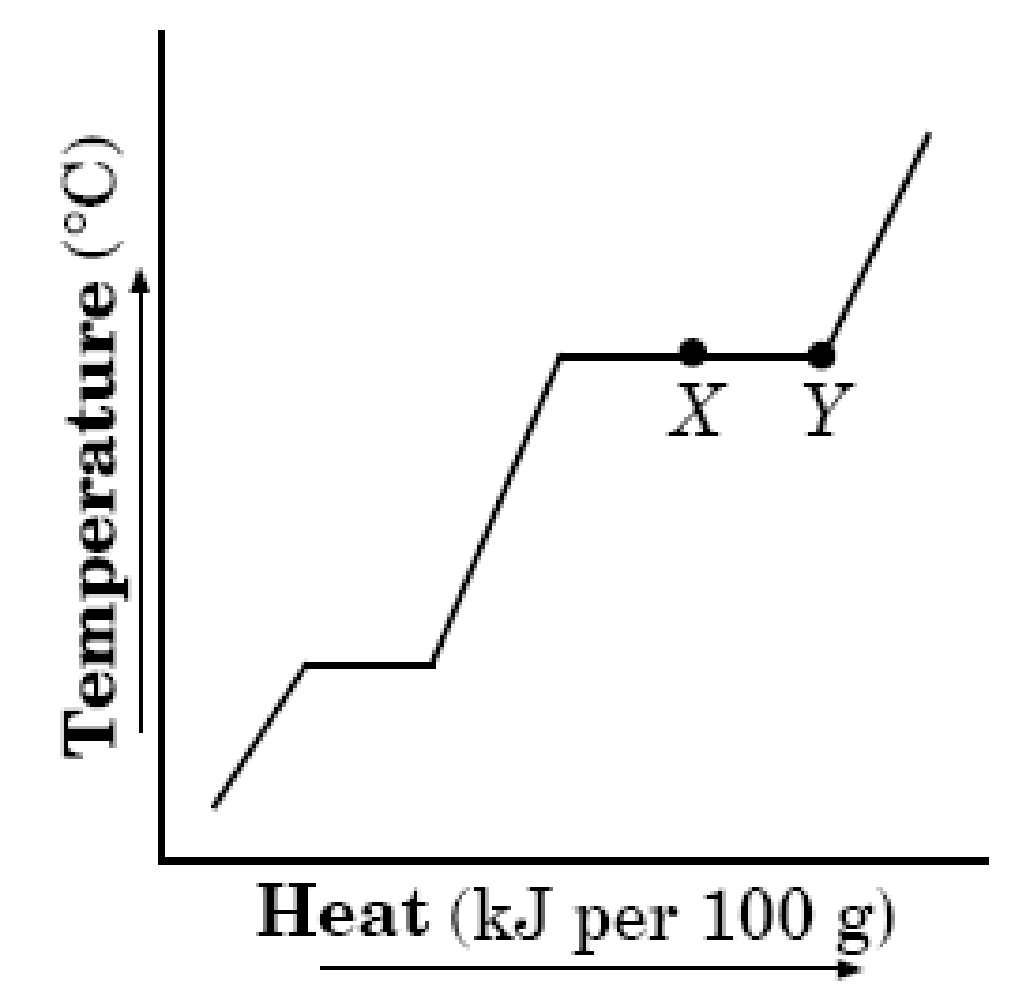
both liquid and gas
300
A substance that is made up of two or more substances but is NOT chemically combined is a __________________.
mixture
300
Flammability and Reactivity are examples of:
Chemical Properties
300
The amount of SPACE a gas takes up is its:
volume
400
A metal cylinder with a mass of 7.12g has a volume of 18 cm3. What is the density of the cylinder? (reported to the correct # of significant figures)
7.12/18 = 0.40 g/cm3 (two significant figures)
400
The mass of a sample of CaCl2 was measured to be 14.5 g. What is the mass in milligrams? (use dimensional analysis and report the final answer in scientific notation)
14.5 g x 1000 mg/1 g = 1.45 x 10⁴ mg
400
Which is NOT a physical property of water?
It has a boiling point of 100ºC.
It is a colorless liquid.
It is composed of hydrogen and oxygen.
Sugar dissolves into it
3
400
Which of these diagrams illustrate a pure substance?

middle, all the same. The others are mixtures
400
True or False
Water is colorless is an example of an extensive physical property.
False - its intensive no matter how much water you have, it will always be colorless!
400
you work in a lab and need to make a solution that holds 5 liters of liquid. You find a container that is 60.0 cm x 10.0 cm x 10.0 cm.. would this be a sufficient container to make the solution?
this would hold 6000 cm3 which is the same as 6000 mL... and 6 Liters. This would be sufficient
500
The initial volume of water was measured with a graduated cylinder at 20.00 mL. An unknown cylinder was placed in graduated cylinder and the final volume was 24.00 mL. The mass was measured to 29.24 g. What is the density (to the correct sig fig)?
7.31 g/mL or g/cm3
500
An experiment requires 24.5 g of ethyl alcohol (density = 0.790 g/mL). What volume of ethyl alcohol, in liters, is required?
24.5/0.790 = 31.0 mL = 0.0310 L
500
The phase change that occurs when a solid turns directly into a gas is:
sublimation
500
Which of the following represents COMPOUNDS only:
1. CO2, H2O, NH3
2. H2, N2, O2
3. H2, Ne, NaCl
4. MgO, NaCl, O2
1. CO2, H2O, NH3
500
True or False:
The metal has a mass of 75 g is an intensive property.
False, extensive because the more that is added, the more mass it will have
500
A material will float on the surface of a liquid if the material has a density of less than that of the liquid. Given that the density of water is approximately 1.00 g/mL, will a block of material having a value of 5.0 liters and having a mass of 500 grams float or sink when placed in a reservoir of water?
it would float being the the density t is 0.1 g/mL (cm3) which is less than water