Process of Science
Organization of Life
Chemistry of Life
Macromolecules
Cell Structure
Cell Function
100
The first step of the scientific method
Observation
100
The smallest unit of life
What is a cell
100
A molecule that has a partially negatively charge side and a partially positive charged size is called a __________ molecule.
polar
100
A large organic molecule that makes up living organisms.
Macromolecule
100
What are the two big categories of cell types.
1.) Prokaryotes
2.) Eukaryotes
100
These structures speed up chemical reactions in cells.
Enzymes
200
The group in an experiment that does not receive the treatment.
control group
200
An organism that can convert inorganic substances to energy.
producers and/or autotrophs
200
The atomic number represents number of _____________ found the atoms of a specific element.
Protons
200
The monomer for nucleic acids
nucleotides
200
List one thing all cells have
Membranes, ribosomes, DNA, Cytoplasm
200
Diffusion of water across a membrane
osmosis
300
Variables that are kept the same between the control and experimental groups.
Constant Variables
300
Meat-eating carnivores have teeth for tearing and skulls capable of biting with great force, while the plant-eating herbivores have teeth and skulls equipped to grind tough vegetation. This is an example of how in biology of the importance of the relationship between...
Structure and function
300
The number of bonds an atom can make depends on
the number of electrons in the outer shell (the valence shell)
300
1. ____________________ reactions bring monomers together to build polymers.
2. ____________________ reactions break the bonds between monomers.
1. Dehydration
2. Hydrolysis
300
Which organelle dysfunction would likely cause a cell to accumulate toxic substances and result in cell damage due to impaired digestion of damaged organelles and foreign substances?
lysosomes
300
List the three factors that can impact enzymatic activity.
1.) amount of substrate
2.) competitive inhibition
3.) non-competitive inhibition
400
A framework of hypothesis in science that are widely accepted and supported by many different lines of evidence. aka repeatedly tested and never disproven.
Theory
400
Name 3 out of the 8 criteria for being considered alive.
1. Order
2. Made of at least one cell
3. Can reproduce using DNA
4. Can grow and develop
5. Can sense and respond to the environment
6. Obtain and use energy
7. Maintain homeostasis
8. Populations can evolve
400
If an uncharged atom has 11 protons and it transfers and electron to another atom forming and ionic bond, what is atom's charge after this bond forms?
positive
400
Name one example of the biological significance of carbohydrates discussed in class.
- energy storing molecule
- structural support for cells
400
What are the 3 assumptions of cell theory:
- All living things are made up of at least one cell
- All cells come from existing cells
- All cells contain the hereditary material that they pass on to new cells during division
400
A red blood cell has a 0.9% solute concentration, but the surrounding environment has lost a lot of water and now has a 1% solute concertation. Which direction do we expect water to flow? What is going to happen to the cell?
1. Water will flow out of the cell.
2. The cell will shrivel.
500
You want to know if fertilizer impacts tomato crop yield. You plant to identical crops, but on one you add fertilizer and on the other you do not. After the growing season you count tomatoes on both.
What are the independent and dependent variables in this scenario?
IV: Fertilizer
DV: Crop yield (# of tomatoes)
500
The tree in your backyard is home to two cardinals, a colony of ants, a nest of wasps, two squirrels, and millions of bacteria. Together, all of these living organisms represent.
What is a community?
500
An atom has an atomic number of 6, how many electrons does it have on its outer most electron shell?
4
500
Name the 4 categories of lipids discussed in class
fatty acids, triglycerides, steroids, phospholipids
500
What three organelles in a eukaryotic cell work together to produce and transport proteins?
Nucleus, ER, Golgi apparatus
500
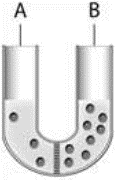
Side A is in what state compared to side B?
Hypotonic state