States of Matter
Relationships and Patterns
Chemical Reactions
Exothermic and Endothermic Reactions
Grab Bag!
100
Define potential energy. (Page 17)
Potential energy is stored energy due to the interactions between particles or objects.
100
Explain the relationship between states of matter and kinetic energy. (Page 16)
Particles in solids have the least amount of kinetic energy. Gas particles have the most.
100
Which side of the arrow in a chemical equation are the PRODUCTS typically located? (Page 148)
The right side of the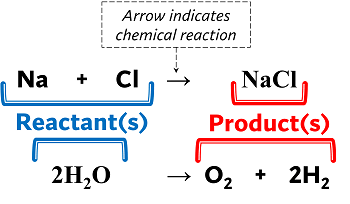 equation.
100
All combustion reactions are considered exothermic or endothermic reactions? (Page 166)
Exothermic
100
Define volume. (Page 117)
The amount of space an object takes up (whether it is solid, liquid, or gas)
200
What kind of energy does temperature measure? (Page 16)
Kinetic energy
200
Explain the relationship between state of matter and attractive forces (Page 17)
As particles move farther apart (like in a gas), the attractive forces between the particles decrease, and as the particles move closer together (like in a solid), the attractive forces between the particles increase,
200
Give a NON-EXAMPLE of a chemical reaction.
Answers vary, but could include physical changes like a melting ice cube or boiling water.
200
What does the prefix 'exo-' mean?
Outside, external, out of
200
Describe the difference between an atom, an element, and a compound. (Pages 19-20)
An atom is a small particle that is the building block of matter.
An element is a substance made of only one type of atom.
A compound is when atoms of two or more different element are bonded together.
300
In terms of shape, which state(s) of matter have NO definite shape? (Page 11)
Liquids and gases
300
Describe the relationship between volume and temperature. (Page 36)
Charle's law states that the volume of a gas increases with increasing temperature, if the pressure is constant.
300
How many molecules AND how many atoms are on the REACTANTS side of this chemical equation? 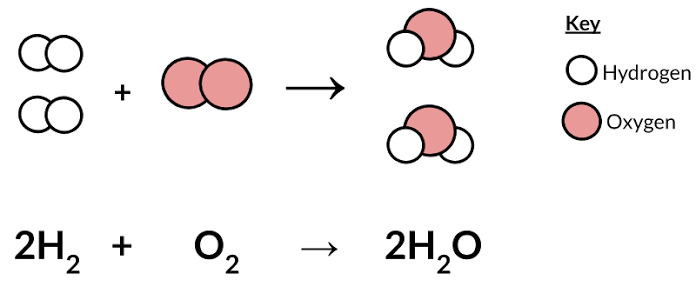
Three molecules, six atoms
300
Define the Law of Conservation of Energy (Page 171)
The law of conservation of energy states that even though energy is always transferring, energy is not created and energy is not destroyed.
300
When a cut apple is left out and starts to brown, is this a chemical reaction? Why or why not?
It is a chemical reaction because the apple's flesh is reacting to the oxygen in the air (and a color change occurs, which can be evidence of a chemical reaction).
400
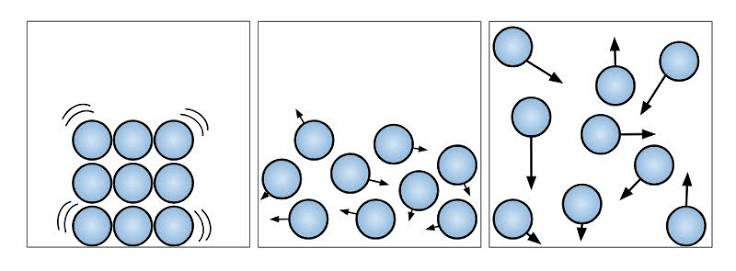
Draw an image showing the particle movement of a solid, a liquid, and a gas.
In a solid, particles are very close to one another and vibrate in place. In a liquid, particles flow around each other. In a gas, particles are widely spaced and move around randomly at high speeds.
400
DOUBLE JEOPARDY! Draw a graph depicting Boyle's Law and describe the relationship/pattern it represents. (Page 62)
The pressure of a gas increases if volume decreases, and the pressure of a gas decreases if the volume increases (assuming temperature is constant). 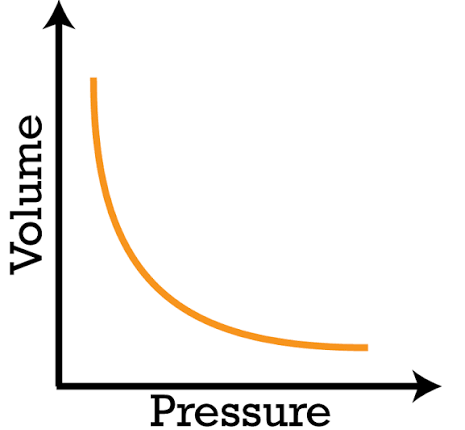
400
Is dissolving salt in water an example of a chemical reaction? Explain why or why not.
It is NOT an example of a chemical reaction because the properties of the salt do not change (it is still salt).
400
When a chemical bond is broken, is energy ABSORBED or RELEASED? (Page 163)
Absorbed
400
Describe the relationship between temperature and pressure in a closed system. (Page 45)
A decrease in temperature decreases the pressure of a gas in a closed system (like in a closed bottle).
500
In the chemical equation below, how many MOLECULES of oxygen are there, and how many atoms are in each molecule? 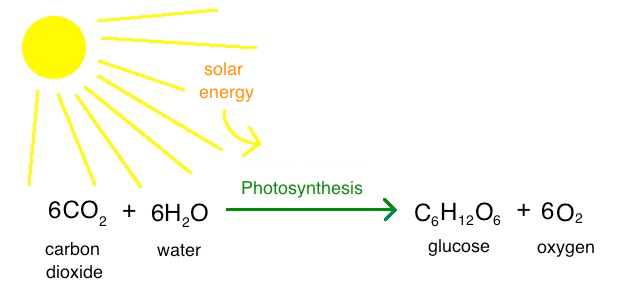
There are six molecules of oxygen (on the products side), and two atoms of oxygen in each molecule.
500
Predict what would happen if you were to blow up a balloon at room temperature, tie it, then place the balloon in a tub of heated water.
The balloon would expand.
500
Give me THREE examples of observations that could be evidence of a chemical reaction.
Possible Answers Include:
- heat or light being produced
- color changing
- a new smell forming
- a new solid forming
- gas bubbles appearing
500
Give an example of an ENDOTHERMIC reaction. (Page 166)
Answers will vary
500
DOUBLE JEOPARDY! What state of matter does vaporization and evaporation start AND end as, and what is the difference between evaporation and vaporization? (Page 48)
Vaporization and evaporation start as a liquid and end as a gas. Evaporation is vaporization that occurs only at the surface of a liquid.