The Atom (Structure & History)
Periodic Table
EELD & Bohr Diagrams
Ions, Isotopes & Molecules
Naming & Formulas
Bonus
100
Matter is Made entirely up of _______________
Atoms!
100
Who is the father of the Periodic Table? What is the pattern that he noticed called?
Dmitri Mendeleev & the pattern he noticed is the Periodicity of elements!
100
Draw the EELD Diagram for:
Potassium & Chlorine Atoms
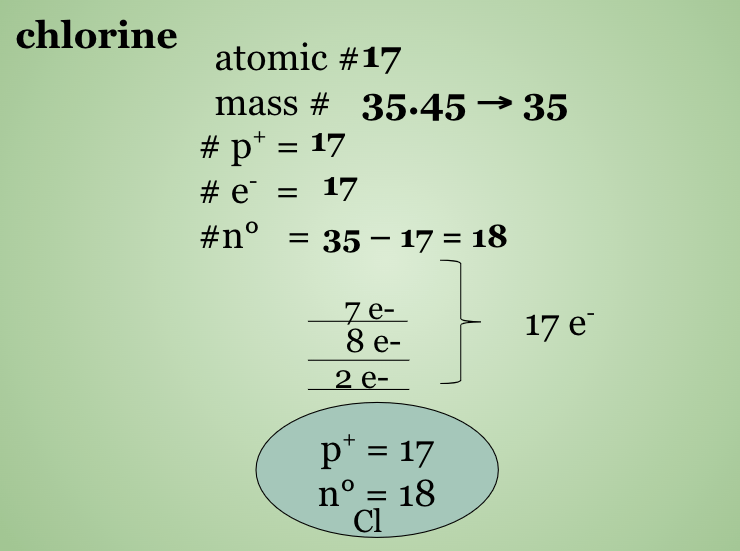
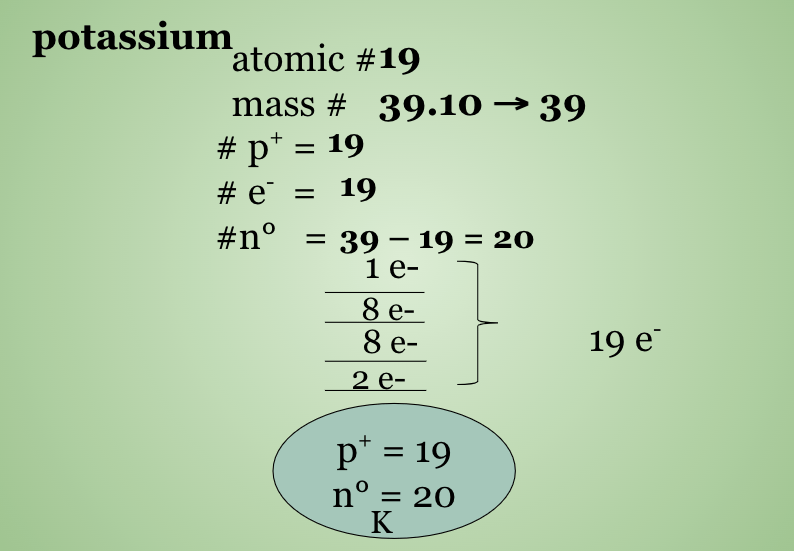
100
What is an Ion? What is an Isotope?
Ions:
Ions are atoms or groups of atoms that have a net charge --> the number of p+ and e− are not equal
Isotopes:
atoms that have the same number of protons but a different number of neutrons
100
Name the Ion for the following elements:
Na, Ir, Ge & F
Na2+ = Sodium Ion
Ir4+ = Iridium Ion
Ge4+ = Germanium Ion
F- = Fluoride Ion
100
What highschool in Calgary did Tate McRae go to?
Western Canada Highschool!
200
Choose one Scientist and tell me:
- Their Name
- Their Atomic Model Name
- The Key Points to their Theory
John Dalton - Billiard Ball/Solid Sphere Model:
- All matter is made up of atoms, which are indivisible (cannot be split further) solid spheres.
- All atoms of a given element are identical in mass and properties.
- All compounds are combinations of different types of atoms.
- A chemical reaction is a rearrangement of atoms - the atoms themselves are not changed.
JJ Thomson - Plum Pudding Model:
- Showed that all atoms contain tiny negatively charged particles, which were named called electrons - this was the first model to include subatomic particles (particles smaller than atoms).
- Proposed the analogy that the atom was similar to a ”pudding” of positive charge, occasionally dotted with very small “plums” of negative charge.
Ernest Rutherford - Nuclear Model:
- Rutherford’s model challenged Thomson’s idea that the positive charge is a big cloud - instead, it had to be much smaller, and much more dense
- The first model to to suggest that the atom’s positive charge is concentrated in a small nucleus (that’s why it’s the nuclear model) orbited by electrons. --> This suggested the existence of a second subatomic particle - protons.
- In 1932, Rutherford and his colleague James Chadwick gave evidence that the nucleus also contains subatomic particles with no charge - neutrons.
Niels Bohr - Planetary/Energy Level Model
- Bohr’s major change to Rutherford’s model was the addition of energy levels (or shells) for electrons. --> Electrons only orbit the nucleus at specific distances, and do not exist between these levels.
- Each energy level can only hold a fixed, limited number of electrons. If one level is full, then electrons will fill a higher level.--> Electrons that absorb energy can be be temporarily excited to a higher energy level, and they emit energy as they return to their original level.
200
Groups 1, 2, 3-12, 17 & 18 are called?
1. Alkali Metals
2. Alkaline-Earth Metals
3-12. Transition Metals
17. Halogens
18. Noble Gases
200
Draw the Bohr Diagram for:
Mg & Ar Atoms
Magnesium:
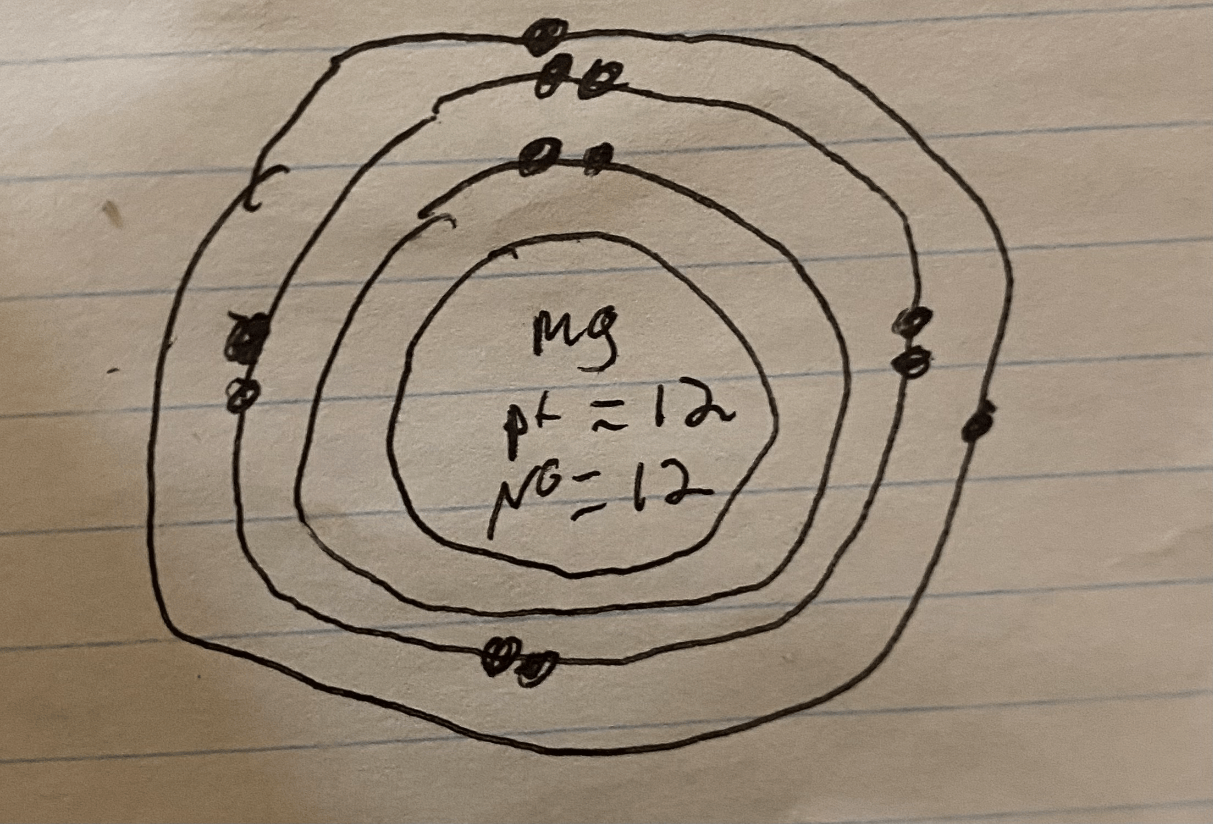
Argon: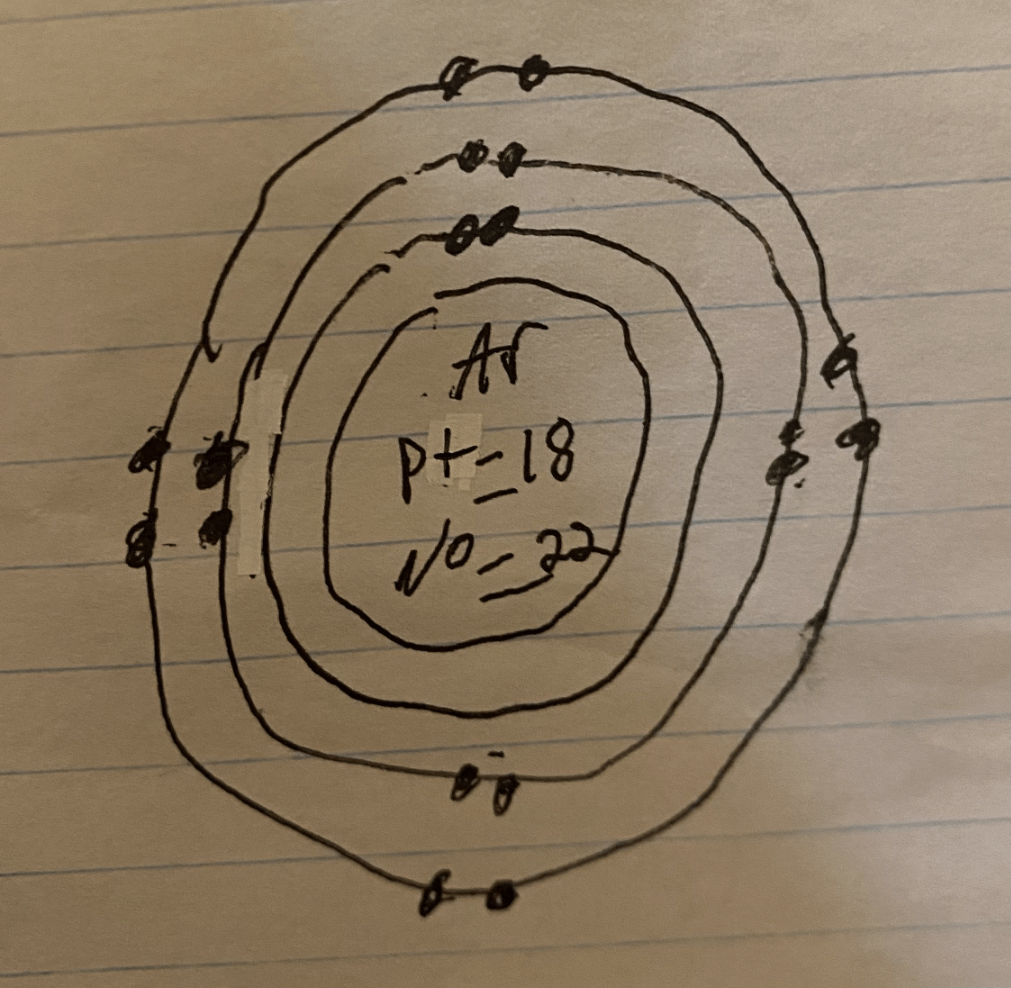
200
Ions of Sodium bond to Ions of Chloride using what type of bonds?
Molecular compounds are bonded together using what type of bonds?
Ionic Bonds
Covalent Bonds
200
Name or provide the formula for the following Ionic Compounds:
- K3N
- Calcium Phosphide
- RaCl2
1. Potassium Nitride
2. Ca3P2
3. Radium Chloride
200
What year was Wifi invented?
1997, but it did not get the name wifi until the year 2000!
300
What subatomic particles are located within:
1. in the nucleus
2. in the cloud region (within energy levels)
Also what charges do each type of subatomic particle have?
1. Neutrons (Neutral) & Protons (Positive)
2. Electrons (Negative)
300
Label Everything on this square except the number directly above Pt (2.2)
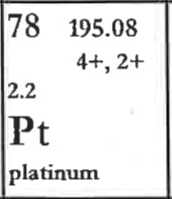
78 = Atomic Number = # of electron = # of protons
195.08 = Atomic Mass (g/mol)
4+, 2+ = Ionic charges (1st charge listed is most common)
Pt = Element Symbol
Platinum - Element Name
300
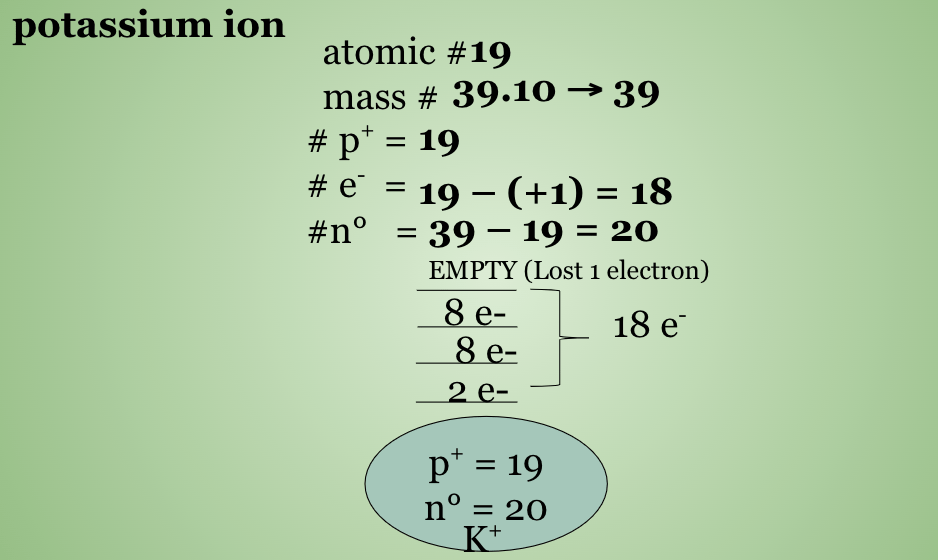
Draw the EELD for the K & Cl Ions:
Potassium Ion (K):
Chloride Ion (Cl): 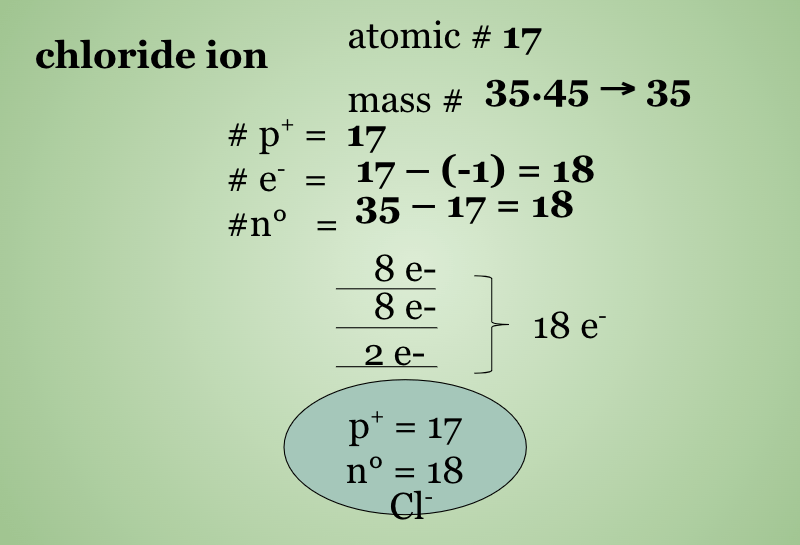
300
What is the Atomic Structure of the Isotope Bismuth - 224
Atomic # = 83
Isotope atomic mass = 224 g/mol
# protons & electrons = 83
#neutrons = 224 - 83 --> 141 neutrons
300
Name or provide the formula for the following Ionic compounds:
1. V2S4
2. titanium (III) selenide
3. CoF3
1. Vanadium (IV) Sulfide
2. Ti2Se3
3. Cobalt (III) Fluoride
300
Name three countries that start with J!
Japan, Jordan & Jamaica
400
What is the atomic structure of an atom of Silver and and atom of Gold ?
(atomic mass, atomic number, # protons, electrons & neutrons)
Silver: atomic number = 47
atomic mass = 107.87 g/mol
# protons & electrons = 47
# neutrons = 107.87 g/mol - 47 protons --> 61 neutrons
Gold: atomic number = 79
atomic mass = 196.97 g/mol
# protons & electrons = 79
# neutrons = 196.97 g/mol - 79 protons --> 118 neutrons
400
Name these Polyatomic Ions:
ClO3-, H2PO4- & S2O32-
1. Chlorate
2. Dihydrogen Phosphate
3. Thiosulfate
400
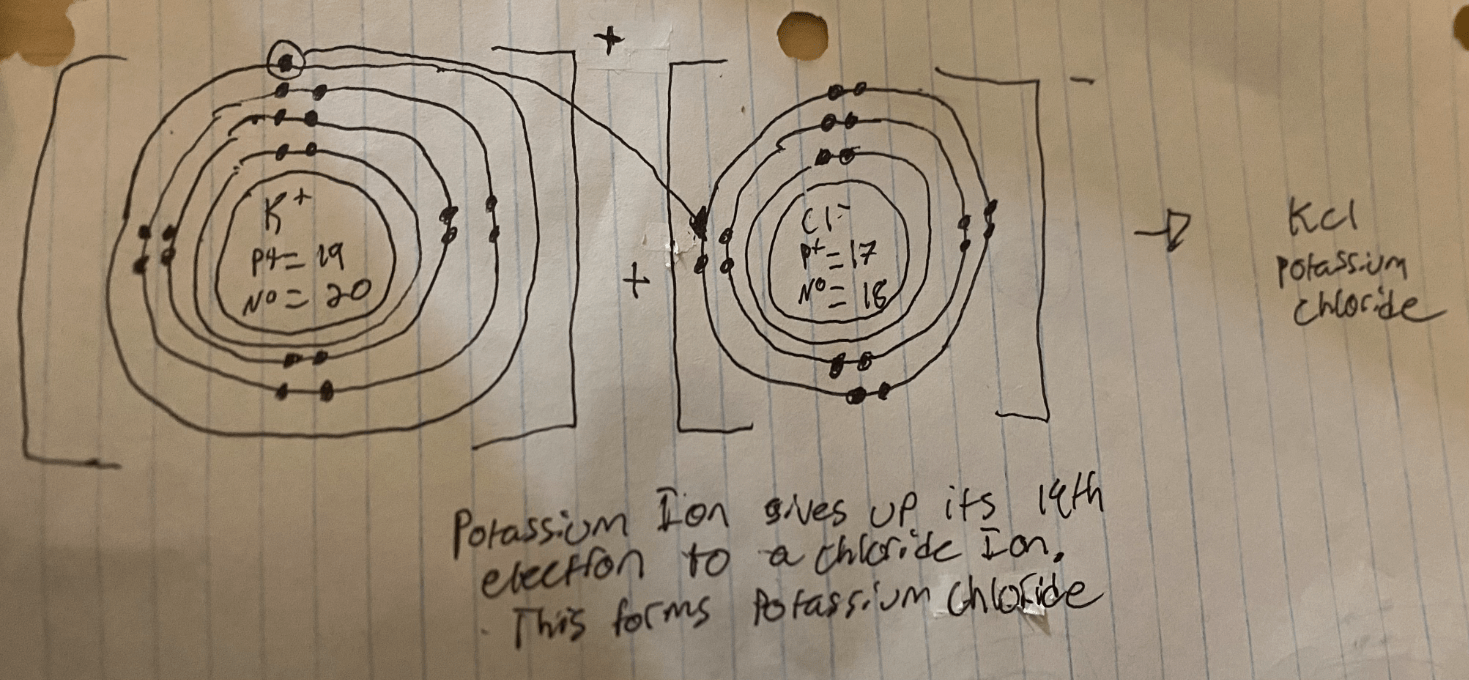
Draw the Formation of Potassium Chloride using Bohr Diagrams (this material is not going to be tested)
- Draw the Bohr diagram including the transfer of elections from one ion to another
400
Why do Cations give up their extra electrons, or why do Anions accept extra electrons when they are in their ionic state?
Because they are trying to fill/empty their valence shell. Elements with complete valence shells (the noble gases) are extremely stable, ions donate/accept electrons to try and achieve that stable configuration!
400
Name or provide the formula for the following Ionic compounds:
1. YPO4
2. Strontium Borate
3. (NH4)2O
1. Yttrium Phosphate
2. Sr3(BO3)2
3. Ammonium Oxide
400
What is the most common last name in Canada (2024)
Smith!
500
Where do electrons exist?
What happens to an electrons position when they gain or lose energy?
1. Alkali Metals 2. Halogens 3. Alkaline Earths
4. Metalloids 5. Transition Metals 6. Noble Gases
Classify the elements below with the names in the list above
rubidium is an example of a(an)____________
strontium is an example of a(an)____________ xenon is an example of a(an)____________
iodine is an example of a(an)____________
Electrons orbit the nucleus at specific distances, inside specific energy levels!
- Electrons that absorb (gain) energy can be be temporarily excited to a higher energy level, and they emit (lose) energy as they return to their original level.
Rb = Alkali Metal (Group 1)
Sr = Alkaline Earth Metals (Groups 2)
Xe = Noble Gas (Group 18)
I = Halogen (not a gas though!)
500
What do elements in the same group (ignoring the 1 in groups 13-18) have in common?
They have the same number of valence electrons!
500
Draw the EELD for an Aluminum Ion:
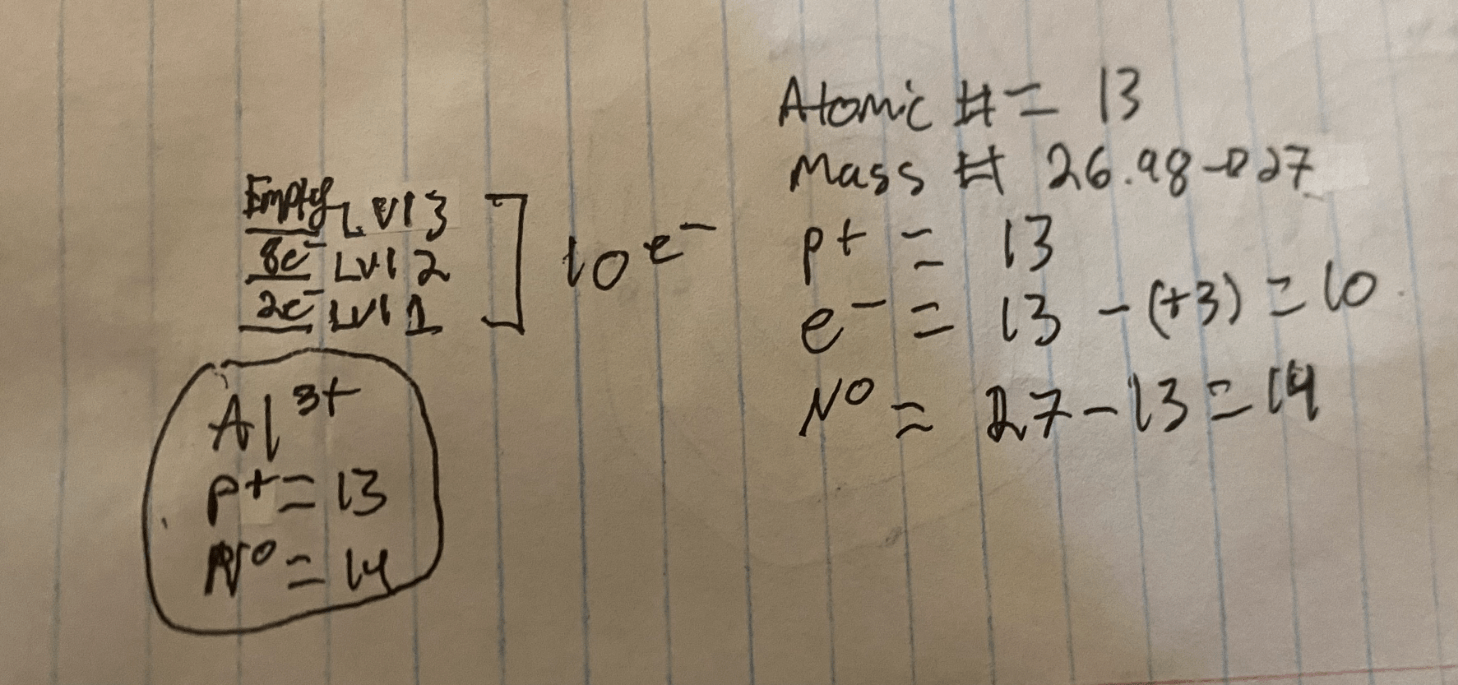
500
What type of bonds are used in
i. Ionic Compounds?
ii. Molecular compounds?
Which bonds are stronger?
i. Ionic Bonds
ii. Covalent Bonds
Ionic bonds are stronger than covalent bonds. This means (normally) more energy is required to break apart an ionic compound, than a molecular compound.
500
Name or provide the formula for the following molecular compounds:
1. carbon tetrachloride
2. P7O10
3. diboron pentabromide
4. C2N3
1. CCl4
2. Heptaphosphorus Decoxide
3. B2Br5
4. Dicarbon Trinitride
500
The last man on earth sits alone in a room. The telephone rings, who is it?
A woman, his wife, a lady of some sort!