Matter & Phase Changes
Chemical Reactions
Weathering, Erosion & Surface Processes
Plate Tectonics
Natural Disasters
100
What are the three states of matter?
olid, liquid, gas.
100
What measures the amount of matter?
Mass
100
What is weathering?
Breaking rock into smaller pieces.
100
What happens at a divergent boundary?
Plates move apart.
100
What natural disaster is hardest to predict?
Earthquakes.
200
Which state of matter has a definite shape and definite volume?
Solid
200
Which two observations prove a chemical reaction occurred?
-Change in Temperature
-Change in color
-Production of gas
-Production of sound
-Formation of a solid
-Change in smell
200
What is erosion?
Movement of sediment.
200
What happens when oceanic crust converges with continental crust?
Oceanic crust subducts.
200
What causes tsunamis?
Underwater earthquakes or subduction-zone movement.
300
Look at the particle diagram below. Which diagram represents liquid.
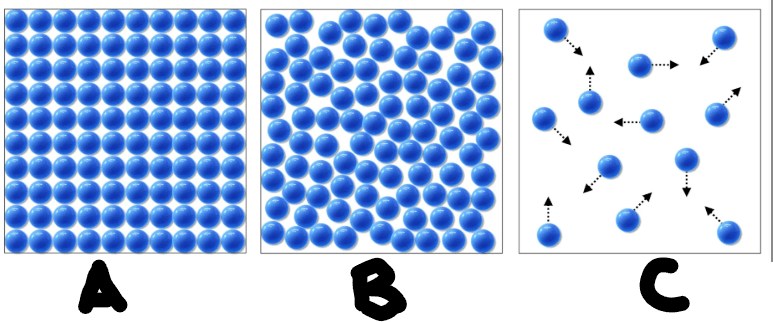
B
300
Using the model below, count the atoms.
H2 + O2 -> H2O
Reactants: H2 + O2
Products: H2O
No, the products show fewer oxygen atoms unless balanced.
300
The diagram shows rain hitting rock and breaking it into smaller pieces without moving them.
Is this weathering or erosion, and why?
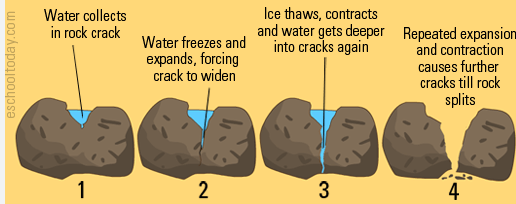
Weathering—rock breaks but does not move.
300
The diagram shows two plates sliding past each other.
Which boundary is this?
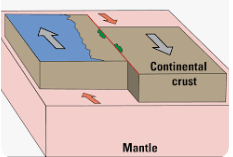
Transform boundary.
300
Look at the diagram showing a fault suddenly slipping.
Which natural event does this cause?
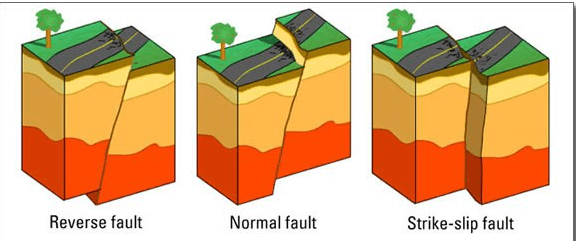
An earthquake.
400
What two phase changes are endothermic?
Melting and vaporization.
400
What does the Law of Conservation of Mass state?
Mass cannot be created or destroyed.
400
What force causes continents to move?
Convection currents.
400
What is a hot spot?
A stationary area where magma rises to form volcanoes.
400
What causes both earthquakes and tsunamis?
Motion of tectonic plates.
500
Explain why melting is endothermic but freezing is exothermic.
Melting absorbs heat to break particle attraction; freezing releases heat as particles lock into place.
500
Look at the before-and-after reaction diagram.
If the number of particles stays the same but changes arrangement, what does this show?
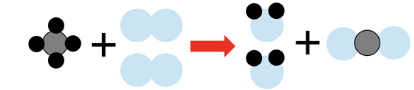
Chemical reactions rearrange atoms without losing or gaining matter.
500
Look at the fossil map of Glossopteris found in Antarctica, Africa, India, and South America.
What major theory does this support?
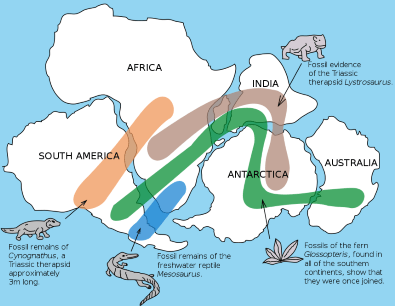
Continental drift (Pangaea once connected these continents).
500
Look at the hot spot chain diagram.
Why is the volcano directly over the hot spot the youngest?
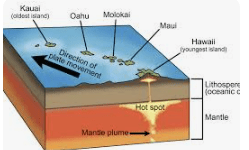
The plate moves, so older volcanoes drift away while new ones form above the hot spot.
500
A map shows a subduction zone on the Pacific Rim.
If an underwater earthquake occurs there, which coastline is most at risk for a tsunami?
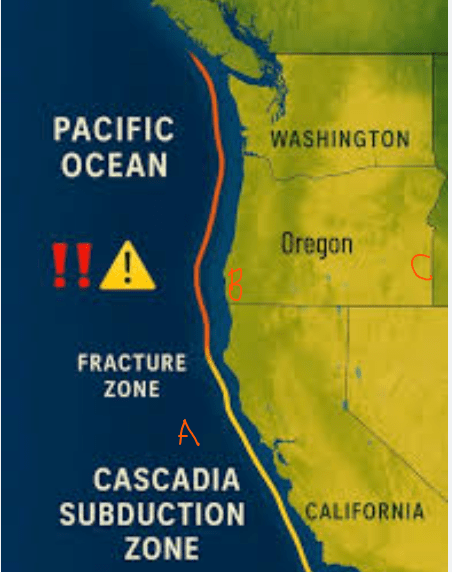
The coastline nearest the subduction zone (Pacific coastal areas).