Practice of Science, Energy, & Forces & Changes in Motion
Motion of Objects, Interactions of Earth's Spheres, & Energy Transfer on Earth
Weather vs. Climate, Patterns of Earth Systems, & Earth Structures
Cells & Classification
Human Body Systems
100
Gabby wondered how different liquids would affect the growth of sunflowers. To design an investigation, she planted three of the same size sunflower plants in the same type of pot. She placed all three pots next to each other where they would receive full sun. Once a day, each pot received a different liquid.
Pot A - 200 mL of coffee
Pot B - 200 mL of soda
Pot C - 200 mL of fruit juice
At the end of each week, she measured and graphed the growth of each plant. After four weeks, she analyzed her data to determine how each liquid affected the growth of the sunflowers. What kind of scientific investigation did Gabby carry out?
A. An experimental investigation where she could document the variables and a control group.
B. An observational investigation where she observed how fast sunflowers could grow over time.
C. A comparative investigation where she could see how the sunflowers' growth was affected by sunlight.
D. A comparative investigation where she could see how each variable affected the growth of the sunflowers.
A. An experimental investigation where she could document the variables and a control group.
100
Examine the distance vs. time graph below to answer the question.
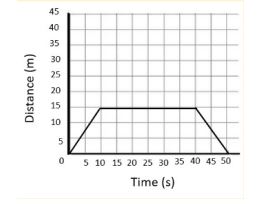
Which of the following scenarios describes Noah’s movement?
A. Noah stood in line in the media center. When the person in front of him finished, he walked up to the desk.
B. Noah left class and walked quickly to the dean's office. He waited for the dean and then quickly returned to class.
C. Noah walked to the cafeteria, realized he forgot his lunch, ran back to class to get it and then returned to the cafeteria.
D. Noah left first period, walked up the stairs and down the hall to the bathroom. He then went downstairs to second period.
B. Noah left class and walked quickly to the dean's office. He waited for the dean and then quickly returned to class.
100
The average temperature in a city during the month of March was 19°C (66°F). The next month, April, the average temperature was 22°C (71°F). Which of the following does this change in temperature, from March to April represent?
A. increased humidity
B. change in the climate
C. change in the weather
D. decreased precipitation
C. change in the weather
100
In science class, Rashad was asked to observe an unknown sample under a microscope and to take notes on what he observed. Below are his observations.
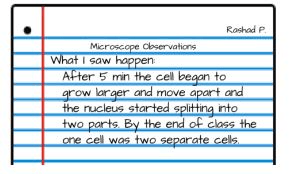
Which component of Cell Theory best supports Rashad’s observations?
A. All cells have a nucleus.
B. All cells need energy to grow.
C. All cells come from pre-existing cells.
D. All cells need to move to make room for other cells.
C. All cells come from pre-existing cells.
100
Which of the following describes how two human body systems would interact?
A. The immune system provides nutrients to the excretory system.
B. The respiratory system filters the blood from the circulatory system.
C. The nervous system sends signals to the excretory system to produce sweat.
D. The musculoskeletal system works with the digestive system to remove infection.
C. The nervous system sends signals to the excretory system to produce sweat.
200
For one week, students in Dr. Phil's class recorded the amount of time they spent exercising.
At the end of the week, each student measured their resting heart rate. The data is recorded in
the graph below.
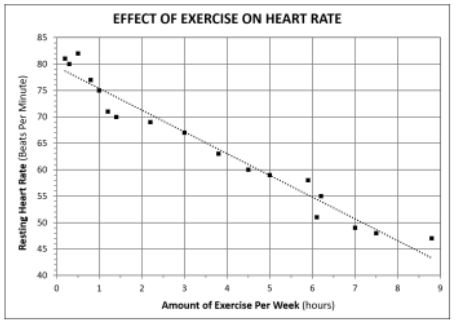
What conclusion can be made?
A. Heart rate remains unchanged regardless of how many hours of exercise.
B. Increasing the amount of hours exercised will lower the students' heart rate.
C. Students who exercise more hours a week have a higher resting heart rate.
D. Decreasing the amount of hours exercised will lower the students' heart rate.
B. Increasing the amount of hours exercised will lower the students' heart rate.
200
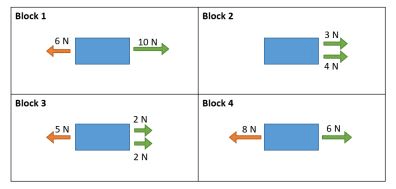
Use the diagram below to answer the following question.
Which block above will have the greatest net force?
A. Block 1
B. Block 2
C. Block 3
D. Block 4
B. Block 2
200
Use the table below to answer the following question.
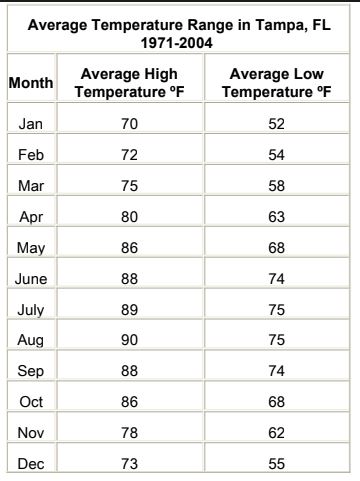
Which of the following statements correctly describes this table?
A. This table shows the weather because it contains several years of temperature data.
B. This table shows the weather because it covers daily temperatures for each month of the entire year.
C. This table shows the climate of Tampa because it contains over 30 years of average temperature data.
D. This table shows the climate of Tampa because it covers the average temperature for each month of the entire year.
C. This table shows the climate of Tampa because it contains over 30 years of average temperature data.
200
A student was looking at cells with a microscope. They know that cells are classified as either plant cells or animal cells. Which organelle would tell them that the cells are from a plant?
A. a cell wall outside the cell membrane
B. cytoplasm that is filled with organelles
C. a large nucleus in the center of the cell
D. a cell membrane surrounding the entire cell
A. a cell wall outside the cell membrane
200
The table below contains statements made by four different students.
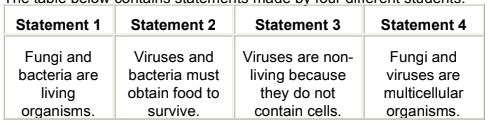
Which statements correctly describe infectious agents?
A. Statements 1 and 2
B. Statements 1 and 3
C. Statements 2 and 4
D. Statements 3 and 4
B. Statements 1 and 3
300
How is the word theory used differently in science compared to everyday life?
A. In science, a theory is often proven, but in everyday life it remains correct.
B. In science, a theory can become a law, but in everyday life, it is a suggestion.
C. In science, a theory is a story developed by scientists, but in everyday life, it is a fact.
D. In science, a theory is a well-tested explanation, but in everyday life, it can mean a guess.
D. In science, a theory is a well-tested explanation, but in everyday life, it can mean a guess.
300
After a hurricane hits a coastal area, flooding damages homes, trees are uprooted and water becomes polluted with debris. Which of the following describes an interaction between Earth's spheres?
A. Trees uprooted by the storm is the atmosphere and biosphere.
B. Water becoming polluted is the biosphere and the hydrosphere.
C. Flooding damaging homes is the hydrosphere and atmosphere.
D. Winds eroding soil and sand is the geosphere and hydrosphere.
A. Trees uprooted by the storm is the atmosphere and biosphere.
300
Which of the following statements accurately describes how temperature affects the cycling of water?
A. Warmer temperatures result in a decrease in both evaporation and precipitation.
B. Warmer temperatures result in an increase in both evaporation and precipitation.
C. Cooler temperatures result in a decrease in evaporation and increase in precipitation.
D. Cooler temperatures result in an increase in evaporation and decrease in precipitation.
B. Warmer temperatures result in an increase in both evaporation and precipitation.
300
The picture below shows a cross-section of a plant stem viewed through a microscope.
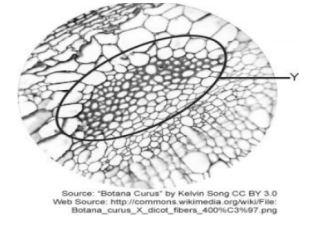
The encircled area “Y” identifies a specific tissue in the plant. Which option best identifies the hierarchical level of organization that tissue is made of?
A. atoms, organs, and cells
B. cells, molecules and atoms
C. organisms, molecules, and cells
D. atoms, molecules, and organ systems
B. cells, molecules and atoms
300
What statement correctly identifies how body systems interact to maintain homeostasis?
A. After eating a meal, the circulatory system breaks down the food into usable nutrients that the excretory system can deliver throughout the body.
B. To maintain body temperature, the respiratory system carries heat throughout the body. The nervous system controls the production of sweat in the excretory system, which cools the body.
C. In order to heal an infected cut, the respiratory system will produce antibodies that will be transported to the area by the circulatory system. The circulatory system will then transport any waste to the kidney for extraction.
D. While running, the musculoskeletal system requires more oxygen, so the respiratory system increases breathing rate. The circulatory system then responds by increasing heart rate to deliver more oxygenated blood to the musculoskeletal system.
D. While running, the musculoskeletal system requires more oxygen, so the respiratory system increases breathing rate. The circulatory system then responds by increasing heart rate to deliver more oxygenated blood to the musculoskeletal system.
400
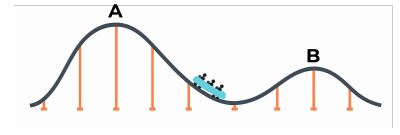
Below is a diagram of a roller coaster.
After descending hill A, the roller coaster car speeds across the track and begins moving up hill B. Which statement best describes the energy transformation happening as the car moves up the hill B?
A. The car is gaining kinetic energy as it goes higher.
B. The car's kinetic energy is transforming into potential energy.
C. The car has only potential energy as it moves up the second hill.
D. The car’s kinetic energy remains the same because it is still moving.
B. The car's kinetic energy is transforming into potential energy.
400
A sea breeze forms during the day and a land breeze forms at night.
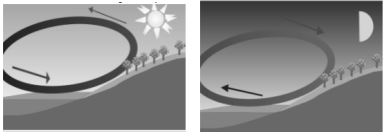
Which statement explains why wind direction changes from day to night?
A. The land quickly heats up during the day and stays warm at night.
B. The water quickly heats up during the day and stays warm at night.
C. The land quickly heats up during the day and the water stays warmer at night.
D. The water quickly heats up during the day and the land stays warmer at night.
C. The land quickly heats up during the day and the water stays warmer at night.
400
Use the picture below to answer the following question.
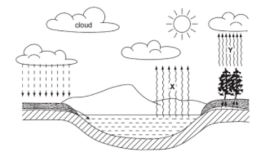
How does point "X" in the cycling of water affect the weather?
A. The ocean reflects the Sun’s rays into the atmosphere and causes the water vapor to condense into a cloud.
B. The cooler temperature of the ocean causes the water to evaporate into the atmosphere to later form clouds.
C. The Sun’s rays heat the ocean’s water and cause some of it to evaporate into the atmosphere to later form clouds.
D. The warmer temperature of the ocean causes the water vapor to release into the atmosphere through condensation.
C. The Sun’s rays heat the ocean’s water and cause some of it to evaporate into the atmosphere to later form clouds.
400
Which of the following describes a key difference between plant and animal cells?
A. Animal cells have a cell wall for support and protection.
B. Plant cells do not have a nucleus to hold genetic instructions.
C. Plant cells have chloroplasts for photosynthesis while animal cells do not.
D. Animal cells have larger vacuoles than plant cells that are used for storage.
C. Plant cells have chloroplasts for photosynthesis while animal cells do not.
400
In science class, students were asked to create a Venn diagram comparing viruses and fungi.
Below is a submission of one students' diagram.
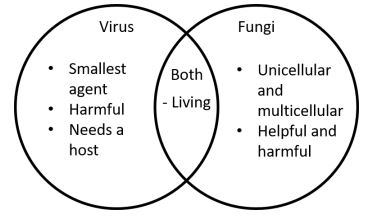
What mistake did the student make in their diagram?
A. "Living" needs to be removed from under both since fungi are non-living.
B. "Helpful" needs to be removed from under fungi since they are all harmful.
C. "Living" needs to be removed from under both since viruses are non-living.
D. "Unicellular" needs to be removed from under fungi since they are only multicellular.
C. "Living" needs to be removed from under both since viruses are non-living.
500
How does gravitational force relate to distance?
A. As objects move away from each other, the gravitational force increases.
B. As objects move away from each other, the gravitational force decreases.
C. As distance remains the same between objects, the gravitational force increases.
D. As distance decreases between objects, the gravitational force does not change.
B. As objects move away from each other, the gravitational force decreases.
500
A dog is walking on the sidewalk on a sunny day. Which statement describes the heat transfer occurring?
A. The sun heats up the sidewalk through conduction, the dog's paws will feel the heat through radiation.
B. The sun heats up the sidewalk through radiation, the dog's paws will feel the heat through conduction.
C. The sun heats up the sidewalk through radiation, the dog's paws will feel the heat through convection.
D. The sun heats up the sidewalk through convection, the dog's paws will feel the heat through conduction.
B. The sun heats up the sidewalk through radiation, the dog's paws will feel the heat through conduction.
500
Plants, such as sea oats and marram grass are often planted in coastal areas near the beach.
Which statement explains why plants are important to the coast?
A. The plants provide a source of shade for beach goers.
B. The plants remove excess oxygen from the environment.
C. The plant roots hold the sand together, decreasing erosion.
D. The plants cause the sand to blow away faster, increasing weathering.
C. The plant roots hold the sand together, decreasing erosion.
500
Scientists study different types of life on Earth and classify them into Domains and Kingdoms. Which statement explains why fungi and plants are classified into different Kingdoms?
A. Fungi are Bacteria and plants are Archaean.
B. Fungi are Archaean and plants are Bacteria.
C. Fungi are multicellular and plants are unicellular.
D. Fungi are heterotrophic and plants are autotrophic.
D. Fungi are heterotrophic and plants are autotrophic.
500
Red blood cells carry oxygen from the lungs to all parts of the body. Which argument BEST describes the organ systems that work together to distribute oxygen throughout the human body?
A. Oxygen enters the body through the excretory system and the red blood cells are transported by the immune system.
B. Oxygen enters the body through the circulatory system and the red blood cells are transported by the nervous system.
C. Oxygen enters the body through the respiratory system and the red blood cells are transported by the circulatory system.
D. Oxygen enters the body through the digestive system and the red blood cells are transported by the musculoskeletal system.
C. Oxygen enters the body through the respiratory system and the red blood cells are transported by the circulatory system.