Habitats Part 1
Habitats Part 2
Soil
Fossils
Extra
100
Rijul and his family are taking a hike in the Georgia mountains. He reaches a waterfall and spots a bear. Rijul is curious to know where else bears could be found. What question and explanation would Rijul need to ask to figure out where bears live?
a. Are bears found in areas where food can be easily accessible? If that is the case, then bears could live in the Piedmont region.
b. Are bears found in areas where they need a lot of space? If that is the case, then they could only live in mountain areas.
c. Do bears sleep during the winter? If that is the case, then bears could only live in mountain areas.
d. Do bears need access to water? If that is the case, then bears could live in mountains and coastal plains.
a. Are bears found in areas where food can be easily accessible? If that is the case, then bears could live in the Piedmont region.
100
The picture shows the Okefenokee Swamp in Georgia.
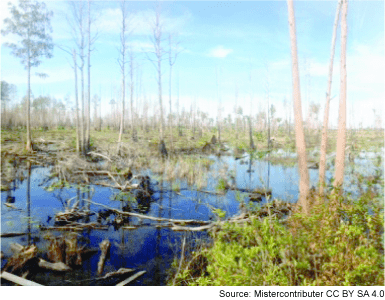
Which animals most likely live in this habitat?
a. turtles, sharks, and trout
b. alligators, otters, and frogs
c. geese, owls, and opossums
d. black bears, deer, and raccoons
b. alligators, otters, and frogs
100
Janelle wants to investigate to determine three different soils’ textures based on their particle size. She says “I only need to use a hand lens to look at them. Then I will write down what I see. This will tell me all I need to know about their texture based on their particle size.” Is Janelle correct in her thinking?
a. Yes, because a hand lens helps you see particle size and then you will know about the soils’ texture
b. No, because in order to determine texture, you also need to know what the soils feels like.
c. Yes, because to see texture you just need to look at the soil closely.
d. No, because you do not need to use a hand lens to determine texture
b. No, because in order to determine texture, you also need to know what the soils feels like.
100
A boy was hiking through a desert with his family. He found a fossilized insect that has pinchers for eating grass while he was digging in the sand. What can the boy conclude about the habitat of the once living insect?
a. The area was always a desert and someone put the fossil there.
b. The area was once covered in water and must have had sea animals.
c. The area must have once had lots of grass because of the characteristics of the fossil.
d. The area has always been a desert because of the location where the fossil was found.
c. The area must have once had lots of grass because of the characteristics of the fossil.
100
In the Coastal region of Georgia, there has been an increase in the number of new technologies on boats to find fish. Which of the following would BEST describe an outcome of the new technologies?
a. The fish will move to another area of the ocean.
b. There will be an increase in the number of fish.
c. Nothing. There will be just as many fish.
d. The population of fish will decrease.
d. The population of fish will decrease.
200
Kevin was given the picture below and asked to determine what habitat this organism is most likely to survive in.
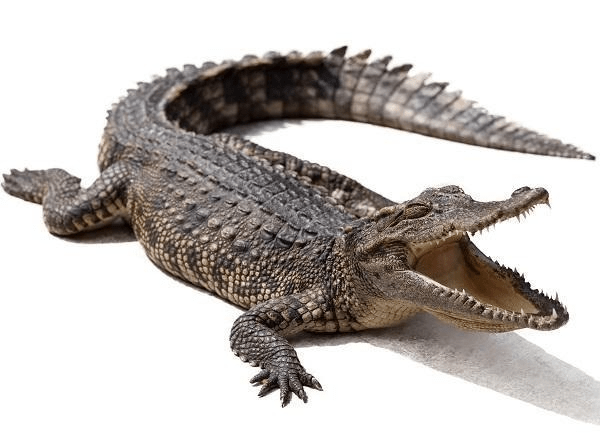
From the list below, what is the best question that Kevin should ask about this organism to help him determine the habitat they are most likely to be found in?
a. Does this organism have a long lifespan?
b. What does this organism eat in order to survive?
c. What does this organism like to do during the day?
d. How many teeth does this organism have in its mouth?
b. What does this organism eat in order to survive?
200
Emily's family is moving to a different region in Georgia. She hopes to move some of her plants to a garden at her new home. Answering which question would best help predict if her plants will survive in the new environment?
a. How many plants is Emily moving to her new home?
b. How many miles away is Emily moving from her old home?
c. How much will it cost to get water and plant food at her new home?
d. How similar is the weather at her new home to the weather at her old home?
d. How similar is the weather at her new home to the weather at her old home?
200
Lily's family went to the beach over the summer. While there, Lily noticed that the rocks closer to the water’s edge were smooth, and the rocks farther away from the water were rough and jagged. What MOST likely caused the rocks closer to the water to be smooth?
a. birds pecking at the rocks
b. fish swimming over the rocks
c. waves crashing down on the rocks
d. people walking over the rocks to get to the water
c. waves crashing down on the rocks
200
A group of friends were hiking to the top of a mountain. When they got to the top of the mountain, they discovered several fossils of animals like the one pictured above.
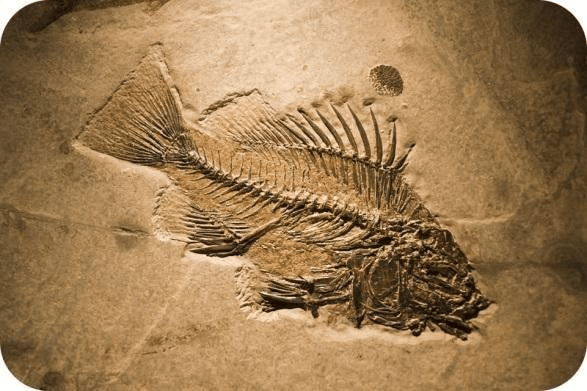
What clues does the fossil give you about how the animal moved and what type of habitat it lived in?
a. This animal lived at the bottom of the mountain since it was discovered at the mountain, but the mountain rose in height over time.
b. This animal lived at the top of a mountain since that is the location it was discovered.
c. This animal lived in a water environment such as a lake or ocean since it has bones.
d. This animal lived in a water environment since it has fins.
d. This animal lived in a water environment since it has fins.
200
Which of the following best describes loam?
a. It does not hold water well.
b. It does not have any nutrients.
c. It has too much organic matter.
d. It has a mixture of particle sizes.
d. It has a mixture of particle sizes.
300
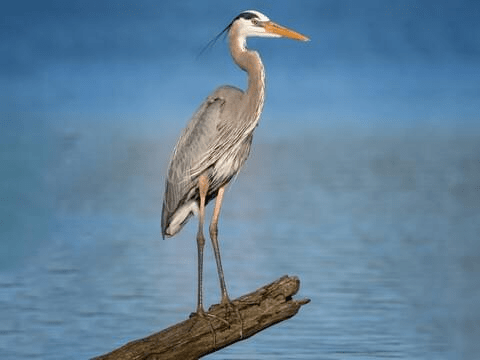
A heron is a bird that has a long, skinny beak that it uses to hunt fish, insects, and crustaceans while standing in shallow water. What question could a student ask to figure out where the heron would BEST survive in which habitat?
a. Would herons best survive in the Atlantic Ocean since they eat crustaceans?
b. Would herons best survive in the Piedmont region since it has a long, skinny beak?
c. Would herons best survive in the mountains since they need to hunt fish and insects?
d. Would herons best survive in the marsh since there is shallow water with plenty of food?
d. Would herons best survive in the marsh since there is shallow water with plenty of food?
300
Your class takes a field trip to the local park and you identify a pretty flower, pictured below.
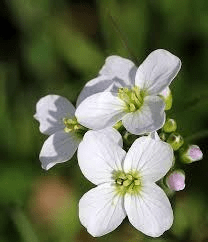
From the list provided, what is the best question you could ask to determine why the flower you’ve seen grows so well in this habitat?
a. Why is the flower so tall?
b. Does the flower need sunlight to grow?
c. How much water does the flower need to grow best?
d. If I cut the flower and put it in a vase, how long would it live?
c. How much water does the flower need to grow best?
300
A student wanted to find out what type of soil could grow lima beans the best. What would be the best investigation to carry out?
a. Add lima beans to sand and measure the growth of plants.
b. Add water to each soil and plant the lima beans in the one that holds the most water.
c. Plant a lima bean in each type of soil and measure the growth of the plants.
d. Plant three lima beans in a mixture of all of the soils and measure the growth of the plants.
c. Plant a lima bean in each type of soil and measure the growth of the plants.
300
A student creates a model to show the process of how the following fossil formed.
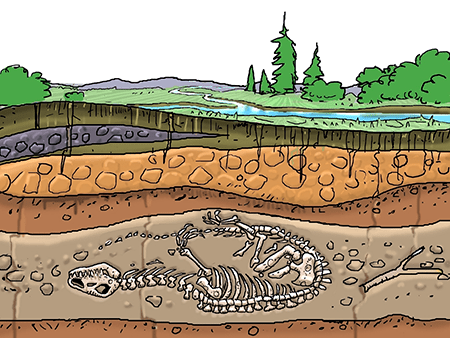
Which of the following should the students include in their illustration?
a. The student should show people digging out the fossil to show an animal becomes a fossil the moment it is discovered.
b. The student should draw a time lapse of images for each step with arrows and descriptions.
c. The student should label the soil types in each layer of the illustration.
d. The student should label the type of dinosaur in their image.
b. The student should draw a time lapse of images for each step with arrows and descriptions.
300
The pictures show the feet of four different animals.
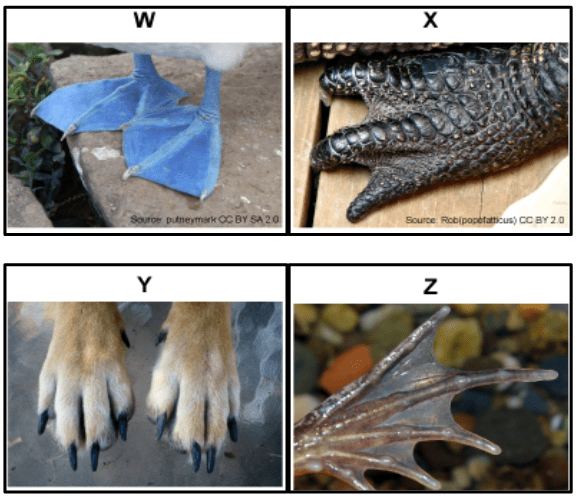
Which animal would be least likely to live in a habitat with a lot of water?
a. animal W
b. animal X
c. animal Y
d. animal Z
c. animal Y
400
Jaxson wants to figure out if a whitetail deer lives in the Piedmont or the Marsh and Swamp habitats. Which question should he ask and why?
a. Does it survive in wet, hot conditions where there is a lot of standing water? Because the piedmont has a lot of standing water and the marsh and swamp do not.
b. Does it survive in wet, hot conditions where there is a lot of standing water? Because the marsh and swamp has a lot of standing water and the piedmont does not.
c. Does it need water to survive? Because the piedmont has water and the marsh and swamp do not.
d. Does it need water to survive? Because the marsh and swamp has water and the piedmont has no water.
b. Does it survive in wet, hot conditions where there is a lot of standing water? Because the marsh and swamp has a lot of standing water and the piedmont does not.
400
How do the webbed feet of the alligator help it survive in its habitat?
a. They make it easier for the alligator to climb trees.
b. They help the alligator swim fast to catch its food.
c. They help the alligator cool off in hot weather.
d. They allow the alligator to grab food quickly.
b. They help the alligator swim fast to catch its food.
400
Some students noticed little trenches or holes around the outside of the school building.
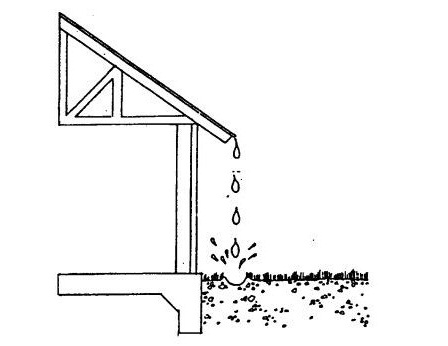
What do you think will happen to the trenches over time?
a. The trench holes will get larger because the rain water will continue to push the soil out of the trench.
b. The trench holes will disappear because rocks and soil will fill up from the bottom layer of the ground.
c. The trench holes will get smaller because grass will grow over the area and it will be watered by the rain.
d. The trench holes will stay the same because they were made to catch the rain and control flooding.
a. The trench holes will get larger because the rain water will continue to push the soil out of the trench.
400
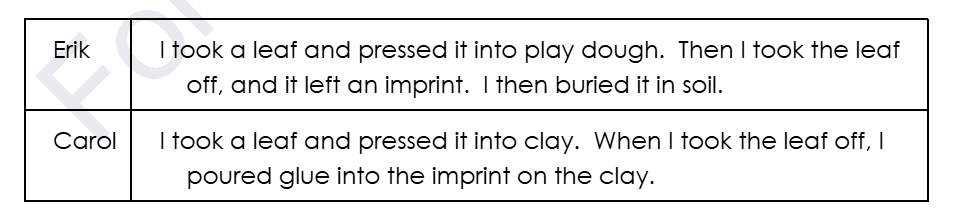
Erik and Carol are each creating a model to represent how an imprint of a leaf fossil is formed. Below are their descriptions of the model they created.
a. Erik, because he used play dough and it will decompose in the soil.
b. Erik, because he buried it in soil which happens to all dead things.
c. Carol, because the glue represents the minerals filling in the spaces to form a fossil.
d. Carol, because she used clay and it could be molded over and over into something new.
c. Carol, because the glue represents the minerals filling in the spaces to form a fossil.
400
Where are most fossils formed?
a. Near volcanoes, because the high heat of the lava helps to form fossils.
b. In glaciers, because fossils are created when an organism is frozen quickly.
c. In sedimentary rock, because being buried in sediment helps to form fossils.
d. Near earthquakes, because the shaking ground traps organisms to create fossils.
c. In sedimentary rock, because being buried in sediment helps to form fossils.
500
Which of the following is the most likely effect of cutting down the trees in a forest habitat?
a. All of the animals in the forest will die in a short period of time.
b. Many animals will learn to fly in order to reach higher branches.
c. Animals that cannot find what they need will move to a new location.
d. All of the animals will begin to live in burrows underneath the ground.
c. Animals that cannot find what they need will move to a new location.
500
A teacher ordered some pitcher plants for the school garden that was located in the Piedmont area of the state of Georgia. The class planted them in August but in October the pitcher plants began to die. What is the best explanation for this?
a. The pitcher plants did not get enough sunlight in the Piedmont.
b. The pitcher plants were too hot in the Piedmont.
c. The climate in the Piedmont was not wet and warm enough.
d. The climate in the Piedmont was not dry and cold enough.
c. The climate in the Piedmont was not wet and warm enough.
500
The picture shows a rock that has changed shape over a long period of time.
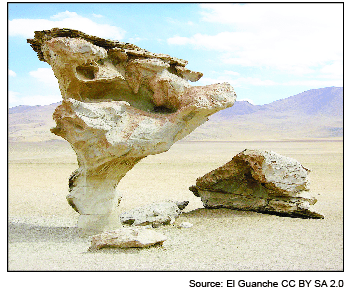
Which best describes how this rock changed shape?
a. The rock was worn away over time by wind.
b. The rock was worn away over time by gravity.
c. The rock was worn away over time by rain.
d. The rock was worn away over time by snow.
a. The rock was worn away over time by wind.
500
A student is observing two fossils found in a warm wooded region. One fossil is of an animal and one of a plant. Both of these fossils appear to have the same characteristic that they retain water. What can you infer about the environment in which these organisms lived?
a. The fossils are of organisms that once lived in an ocean because they need water in order to survive.
b. The fossils are of organisms that once lived in a desert since these organisms are able to live where there is limited water.
c. The fossils are of organisms that once lived on the coast next to the ocean because they lived on land, but need access to the ocean.
d. The fossils are of organisms that once lived in a wooded area because there are a lot of types of plants and animals found in this region.
b. The fossils are of organisms that once lived in a desert since these organisms are able to live where there is limited water.
500
The third graders in Mr. Miller’s class were looking at pictures of mountain ranges in the United States. The students observed that the Appalachian Mountains were round and short, while the Rocky Mountains were taller and more jagged. What would cause the mountain ranges to be so different?
a. The Appalachian Mountains have had more exposure to erosion from wind and water.
b. More people have traveled over the Rocky Mountains than the Appalachian Mountains.
c. More animals live in the Appalachian Mountains, so they have been worn down more from the animals walking over them.
d. The snow in the Rocky Mountains keeps them for eroding as quickly as the Appalachian Mountains.
a. The Appalachian Mountains have had more exposure to erosion from wind and water.