Misc.
Organisms
Parts of a Cell
Classification
Random
100
a complete living thing
organism
100
Plants are (unicellular or multicellular) organisms
multicelular
100
provides the external boundary for a cell
cell membrane
100
the largest classification's scientific name
kingdom
100
yogurt and your ______ contain useful bacteria
intestines
200
uses lenses to magnify objects
microscope
200
putting organisms with similar characteristics into groups
classification
200
the bubble-like storage organelles found in a cell
vacuoles
200
the second largest classification's scientific name
phylum
200
list these in order from smallest to largest:
systems, tissues, cells, organs
cells, tissues, organs, systems
300
plants use a green pigment called ___- to absorb energy
chlorophyll
300
the process by which an organism produces reproductive cells
meiosis
300
the parts of a cell that act like engines, breaking down food and releasing energy
mitochondria
300
the third largest classification's scientific name
class
300
name three of the five characteristics of living things
grow and develop
reproduce
respond to their environment
use energy
made of cells
400
the scientific name of an organism uses its ___ and ___
genus and species
400
organisms grow and replace cells through the process of...
mitosis
400
the part of a cell that provides support for plant cells
cell wall
400
the fourth and fifth largest classification's scientific name
order, family
400
How is man different from animals?
Man was created in the image of God and can have a persona relationship with Him.
500
This states that living things are made of cells and that cells can function as individual organisms or as the smallest units in a larger organism.
cell theory
500
Name each label of the cell.
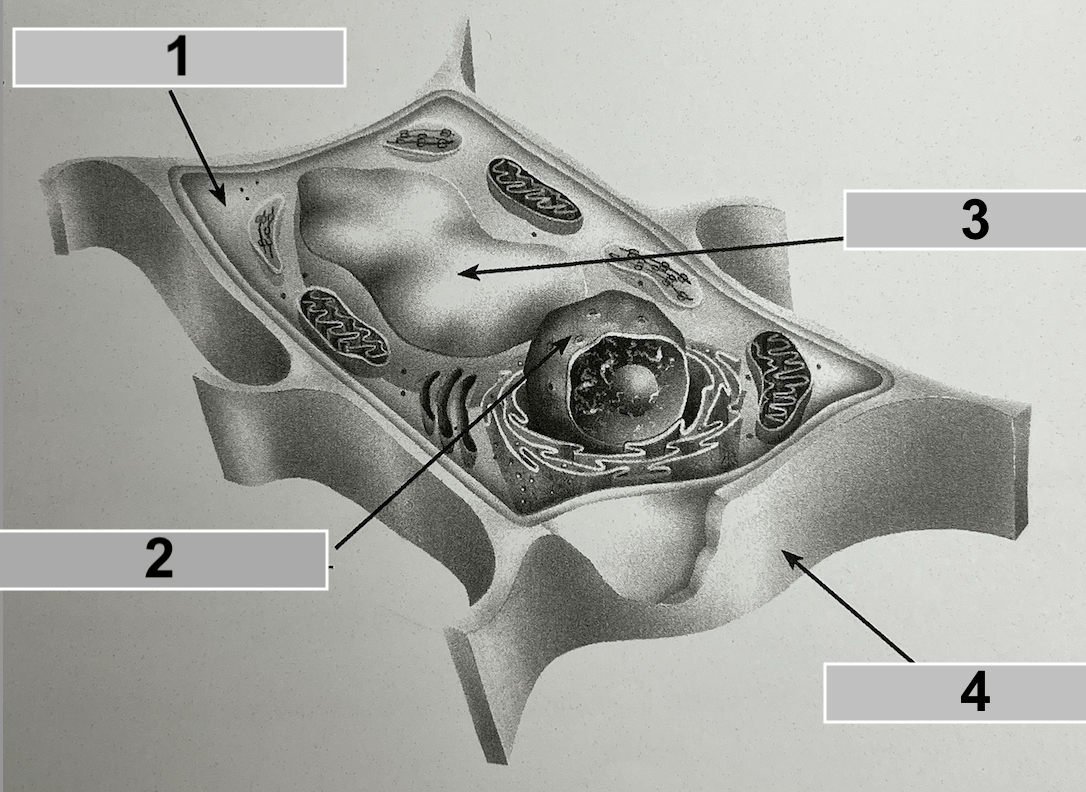
1. cytoplasm
2. nucleus
3. vacuole
4. cell wall
500
a group of cells working together is called a...
tissue
500
the two smallest classification's scientific name
genus, species
500
name the six kingdoms
eubacteria, archaebacteria, protista, fungi, plantae, anamalia