Earth/Space
Life
Physical
Nature of Science
Random
100
What motion of Earth is responsible for the cycle of day and night?
A. Earth’s revolution around the Sun
B. Earth’s rotation on its axis
C. The Moon’s orbit around Earth
D. Changes in Earth’s tilt
B. Earth’s rotation on its axis
100
Which type of organism produces its own food using energy from sunlight?
A. Decomposer
B. Consumer
C. Producer
D. Predator
C. Producer
100
Which state of matter has a definite volume but no definite shape?
A. Solid
B. Liquid
C. Gas
D. Plasma
B. Liquid
100
A student changes the amount of sunlight a plant receives and measures how tall the plant grows after two weeks. What is the independent variable in this investigation?
A. Height of the plant
B. Type of plant
C. Amount of sunlight
D. Time the plant grows
C. Amount of sunlight
100
Why is a control group important in an experiment?
A. It proves the hypothesis
B. It provides a comparison
C. It increases sample size
D. It removes all variables
B. It provides a comparison
200
Which layer of Earth is composed mostly of solid rock and includes continents and ocean floor?
A. Mantle
B. Outer core
C. Inner core
D. Crust
D. Crust
200
Which organisms receive energy directly from producers in a food web?
A. Secondary consumers
B. Tertiary consumers
C. Decomposers
D. Primary consumers
D. Primary consumers
200
Two objects have the same mass but different volumes. Which property must be different?
A. Weight
B. Density
C. Temperature
D. State of matter
B. Density
200
A student investigates how the angle of a ramp affects the speed of a toy car. The student changes the angle of the ramp and records how fast the car travels each time. Which variable is the dependent variable in this investigation?
A. Angle of the ramp
B. Type of toy car
C. Speed of the toy car
D. Length of the ramp
C. Speed of the toy car
200
A student observes water droplets forming on the outside of a cold glass.
What process causes the droplets to form?
A. Evaporation
B. Condensation
C. Freezing
D. Melting
B. Condensation
300
A student notices that some constellations are visible in summer but not in winter. Which Earth motion best explains this observation?
A. Earth’s rotation on its axis
B. Earth’s revolution around the Sun
C. The Moon’s phases
D. Changes in atmospheric pressure
B. Earth’s revolution around the Sun
300
If a top predator is removed from an ecosystem, what is the most likely long-term effect?
A. A decrease in all populations
B. An increase in prey populations
C. No change in the food web
D. Immediate extinction of producers
B. An increase in prey populations
300
Two clear liquids are heated. One boils at 100 °C and the other at 118 °C. What conclusion can be drawn?
A. They are the same substance
B. The liquids have equal densities
C. The liquids are different substances
D. One liquid is a mixture
C. The liquids are different substances
300
A student tests how the mass of an object affects the distance it slides down a ramp.
Which variable should be kept constant?
A. Distance the object slides
B. Mass of the object
C. Surface of the ramp
D. Speed of the object
C. Surface of the ramp
300
A student mixes two clear liquids together. After mixing, bubbles form and the temperature of the mixture increases. No heating device is used.
Which conclusion is most supported by these observations?
A. A physical change occurred because the substances mixed
B. A chemical change occurred because energy was released
C. The mixture cooled due to evaporation
D. The substances dissolved without reacting
B. A chemical change occurred because energy was released
400
Two locations receive similar sunlight, but one has cooler summers because it is near the ocean. Which factor most affects this climate difference?
A. Latitude
B. Elevation
C. Proximity to large bodies of water
D. Earth’s axial tilt
C. Proximity to large bodies of water
400
A species of bird has individuals with different beak shapes. After a drought, birds with short, thick beaks survive more often than birds with long, thin beaks.
Which explanation best describes why the population changes over time?
A. The birds change their beak shape during their lifetime
B. Birds with favorable traits survive and reproduce more often
C. All birds adapt in the same way to environmental change
D. The environment directly causes genetic mutations in all birds
B. Birds with favorable traits survive and reproduce more often
400
A student measures the mass and volume of three different samples of the same solid substance. The measurements are shown below.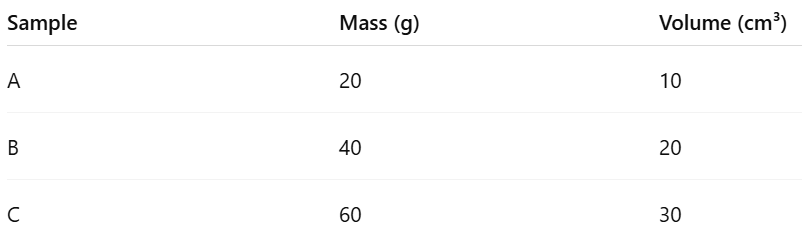
What conclusion can be drawn from these data?
A. The density of the substance changes as the sample size increases
B. Each sample is a different substance
C. The density of the substance remains the same for all samples
D. Larger samples have greater density
C. The density of the substance remains the same for all samples
400
A student investigates how the type of liquid affects the rate of evaporation. Which variable is the independent variable?
A. Rate of evaporation
B. Temperature of the room
C. Type of liquid
D. Amount of liquid remaining
C. Type of liquid
400
A student places a pencil in a glass of water. The pencil appears bent at the surface of the water.
What causes the pencil to appear bent?
A. Light is absorbed by the water
B. Light reflects off the surface of the water
C. Light refracts as it moves from air into water
D. Light travels faster in water than in air
C. Light refracts as it moves from air into water
500
A rock sample shows flattened mineral layers formed under intense heat and pressure deep underground. How should this rock be classified?
A. Igneous
B. Sedimentary
C. Metamorphic
D. Clastic
C. Metamorphic
500
Two populations of the same species live in different environments. One population lives in a cold climate, while the other lives in a warm climate. Over many generations, the cold-climate population develops thicker fur.
Which statement best explains this change?
A. Individual organisms grew thicker fur to survive the cold
B. Environmental conditions caused all individuals to change at the same time
C. Organisms with traits better suited for cold climates reproduced more successfully
D. Thicker fur developed because organisms needed it during their lifetime
C. Organisms with traits better suited for cold climates reproduced more successfully
500
An object remains at rest while two equal forces push it in opposite directions. What can be concluded?
A. The object has no mass
B. The forces are unbalanced
C. The forces are balanced
D. Gravity is absent
C. The forces are balanced
500
A student wants to determine how salt concentration affects the boiling point of water. Which setup best identifies the dependent variable?
A. Measuring the mass of salt added to each sample
B. Recording the temperature at which each solution boils
C. Changing the volume of water in each beaker
D. Using different heat sources
B. Recording the temperature at which each solution boils
500
Astronomers observe two stars. Star A appears blue, and Star B appears red. What can be concluded about the temperatures of these stars?
A. Star A is cooler than Star B
B. Star A and Star B have the same temperature
C. Star A is hotter than Star B
D. Star B is hotter because it appears brighter
C. Star A is hotter than Star B