Scientific Method
Earth
Plate Tectonics
Rock Cycle
Mix-mix
100
A _________ is an educated guess about the outcome of an experiment.
Hypothesis
100
Scientist think the Earth was formed ______ years ago.
4.6 billion
100
Large continent-sized blocks of rock from the crust and upper mantle are called _______
Tectonic Plates
100
The process of moving sediment from one place to another is called _____
Erosion
100
Which layer of the Earth is normally a solid but heat from the other layers can change it to a very thick liquid?
The mantle
200
Something you observe with your own eyes is called a _________
Observation
200
The preserved remains or imprints of animals, plants, and other organisms from the distant past are called
Fossils
200
_______ boundaries occur when plates move apart.
Divergent
200
The process of dropping sediment in a new location is called ____
Deposition
200
What fossils were found in the Coastal Plain/Tidewater region, and what can you infer about how this area has changed?
Bones and teeth from ancient ocean animals; this area was once covered by an ocean.
300
When you explain or make sense of your observations, you are making a(n) __________
Inference
300
Name the layers of the Earth according to the diagram below
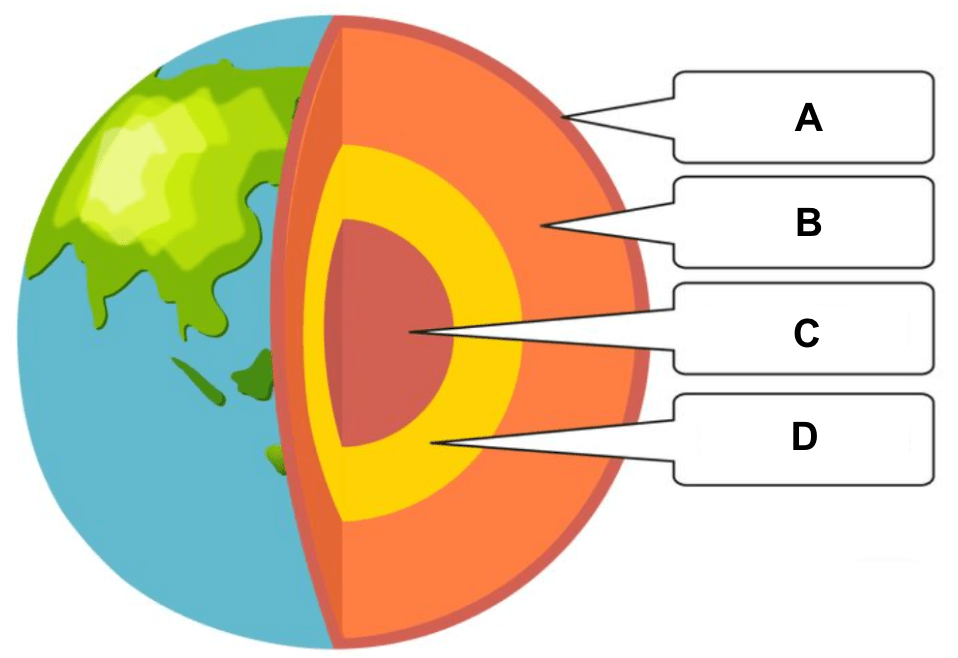
A. Crust
B. Mantle
C. Outer core
D. Inner core
300
_______ occur along convergent, divergent, and transform boundaries.
Earthquakes
300
The process of breaking rocks into smaller pieces is called ____
Weathering
300
The downhill movement of soil and rock due to gravity is called _____
Mass movement
400
The steps scientists use to help figure out why things happen the way they do is called ______
Scientific Method
400
Which layer of the Earth is rocky and surrounds the Earth like a shell or skin?
The crust
400
A break in the Earth's crust that results from the ground shifting is called a ___
Fault
400
List the four agents of erosion.
Water, wind, glaciers, gravity
400
the factor in an experiment that changes as a result of manipulating the independent variable is called the _____
dependent variable
500
A variable in an experiment that is purposely changed by the experimenter is called a(n) ______
Independent Variable
500
Which layer of the Earth is the thickest?
The mantle
500
________ boundaries occur when plates toward each other.
Convergent
500
Rock gets broken down into sand, clay, and tiny pieces of rocks called ____
Sediment
500
Water, rain, ice, and plant roots all cause ____
Weathering
600
Those things that are purposely kept the same throughout an experiment are called ______
Constants
600
Which layer of the Earth is made of molten (melted) iron and nickel?
The outer core
600
Where are most earthquakes and volcanoes located?
Plate boundaries, along fault lines.
600
Deltas forming at the mouth of rivers is an example of ____
Deposition
600
_______ boundaries occur when plates slide past each other.
Transform