6.1
6.2
6.3
6.4
6.5
100
Describe the link between amplitude and the loudness of a wave.
As amplitude increases, loudness
increases, or As loudness increases,
amplitude increases. (Can also be written
in terms of both quantities decreasing.)
100
Which of these will always result in a louder sound being heard?
Write the letter.
A) two sound waves cancel
B) two sound waves reinforce
C) two sound waves reflect
D) two sound waves refract
B
100
The collision theory suggests that an object called Theia collided with Earth.
Which of these planets is closest in size to Theia?
A) Mars B) Earth C) Neptune D) Jupiter
A
100
Name the two gases most commonly found in nebulae.
hydrogen and helium
100
Describe how convection currents happen in the Earth’s mantle.
The mantle is heated by the core; molten rock in contact with the core is heated (by conduction); this expands, becomes less dense and rises through the mantle; cooling occurs next to the crust (which is cooler) and the molten rock sinks again.
100
Describe the the link between frequency and the pitch of a wave.
As frequency increases, pitch increases,
or As pitch increases, frequency increases.
(Can also be written in terms of both
quantities decreasing.)
100
Which of these will always result in no sound being heard?
Write the letter.
A) two sound waves cancel
B) two sound waves reinforce
C) two sound waves reflect
D) two sound waves refract
A
100
Which of these statements could explain why the composition of rocks on the Earth and on the Moon is very similar?
A) The Moon is mostly formed from Theia’s rocks and the Earth only has a small quantity of Theia’s rocks.
B) The Earth is mostly formed from Theia’s rocks and the Moon only has a small quantity of Theia’s rocks.
C) Rocks from Theia and Earth were completely mixed during the collision.
C
100
a) Describe the features that are common to all nebulae.
b) Describe the difference between a nebula and a galaxy.
a) They are clouds of dust and gas in space.
b) Galaxies are larger; galaxies may contain nebulae but not the other way around; galaxies contain older stars and planet systems that formed many millions of years ago; galaxies contain other objects such as comets and asteroids.
100
Describe what is meant by the term tectonic plate.
A tectonic plate is part of the Earth’s crust that can move; it is supported on the mantle and moves on the mantle.
300
1. Which of these describes the amplitude of a sound wave?
A) The maximum distance that particles move from their position when there is no wave.
B) The total distance that particles move forward and move backward in the wave.
C) The number of times that particles vibrate backwards and forwards every second.
D) The direction that particles move in the wave compared to when there is no wave.
2. Which of these describes the frequency of a sound wave?
A) The maximum distance that particles move from their position when there is no wave.
B) The total distance that particles move forward and move backward in the wave.
C) The number of times that particles vibrate backwards and forwards every second.
D) The direction that particles move in the wave compared to when there is no wave.
1. A
2. C
300
a) Describe how two sound waves must meet in order to reinforce.
b) Describe how two sound waves must meet in order to cancel.
a) peak to peak
b) peak to trough
300
The planet Mars has two moons called Phobos and Deimos. Scientists have evidence that Phobos and Deimos are asteroids that were captured by the gravity of Mars, so they remain in orbit around Mars.
Suggest how the composition of rocks on Phobos and Deimos would compare with the rocks on the planet Mars if Phobos and Deimos were: originally asteroids
The composition of the rocks on the two moons would be different from that of Mars, and possibly different from each other.
300
a) Describe what is meant by the term stellar nursery.
b) Which of these statements is correct?
A) all nebulae act as stellar nurseries
B) only some nebulae act as stellar nurseries
C) no nebulae ever act as stellar nurseries
a) A place in a nebula where stars are formed.
b) B
300
The continents of Earth appear to fit together like a jigsaw.
Explain how this provides evidence for tectonic plates.
The continents were originally one large mass of land; this split apart, so the continental coastlines that we see today are the lines made by the splitting. The movement was caused by the movement of tectonic plates; in theory, the continents could be pushed back together to fit again.
400
This is a sound wave detected by a microphone and
displayed on an oscilloscope screen:
Write down:
a) the letter that represents the amplitude of the wave
b) one letter that shows a measurement that depends on the frequency of the wave.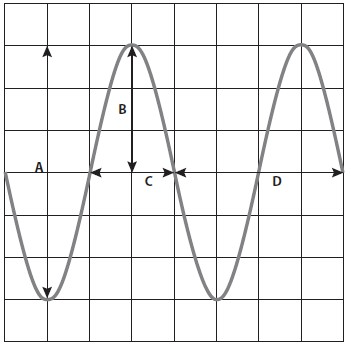
a B
b C or D
400
The table gives information for two waves that will meet to reinforce. Copy the table and complete the missing information about the one wave that is formed.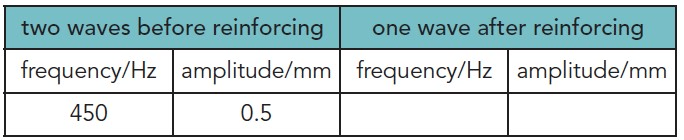
frequency 450 (Hz), amplitude 1.0 (mm)
400
The planet Mars has two moons called Phobos and Deimos. Scientists have evidence that Phobos and Deimos are asteroids that were captured by the gravity of Mars, so they remain in orbit around Mars.
Suggest how the composition of rocks on Phobos and Deimos would compare with the rocks on the planet Mars if Phobos and Deimos were: formed by a collision of another object with Mars.
The composition of the rocks on the two moons would be very similar to that of Mars, and very similar to each other.
400
The light year, ly, is a unit of distance measurement used in space. The diameter of the Solar System is 0.001 ly. The diameter of the Orion nebula is 24 ly.
Calculate how many times bigger, the diameter of the Orion nebula is than the diameter of the Solar System.
24 / 0.001 = 24 000
400
Scientists think that the Earth’s magnetic field has reversed 183 times in 83 million years. Calculate the average time between reversal events.
83 000 000 / 183 = 454 000 years
500
Look at the four sound waves, A, B, C and D.
Copy and complete these sentences. Choose your answers from the list below.
increases, decreases, stays, the same
a) When the sound changes from A to B, the amplitude of the wave ………….
b) When the sound changes from A to B, the loudness of the sound ………….
c) When the sound changes from C to D, the pitch of the sound ………….
d) When the sound changes from C to D, the loudness of the sound ………….
e) When the sound changes from C to D, the frequency of the wave ………….
a increases
b increases
c decreases
d stays the same
e decreases
500
Two sound waves have equal frequencies of 600 Hz. The amplitude of one of the waves is 0.25 mm.
a) State the amplitude of the other wave required for the two waves to cancel.
b) State the amplitude after the waves cancel.
a) 0.25 mm
b) zero / 0 mm
500
Models of the formation of the Solar System show that collisions between planet-size objects would have been common soon after the Solar System formed. Suggest why these collisions are no longer common.
Most of the objects that were travelling in paths close to those of planets have already collided with planets; soon after the Solar System was formed, there would still be many left-over objects; the Solar System was still developing for quite some time after the planets were first formed; idea that the Solar System has become more stable over time.
500
Outline the process by which a new star forms.
Dust and gas particles are pulled together by gravity; as the object grows, the force of gravity increases; the increasing force of gravity attracts more material; as the object grows larger the pressure inside increases; high pressure inside the object can start reactions that give out heat and light.
500
Describe how each of these provides evidence for the movement of tectonic plates
a) the fossil record
b) the alignment of magnetic materials in rocks.
a) Some fossils of the same species are found in continents that appear as if they could fit together, such as South America and Africa. This suggests that these continents were once joined. Tectonic plate theory explains how the continents have moved apart.
b) Magnetic materials in molten rocks line up with the Earth’s magnetic field and remain in this alignment when the rock solidifies; the Earth’s magnetic field reverses over periods of millions of years. Rocks either side of mid-ocean ridges