Vocabulary
Scientific Method & Laws/Theories
Gravity
Density
Hands-on Lab Connections
100
The amount of matter that makes up an object is called ____________.
Mass
100
A hypothesis must ALWAYS include the word...
BECAUSE
100
What two variables affect how strong gravity is?
For an extra 100 points, where is the gravity of an object focused?
Mass and Distance
ITS CENTER!!!
100
What is the formula for calculating density?
Density= Mass/Volume
100
Name something the density towers showed us about density.
Objects with less density float on top of objects with more density
200
The variable I change is the ____________.
Independent Vairable
200
What do we do to a theory if new information is presented that opposes our intial findings?
ALTER THE THEORY
200
A chair has a mass of 10 kg on Earth. Is the mass of the chair on Mercury greater than, less than, or equal to 10 kg?
Will the weight increase, decrease, or remain the same?
(Note: Earth is about x18 more massive than Mercury)
Equal to
Decrease
200
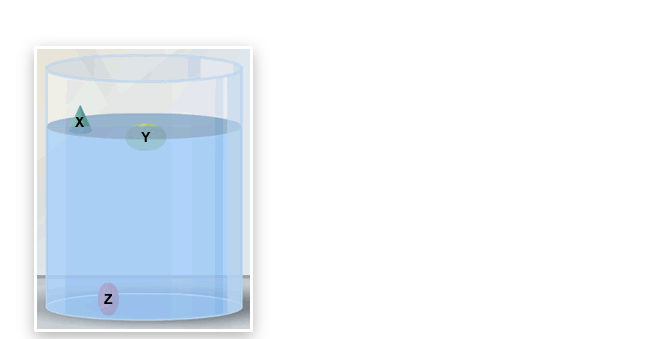 Rank the objects from least dense to most dense
Object X, Object Y, Object Z
200
Explain why the coke can floated but the diet coke can sank?
Use the words mass and density in your answer.
The coke can has more mass in the form of added sugar, and when mass is added to an object without changing volume, density increases.
300
The amount of stuff within a particular volume is a weird way of defining ____________.
Density
300
How many variables should you change at a time when conducting a scientific experiment?
Why?
ONLY ONE VARIABLE AT A TIME!!!
If we change more than one variable, the cause of the results (the independent variable) is unclear.
300
Which of these four pairings would have the strongest gravitational force?
A: Two small asteroids fragments close to each other
B: A large gas giant (Saturn) and a small moon really far apart
C: A medium-sized star close to Earth
D: Two massive star clusters right next to each other
D
300
An apple has a mass of 74.4 g and volume of 86 cm3. What is the density of the apple? Round to the nearest hundredths and INCLUDE YOUR UNIT!!!
Will it sink or float?
0.87 g/cm3 and FLOAT
300
Describe how you would use the gravity well to prove that increasing mass leads to more gravity.
Then, describe how you would use the gravity well to prove that increasing distance leads to less gravity.
Your description should include what you would change AND what you would observe when you change it.
To show increasing mass would lead to more gravity, you can change the mass in the center into larger and larger masses. When this mass is changed, the marbles move quicker as the mass increases, representing increased gravity.
To show increasing distance would lead to less gravity, you can move the marbles farther and farther out. As the marbles are farther from the center mass, the marbles require more time to reach the center, representing decreased gravity.
400
A measure of how much gravity is pulling on an object is its ____________.
Weight
400
"Living things learn through reacting to stimuli in their environment rather than learning through personal feelings because our ancestors were hardwired to react to bad weather and hunger which are basic human necessities."
Is this a theory or a law? Explain
THEORY (This is the theory of Behaviorism in psychology)
It includes the word because, thus providing an explanation
400
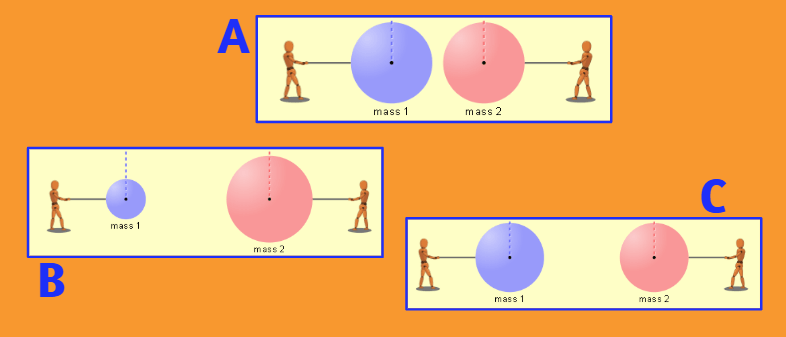 Which diagram represents the weakest gravitational attraction? Explain your answer
B
Gravity depends on mass and distance. When the mass between the two objects is smaller, gravity weakens, When the distance between the two objects is farther, gravity also weakens. Diagram B has the largest distance and the smallest combined mass.
400
Fill in the blanks:
If mass is unchanged but volume decreases, density will ___________.
If volume is unchanged but mass decreases, density will ___________.
If mass stays the same but volume increases, density will ___________.
If volume stays the same but mass increases, density will ___________.
-increase
-decrease
-decrease
-increase
400
The paper towel demonstration not only taught us about variables and constants but also walked us through the scientific method step by step!!!
Thinking about the process we followed with the paper towel "spillage," attempt to list the 5 steps of the scientific method IN ORDER
1.) Make an observation/Ask a Question
2.) Form a hypothesis
3.) Conduct the experiment
4.) Collect and Analyze Data
5.) Form a conclusion
500
In science, a statement of what is guaranteed to occur every single time an observation is made is called a ____________.
Law
500
You and a friend decide to test which brand of mosquito repellent is the most effective. Acting as the living sacrifice, you decide to be the one the mosquitoes will bite.
You spray one arm with a brand of mosquito repellent and leave the other arm unsprayed. After two hours, you record how many bites are on both arms. You then wash off your arms and repeat this experiment with the two other brands of repellent.
What is the IV? DV? 2 constants?
IV= Brand of mosquito repellent
DV= # of bites
Constants= Same amount of repellent
Same amount of time to bite
Same person
500
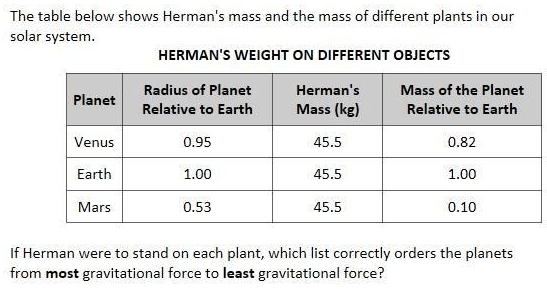 A: Earth, Mars, Venus
B: Earth, Venus, Mars
C: Venus, Mars, Earth
D: Venus, Earth, Mars
B
500
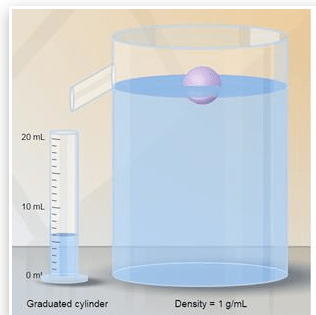 Using the image below and the fact that the ball has a mass of 3.5 g, find the density of the ball
0.7 g/cm3
500
Explain why you developed theories about the Humanaris boxes rather than laws about them.
Your explanation should have at least one sentence that mentions the difference between a law and a theory and another sentence that mentions how that difference relates to the boxes.
(I have more than two sentences though)
By definition, laws describe what happens every time something happens. Since the Humanaris will not allow us to open the box, we can't say what will happen every time. Instead, we are attempting to explain the data we collected via our touch and our sound. Theories attempt to explain data, so we formed theories.