Science Investigations 1
Plants Investigations
Animal Investigations
Rock & Investigation
Mixed Investigations
100
Scientist Sue has discovered a new plastic that conducts electricity. She writes down her results and all the steps to make the plastic. Then she shares the results with other scientists.
Why do scientists share their discoveries in this way?
A. because they want to be famous
B. because they want others to repeat and use their work
C. because they want to make money from their discoveries
D. because they are nice people
B. because they want others to repeat and use their work
100
Janice wants to grow flowers in her backyard. She has four types of dirt that she could use, but she is unsure of which type would allow the flowers to grow the best. In order to figure this out, she sets up an investigation. Janice puts each type of soil in a different pot and plants a flower in each pot.
What scientific question should Janice ask from her experiment?
A. Which soil type allows the flower to grow the most?
B. Which soil looks the best?
C. Which soil is the oldest?
D. Which soil type is preferred by most people?
A. Which soil type allows the flower to grow the most?
100
Sally's chicken has three new baby chicks.
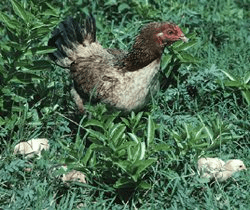
Which question could Sally answer by observing (measuring) the mass of the chicks each week?
A. How much are the chicks growing each week?
B. Do chicks like to take baths when they are young?
C. Do the chicks look more like the mother or the father?
D. Are the chicks' feathers changing colors as the chicks grow?
A. How much are the chicks growing each week?
100
Metamorphic rocks used to be igneous and sedimentary rocks. They were changed into metamorphic rocks by
A. weathering.
B. heat and pressure.
C. change in climate.
D. volcanic eruption.
B. heat and pressure.
100
In science, which of the following can only be made using the senses of sight, sound, touch, taste, and smell?
A. interpretations
B. predictions
C. conclusions
D. Observations
D. Observations
200
Valerie and her friend Peeta are studying for a science test together. Valerie asks Peeta to describe how heat energy is transferred. Peeta tells her that heat energy is always transferred from cold objects to warmer ones.
Valerie thinks that Peeta is wrong, so she asks him to defend his claim. Peeta says that he is right because, "Everyone knows that heat moves from cold objects to warm ones."
Should Valerie believe Peeta's claim?
A. No, only scientists are allowed to study heat energy.
B. Yes, Peeta knows more about science than Valerie does.
C. Yes, Peeta provided good scientific evidence to support his claim.
D. No, saying that "everyone knows" something is not good scientific evidence.
D. No, saying that "everyone knows" something is not good scientific evidence.
200
Ms. Landford's class is learning to design experiments. The students know that they need to ask a testable question before designing an experiment to answer the question.
What is a testable question the students could ask and then design an experiment to answer?
A. If a plant is turned upside down, which way will the roots grow?
B. Do squirrels like to climb trees?
C. Ms. Landford's class has 12 boys and 13 girls.
D. Peanuts are not really nuts.
A. If a plant is turned upside down, which way will the roots grow?
200
A good experiment can be planned only after asking a scientific question. Which of the following is a good scientific question?
A. What does an astronaut think about the atmosphere?
B. How does the color of a plant affect whether it likes to be in the cold?
C. How does stirring affect the rate at which a substance dissolves?
D. What is the effect of the weather on the color of clothes my friend likes to wear?
C. How does stirring affect the rate at which a substance dissolves?
200
Sand on a beach is covered by other layers of sand over time. The extra layers compress the first layer, packing it tighter and tighter. Over time, the bottom layers of sand have formed into sandstone, with colored bands showing the different layers.
What kind of rock can sandstone be classified as?
A. volcanic rock
B. sedimentary rock
C. metamorphic rock
D. igneous rock
B. sedimentary rock
200
Nicole did an investigation about fruit. She collected some data during the investigation. She wants to display the data. She is making a bar graph.
Which data did she most likely collect?
A. how many of her friends like each kind of fruit
B. the number of friends with bananas in their lunch each day this week
C. the percent of her friends that have fruit trees at home
D. the number of apples she ate each day this month
A. how many of her friends like each kind of fruit
300
Mike has several pets, including a snake, a rabbit, and a turtle. While he was playing with his pets, he noticed that each one moved differently and with a different speed.
Mike decided to do a scientific experiment to learn more about the movement of his pets.
Which of the following would be a valid scientific question for Mike to ask about the way his pets move?
A. Which pet can move the fastest?
B. What does each pet like to eat?
C. Which pet is largest?
D. Which pet enjoys moving the most?
A. Which pet can move the fastest?
300
Which question about plants can be answered scientifically by classifying?
A. Is an oak tree a plant?
B. What does a plant need in order to survive?
C. What kinds of animals like to eat dandelion plants?
D. Which kind of flower smells the best?
A. Is an oak tree a plant?
300
Observations are made by using one of the five senses (touch, sight, taste, smell, hearing) to gather information.
Fatima went to the zoo with her parents. She saw the animal shown in the picture below. She wants to write in her science journal about the animal.
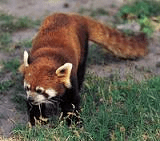
Which of the following is a scientific observation that she could write about the animal?
A. The animal is very cute.
B. The animal eats insects.
C. The animal has fur.
D. The animal is from Asia.
C. The animal has fur.
300
Because of the way they form, fossils are usually only found in _______ rocks.
A. sedimentary
B. igneous
C. mineral
D. metamorphic
A. sedimentary
300
Mia has a toy car. She uses two boards to make ramps. She makes one of the ramps higher than the other. She wants to find out if the height of the ramp affects how far the car rolls. She rolls the car down both ramps.
How can Mia collect data to answer her question?
A. weigh the car
B. measure the length of the car
C. buy new toy cars
D. measure how far the car rolls
D. measure how far the car rolls
400
To answer questions about the natural world, a scientist can make measurements, describe objects or living things, classify objects or living things, group and sort, or put things in order.
Which of the following questions could be answered by describing objects or living things, without doing any measuring, classifying, grouping, or sorting?
A. What kinds of animals have fur as a body covering?
B. What does the Moon look like at different times of the month?
C. What is the temperature outside today?
D. What is the average height, in centimeters, of students in my class?
B. What does the Moon look like at different times of the month?
400
Jerome plants seeds. He waters the seeds. He measures the plants. He graphs the height of each plant.
What did Jerome do to collect data?
A. water the seeds
B. plant the seeds
C. draw the graphs
D. measure the plants
D. measure the plants
400
There are two groups of earthworms on the sidewalk. One group is on a shady, moist area on the sidewalk, and they are moving. The other group is on a very sunny, dry area of the sidewalk, and none of the worms in this group are still living.
What question could be asked to investigate the reason for these observations?
A. What kind of living environment do earthworms need?
B. What kinds of birds eat earthworms?
C. How do earthworms get on the sidewalk?
D. Why do earthworms crawl?
A. What kind of living environment do earthworms need?
400
Which type of rock is created when lava cools and hardens?
What is an Igneous rock?
400
According to the chart, the ice cream store sold _______ more chocolate ice cream cones than vanilla ice cream cones on Tuesday. 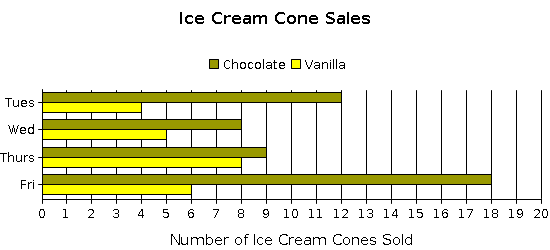
A. 12
B. 8
C. 4
D. 16
B. 8
500
Paula set up the following experiment:
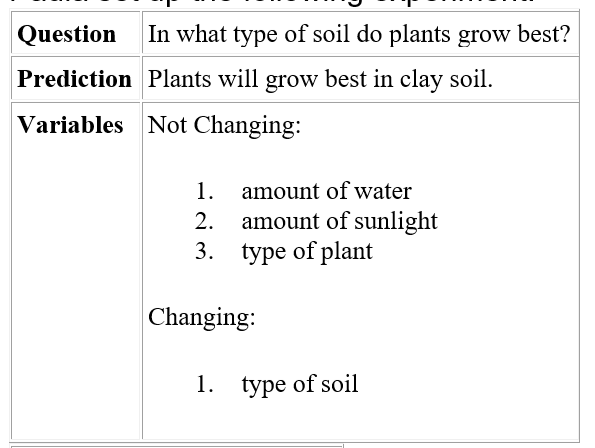
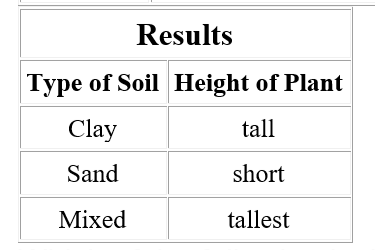
Which of the following is the best conclusion for Paula's experiment?
A. The prediction was wrong because the plant in the sandy soil grew the tallest.
B. The prediction was right because the plant in the clay soil grew the tallest.
C. The prediction was right because the plant in the mixed soil grew the shortest.
D. The prediction was wrong because the plant in the mixed soil grew the tallest.
D. The prediction was wrong because the plant in the mixed soil grew the tallest.
500
Brad wants to learn about what happens to the materials that make up a plant after the plant dies.
Which of the following could help Brad answer this question?
A. Brad could go outside to look at trees and draw pictures of them in his notebook.
B. Brad could plant a rosebush in a sunny area and measure how tall it grows.
C. Brad could gather several dead leaves and watch what happens to them over several weeks.
D. Brad could ask all of his classmates to tell him their favorite kind of plant.
C. Brad could gather several dead leaves and watch what happens to them over several weeks.
500
Elliot wants to compare the density of four objects to the density of water. Elliot knows that if an object sinks in water, it has a higher density than water and that if an object floats in water, it has a lower density than water.
Which of the following is a scientific investigation that Elliot could conduct to test the densities of the objects?
A. Elliot could put the four objects in water to see if they sink or float.
B. Elliot could ask his teacher which object has the greatest density.
C. Elliot could put the objects in water to see how much water they absorb.
D. Elliot could look up the densities of the objects in a textbook.
A. Elliot could put the four objects in water to see if they sink or float.
500
_______ form when magma or lava cools down and becomes solid.
What is an Igneous rock?
500
Lewis and Carter watched their teacher mix baking soda and vinegar. The mixture made a lot of bubbles.
Lewis thinks that the mixture made bubbles because it was very hot and it boiled. Carter thinks the mixture changes to make a new gas and the gas made the bubbles.
What could they do help them decide which explanation is correct?
A. put the mixture in a clear container while it is bubbling
B. draw a picture of how the baking soda and vinegar look
C. make the mixture again using more vinegar than baking soda
D. measure the temperature of the mixture while it is bubbling
D. measure the temperature of the mixture while it is bubbling