Testing Relationships
Bivariate and Multivariate Analysis
Correlation
Regression
Potpourri
200
Commonly labeled as H0, this is used to describe the absence of a statistical relationship between two or more variables.
Null hypothesis
200
This is the data analysis technique designed to test hypotheses involving two variables.
Bivariate analysis
200
This is the type of statistical correlation measure of the strength and direction of a linear relationship - the one primarily taught in this class.
Pearson's r
200
OLS regression is best suited to a dependent variable with this level of measurement.
Continuous/ratio
200
This type of R2 value accounts for the number of independent variables (IVs).
Adjusted R2
400
This is the "score" representing the number of standard deviations (σ or S) from the mean.
z score
400
This is the data analysis technique designed to test hypotheses involving more than two variables
Multivariate analysis
400
Pearson's r ranges between these two values.
-1 to 1
400
This is the percentage of variation in Y (DV) that can be explained by the variation in the independent variable(s).
r-squared
400
This is a statement about the value or values of a population parameter. A hypothesis proposed as an alternative to the null hypothesis, typically represented by H1 (H2, H3, and so on).
Alternative hypothesis or research hypothesis
600
These are probability estimates of the true parameter value in terms of its occurrence between constructed boundaries - when calculating, we get two numbers for this.
Confidence intervals
600
In this type of relationship, variables move in the same relative direction, but not necessarily at a constant rate.
Monotonic relationship
600
When considering Pearson's r correlation, the -/+ value of the calculated number represents this.
The directionality of the relationship
600
This is a nonlinear regression model that relates a set of explanatory variables to a categorical (e.g., binary) or ordinal DV.
Logistic regression
600
If one were to add up all errors/residuals, especially when utilizing a computer to calculate the best-fit line, this is the cumulative sum of values for the errors/residuals.
0
800
with confidence intervals, Za/2 is known as the ____________.
Critical value
800
This shows the joint or bivariate relationship between two categorized (nominal and/or ordinal) variables.
Cross-tabs or cross-tabulation
800
With Pearson's r, a value of 0 indicates this.
No correlation
800
This is a statistical analysis technique for measuring the mathematical relationships between more than one IV (i.e., multiple) and a DV while controlling for all other IVs in the equation.
Multivariate regression
800
In statistics, these come from effects of “omitted causes” of the DV, measurement errors in the DV, and/or natural variation among subjects included in the sample (n).
Errors or Residuals
1000
In the formula below, σ / the square root of n/N is called _____________: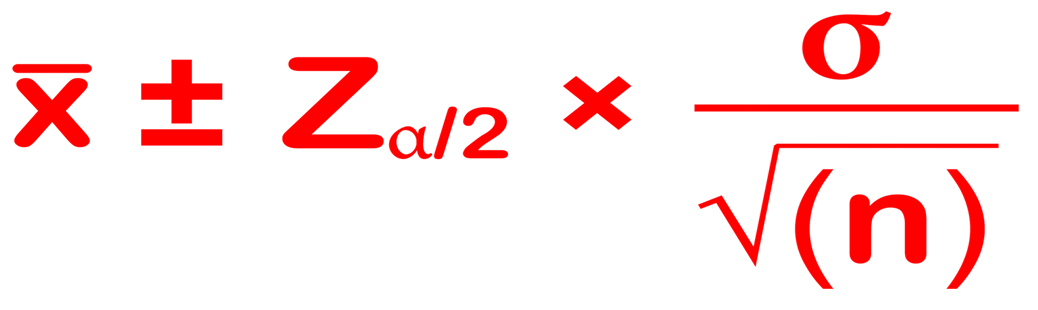
Standard error of the mean
1000
In this type of (good, and not overlooked) 3-way relationship. the strength, direction, and nature of the X–Y relationship depend on levels of the (grouping) control variable (Z).
Statistical interaction, interaction, or moderation
1000
With Pearson's r, an absolute value of 1 (aka, -1 or +1) indicates this.
A perfectly positive association
1000
Though we often get regression coefficients as an output representing the nature of the relationship/association between an IV and DV, we can often convert this to a(n) ____________, which is a measure of how strongly an event is associated with exposure.
Odds ratio
1000
This is a statistic used to test whether a relationship is statistically significant in a cross-tabulation table; in other words, it measures the discrepancy between frequencies actually observed and those we would expect to see if there was no population association between the variables.
Chi-Square