Ecosystems and Sustainability
Electricity and Energy
Atoms, elements and nuclear
Bonds and Reactions
Wildcard
100
Difference between abiotic and biotic? (With examples)
Biotic = living (e.g., animals, plants, bacteria).
Abiotic = nonliving (e.g., rocks, water)
100
What is 'current'?
Current is the flow of electrons.
100
What are the three subatomic particles in an atom?
Proton, Neutron, Electron
100
What do atoms do with electrons in a covalent bond?
They share their electrons.
100
Who is this?
Xiao Long Gao
200
What is the role of decomposers in a food web?
To break down biotic waste and recycle nutrients through the ecosystem
200
Define the law of conservation of energy.
The law of conservation of energy states that 'Energy cannot be created or destroyed - only change forms).
200
What does the atomic number tell you about an element?
The number of protons (and electrons for first 20 elements)
200
What are the two products of a complete combustion?
Carbon dioxide and water
200
What does a catalyst do in a chemical reaction?
It speeds up the rate of reaction (without being used up)
300
What is the difference between a renewable and non-renewable resource?
Renewable resources and replenished faster than they are consumed. Non-renewables aren't.
300
You have 3 lightbulbs in series, and one breaks. What happens and why?
They all go out - one breaking means the flow of current is cut off for the others as well, hence they turn off.
300
How do you determine the number of neutrons in an atom?
Atomic mass - atomic number (rounded to the nearest 1)
300
In ionic bonding, what happens to the metal's electrons?
They are given away to the non-metal (anion)
300
What's her name 
Annie
400
List the trophic levels that are found on a food web.
Producer, primary consumer, secondary consumer, tertiary consumer, decomposer.
400
Why is it generally considered that it is impossible to have 100% efficient energy transformations?
You almost always lose some energy to heat/sound as friction, etc.
400
An isotope has a half-life of 10 years. What percentage of the original sample is left after 40 years?
(50%)4 = 6.125%
400
Balance the following equation:
__C3H8 + __O2 → __CO2 + __H2O
C₃H₈ + 5O₂ → 3CO₂ + 4H₂O
400
Name one advantage and disadvantage of nuclear energy use.
Advantage - little waste, low emissions, high output.
Disadvantage - radioactive waste disposal, possible meltdown
500
Describe one environmental problem caused by industrial farming practices.
E.g., soil erosion, deforestation, reduced biodiversity.
500
In the 'pipe' analogy for electricity, what do each of the following represent - V, I, R.
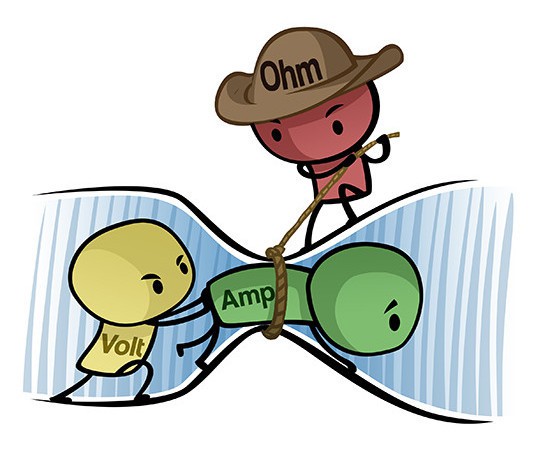 V (Voltage) - the guy pushing current through.
I (Current) - the guy getting pushed through.
R (Resistance) - the guy trying to stop current from passing through.
500
Name & describe the three types of nuclear radiation
Alpha radiation is a helium nucleus made of two protons and two neutrons, and it has low penetrating power.
Beta radiation is a fast-moving electron with medium penetrating power.
Gamma radiation is a high-energy electromagnetic wave with very high penetrating power.
500
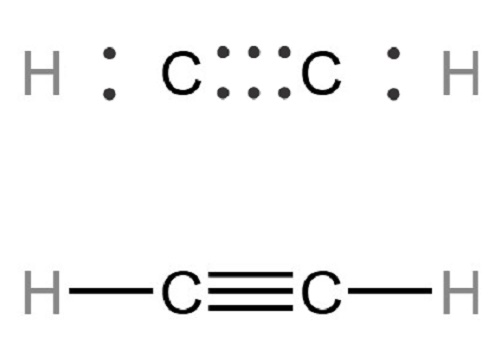
Draw the lewis dot diagram for a molecule of ethyne (C2H2)
500
Why don't I want you guys eating in the lab?
U r grubby and don't clean up properly. Then you eat on table that hasn't been cleaned properly. Then eat chemical. And die.