Respiratory
Acid Base/Electrolyte
Fluid and Electrolyte
Who knows
Cardiac II
Immunity
Pot Pourri
100
Pneumonia management may include what?
1. antibiotics
2. supplemental o2
3. Turning and repositioning in at risk patients
4. Pursed lip breathing
100
Interpret this ABG
pH 7.35
CO2 67
HCO3 30
FULLY COMPENSATED RESPIRATORY ACIDOSIS
The pH is now normal. The deviation likely moved up. CO2 is significantly elevated. Bicarb moved to compensate.
100
What are some reasons a patient can develop Hyperkalemia?
1. Kidney Problem
2. ACE Inhibitors
3. Hemolysis (Make sure you can think of which diseases/injuries can cause this)
4. Certain foods, salt substitutes
sickle cell, trauma
4. Acidosis
Are we missing any more?
100
Administer Epinephrine Immediately
- Priority intervention.
- Reverses airway swelling, bronchoconstriction, and hypotension.
Maintain Airway and Administer High-Flow Oxygen
- Assess for stridor, tongue swelling, and respiratory distress.
- Prepare for advanced airway management if needed.
Establish IV Access and Administer Fluids
- Treat hypotension and shock.
- Normal saline boluses may be required.
Priorities for Anaphylaxis
100
When caring for a patient with congestive heart failure, what is something important for the nurse to teach the patient regarding diet and over the counter drugs?
Limit the use of NSAIDS (worsen HTN, promote fluid retention).
Limit Salt intake
100
The charge nurse observes the primary nurse interacting with a client. Which action by the primary nurse warrent immediate intervention by the RN charge nurse?
1. The nurse explains the IVP diuretic will make the client urinate
2. The nurse dons nonsterile gloves to remove the client's dressing
3. The nurse administers a medication without checking for allergies
4. The nurse asks the UAP for help moving a client up in bed.
3. Checking for allergies is of the rights of medication administration. Is it the right drug? Even if the drug is the one the HCP ordered, it is not the right drug if the client is allergic to it . The nurse should always assess client allergies prior to administration.
Test taking Hint: The tem asks the test taker to determine which is the incorrect action, an "except" question. Three answers are actions the nurse should take
100
A patient with asthma presents to the emergency department with the following findings:
- Respiratory rate: 32/min
- SpO₂: 88% on room air
- Difficulty speaking in complete sentences
- Use of accessory muscles
- Expiratory wheezes bilaterally
Which nursing action should be performed first?
A. Encourage fluid intake
B. Administer prescribed bronchodilator therapy
C. Teach pursed-lip breathing
D. Obtain a sputum culture
Answer: B. Administer prescribed bronchodilator therapy
Rationale: The patient is experiencing acute respiratory distress from bronchospasm. The priority intervention is rapid administration of a short-acting bronchodilator (such as albuterol) to open the airways and improve oxygenation. Airway and breathing take priority according to ABCs.
200
What are some ways to diagnose Tuberculosis?
1. Chest X-ray
2. Sputum Culture (AFB)
3. Mantoux skin test
4. Gold top (quantiFERON blood test)
200
Interpret this ABG
pH 7.19
CO2 40
HCO3 - 18
Metabolic Acidosis
200
A dehydrated patient will likely have which lab abnormalities
Sodium ____
Urine Specific Gravity ____
BUN _____
Elevated
Elevated
Elevated!!!
Know the normal values
200
Complications of unmanaged/untreated HTN are?
1. Renal Failure
2.Heart Failure
3. Aneurysms
4. Stroke
200
A Deep Venous Thrombosis manifests as ______ s/s?
unilateral leg pain,
erythema
swelling
+ homan's sign
200
The client is known to be HIV positive. Which data indicates that the client has now progressed to the diagnosis of AIDS?
1. The client's CD4+ count is 189
2. The client has an Hgb of 9.4 and Hct of 29.1
3. The client's chest xray shows infiltrate
4. The client reports a headache unreleived by acetaminophen
1. The diagnosis of AIDS is determined by predefined criteria: Positive HIV, a CD4 count less than 200, and one or more of the following AIDS defining illnesses" fungal infection candidiasis of the bronchi, lungs, esophagus, or PJP disseminated extrapulmonary coccidioidomycosis, disseminated extrapulmonary histoplasmosis, CMVdisease other than liver, spleen or nodes, toxoplasmosis, Kaposi sarcoma,etc.
200
A nurse is assessing a patient with severe hypocalcemia. Which assessment finding requires immediate follow-up?
A. Constipation
B. Positive Chvostek's sign
C. Increased bone density
D. Weight gain
Answer: B. Positive Chvostek's sign
Rationale: A positive Chvostek's sign (facial muscle twitching when tapping the facial nerve) indicates neuromuscular irritability associated with hypocalcemia. Severe hypocalcemia can progress to tetany, seizures, and laryngospasm, making this a priority finding.
300
What precautions should the nurse advocate for with a patient who presents to the hospital with a complaint of fever, night sweats, weight loss, hemoptysis?
1. Airborne/Droplet
TB patients need to be put in isolation to minimize spread of disease.
300
What are some causes of Acidosis?
Hypoxemia
DKA
Diarrhea
Toxicity/OD
Can you name others?
300
A patient has been taking Spironolactone for the past 3 months. What complication should the nurse anticipate?
Hyperkalemia
300
A 64 year old male presents to the ER with a complaint of chest pain. What are some important diagnostic tests the nurse should anticipate?
ECG
Cardiac Troponin I
300
Respiratory things that go BIPA
Bronchoscopy Thoracentesis Chest tube insertion Lung biopsy Tracheostomy
300
The 26-year-old female client reports a low grade-fever, arthralgias, fatigue and a facial rash. which laboratory tests should the nurse expect the HCP to order if SLE is suspected?
1. Comprehensive metabolic panel and liver functions tests.
2. Complete blood count and antinuclear antibody tests
3. Cholesterol and lipid profile tests
4. Blood urea nitrogen and glomerular filtration rate test
2. No single laboratory tests diagnoses SLE but the client usually presents with moderate to severe anemia, thrombocytopenia, leukopenia, and a positive antinuclear antibody test.
300
What am I?
- Bone pain
- Kidney stones
- Constipation
- Lethargy/confusion
- Shortened QT interval
"High Calcium = Groans, Stones, Bones, and Moans"
400
1 37 year old M presents to the ER with a c/o productive cough (green phlegm) x 3 days. The patient has the following VS
T - 101.9
RR - 20
O2 93%
BP 118/76
What is the likely cause of the patient's symptoms?
Pneumonia
Difference between CAP and HAP??
400
Symptoms of hypernatremia include?
- Seizures.
- Abdominal Cramping/nausea
- Lethargy.
- Tendon Reflex down
- Loss of urine/decreased
- Orthostatic Hypotension
- Shallow Respirations
- Spasms of muscles
- Brain cells shrink
400
A patient taking Loop Diuretics may develop
Hypokalemia
Hypotension
Dehydration
400
Immunity things that can go BIPA
Transplant-Related Procedures
- Bone marrow transplant (HSCT)
- Stem cell infusion
- Kidney transplant
- Liver transplant
- Heart transplant
- Lung transplant
- HIV Patient
Bronchoscopy- B = Hemoptysis/bleeding
- I = Infection
- P = Airway trauma/perforation
- A = Sedation reaction
Lupus Patient
Kidney Biopsy- B = Hemorrhage
- I = Infection
- P = Organ injury/perforation
- A = Local anesthesia reaction
Leukemia Patient
Bone Marrow Biopsy- B = Bleeding
- I = Infection
- A = Anesthesia reaction
Stem Cell Transplant Patient
Central Line Insertion- B = Bleeding
- I = Central-line infection
- P = Vessel injury/perforation
- A = Sedation reaction
400
If Hypertension goes unmanaged for years what will likely happen?
1. Renal Dx
2. CHF
3. Stroke
400
The client comes to the ED reporting dyspnea and wheezing after eating at a seafood restaurant. The client cannot speak and has a bluish color around the mouth. Which intervention should the nurse implement first?
1. Initiate an IV with normal saline
2. Prepare to intubate the client
3. Administer 100% oxygen
4. Ask the client about an iodine allergy
3. The client is cyanotic with dyspnea and wheezing. The nurse should administer should administer oxygen first.
400
A nurse is assessing a patient experiencing an acute asthma exacerbation. Which assessment finding indicates the patient's condition is worsening and requires immediate intervention?
A. Expiratory wheezing throughout the lung fields
B. Respiratory rate of 24 breaths/minute
C. Absence of wheezing with increasing shortness of breath
D. Productive cough with clear sputum
Answer: C. Absence of wheezing with increasing shortness of breath
Rationale: A sudden absence of wheezing in a patient with severe asthma may indicate minimal air movement ("silent chest"), a sign of impending respiratory failure and a medical emergency.
500
Having the patient use Incentive Spirometry, cough, managing their pain, ambulating after surgery or during hospitalization are good ways nurses help patient prevent getting ______
Pneumonia
500
Central pontine myelinolysis is a complication from
correcting hyponatremia too quickly, slow sodium replacement to avoid
500
A patient with Hyperkalemia received Kayexalate. How does this medication work?
As the resin passes along the intestine or is retained in the colon after administration by enema, the sodium ions are partially released and are replaced by potassium ions. For the most part, this action occurs in the large intestine, which excretes potassium ions to a greater degree than does the small intestine.
https://www.accessdata.fda.gov/drugsatfda_docs/label/2009/011287s022lbl.pdf
500
A 45 year old Female with epigastric pain, nausea, and vomiting should be assessed with ________ to r/o_______ as these symptoms are called _____________
ECG
STEMI!!!
Atypical MI symptoms/Anginal Equivalents
500
Administer Short-Acting Bronchodilator (Albuterol)
- First-line treatment for acute bronchospasm.
- Rapidly improves airflow.
Assess Respiratory Status Frequently
- Monitor breath sounds, respiratory effort, SpO₂, accessory muscle use, and ability to speak.
- Watch for a "silent chest," a sign of impending respiratory failure.
Administer Supplemental Oxygen
- Maintain adequate oxygenation.
- Monitor pulse oximetry and response to treatment.
3 Priority Nursing intervention for Asthma
500
The client is diagnosed with mild intermittent asthma . Which medications should the nurse discuss with the client?
1. Daily inhaled corticosteroids.
2. Use of a rescue inhaler
3. Use of systemic steroids
4. Leukotriene agonists
2. Clients diagnosed with intermittent asthma will have exacerbations treated with rescue inhalers. Therefore, the nurse should teach about rescue inhalers.
Test taking strategies: In the stem, two words are giving the test taker a clue about the correct answer. "Mild" and " intermittent" indicate the client is not experiencing frequent or escalating symptoms. Steroid medications can have multiple side effects.
500
The nurse reviews laboratory results for four patients. Which patient is at greatest risk for developing cardiac dysrhythmias?
A. Calcium level 9.2 mg/dL
B. Calcium level 8.8 mg/dL
C. Calcium level 6.9 mg/dL
D. Calcium level 10.1 mg/dL
Answer: C. Calcium level 6.9 mg/dL
Rationale: A normal total calcium level is approximately 8.6–10.2 mg/dL. A calcium level of 6.9 mg/dL indicates significant hypocalcemia, which can prolong the QT interval and increase the risk of dysrhythmias.
600
Nursing diagnosis associated with a patient with pneumonia include ....
Ineffective airway clearance
Impaired Tissue Perfusion
Activity Intolerance
Know the implications and reasoning behind these
600
A patient given Spironolactone and Metoprolol for heart failure is expected to have
a. normal K, HR 67
b. Hyper K, HR 90
c. Hypo K, HR 59
d. Hyper Na, HR 100
A
600
Two patients
First with a serum sodium of 173mg/dl who is symptomatic would likely develop what medical problem? What would be the appropriate intervention?
Second with a serum sodium of 122mg/dl who is symptomatic would likely develop what medical problem? What would be the appropriate intervention?
First Pt has Hypernatremia, Can develop Seizures, Need to
✅ Seizure precautions
✅ administer Hypotonic saline (0.45 NS or water)
Second Pt has Hyponatremia, can develop Seizures
Need to
✅ Restrict free water intake (if appropriate to the cause)
✅ Administer hypertonic saline (3% sodium chloride) as prescribed for severe symptomatic hyponatremia
600
Position in High Fowler's or Tripod Position
- Promotes lung expansion and decreases work of breathing.
- Improves ventilation and oxygenation.
Administer Oxygen as Prescribed
- Target SpO₂ typically 88–92% unless otherwise ordered.
- Monitor for signs of worsening respiratory distress.
Administer Bronchodilators and Assess Response
- Albuterol and other bronchodilators help open airways.
- Reassess lung sounds, respiratory rate, and oxygen saturation.
COPD: 3 Priority Nursing Interventions
600
Red Flag Signs 🚩
- Silent chest
- Inability to speak
- SpO₂ < 90%
- Accessory muscle use
- Altered mental status
What is Asthma?
600
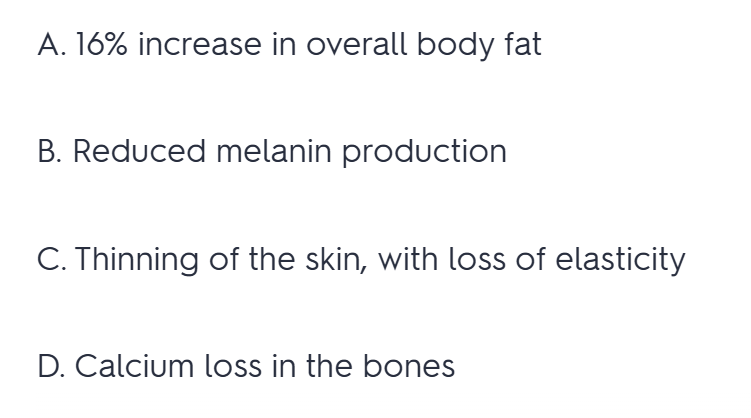
A home health nurse knows that a 70-year-old male client who is convalescing at home following a hip replacement is at risk for developing pressure ulcers. Which physical characteristic of aging puts the client at greatest risk?

600
What am I?
- Tingling
- Tetany
- Trousseau's sign
- Chvostek's sign
- Seizures
- Prolonged QT interval
"Low Calcium = Twitchy and Seize-y"