"Trends" (unit 4)
Unit 4 Vocabulary
"Users" (unit 5)
Unit 5 Vocabulary
"Parasocial" (unit 6)
Unit 6 Vocabulary
100
A 2016 viral social media trend where people freeze in place while a video is recorded moving around them.
Mannequin challenge
100
Feeling connected to or remembering the past in a sentimental way
nostalgic
100
Why do social media platforms keep sending notifications even when users aren’t active?
Retention. To pull users back into an engagement loop and keep them engaged.
100
someone who reads content but rarely or never posts
lurker
100
What do parasocial relationships depend on instead of real-life contact?
A) Mutual friendship
B) Physical proximity
C) Illusion of intimacy
D) Direct communication
C) Illusion of intimacy
100
A one-sided emotional connection where a person feels attached to a public figure, creator, or fictional character who does not personally know them
parasocial
200
A social media trend describing a simple or random meal made of snacks or small foods instead of a traditional full meal
girl dinner
200
turning an action into something you do automatically
habit formation
200
Which of these terms encompasses all of the other terms:
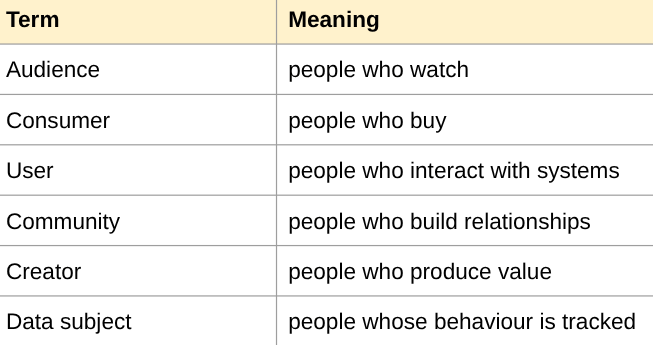
Users (social media users are now the audience, consumer, community, creators, and data subject)
200
a marketing strategy that analyzes personal data to deliver highly tailored advertisements to very specific individuals
microtargeting
200
Here is 200 points! Don't spend it all in one place.
200
acting as if everything online revolves around you
Main Character syndrome
300
How can social media create a dopamine loop for users?
A dopamine loop happens when rewards (likes, notifications, or new content, etc.) encourage people to keep checking social media repeatedly
300
When something becomes so common that people see too much of it
saturation
300
You have a choice. You can be selfish and take 300 points for yourself, or you can be a nice person and give 300 points to another group.

300
the trail of data a person leaves online
digital footprint
300
What strategy was suggested for managing parasocial relationships more healthfully?
a. noticing what emotions lead you to seek them out
b. completely avoiding influencers
c. replacing all online interactions with in-person ones
a. noticing what emotions lead you to seek them out
300
A specialized or narrowly focused area of interest, market, or community
niche
400
Which of these is NOT a reason trends take off (according to experts)
a. Identity
b. Virality
c. Participation
d. Remixability
b. Virality
(people must be able to identify with it, they must be able to participate in it, and they must be able to put their own spin on it)
400
Content that imitates or repeats another creator’s idea, style, or trend
Copycat content
400
Name each of the features in the photo using the words in the parenthesis:
(pull-to-refresh, streaks, notifications, seen receipts, typing indicators, autoplay, personalized recommendations, infinite scroll)
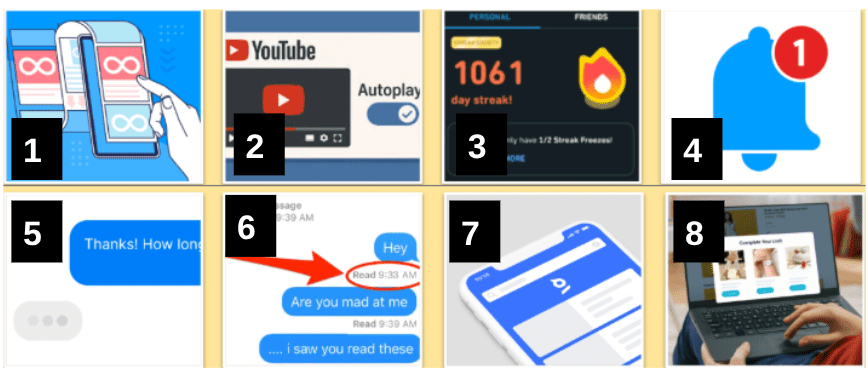
1.infinite scroll 2.autoplay 3.streaks 4.notifications 5.typing indicators 6.seen receipts 7.pull-to-refresh 8.personalized recommendations
400
When human attention is treated as a valuable resource that companies compete for
attention economy
400
Why does social media blur the line between real relationships and parasocial ones (according to the Ted talk?)
a. users spend more time online than offline
b. celebrities now respond directly to most followers
c. posts from friends and public figures appear in the same space
c. posts from friends and public figures appear in the same space
400
The version of a person that exists online
Digital identity
500
put these "Life Cycle of a Trend" phases in the correct order:
a. death phase
b. fault line shift
c. origin
d. saturation
e. peak
f. adoption
b. The fault line shifts (Something changes in what people care about)
c. Origin (small niche community start to do something new)
f. Adoption (early creators [champions] emerge)
e. Peak (mainstream explosion, it blows up, everyone is doing it. Brands jump in)
d. Saturation (overdone, decline starts, people start getting tired of it or making fun of it)
a. Death (Irony phase)
500
To increase the volume (the reach, attention, or impact) of something online
amplify
500
Why is user activity on social media considered “free labor” for companies?
Because users create content, data, and attention that platforms profit from without paying them.
500
designing environments, systems, or experiences to influence how people behave
Behavioral engineering
500
Who is the pop star known for hiding “easter eggs” in her lyrics, music videos, and social media posts, often including references like the number 13 and detailed album-era clues that fans analyze closely?
Taylor Swift
500
To turn something into a product, brand, or source of profit that can be marketed, sold, or consumed
commodify