Minerals
Rocks
Plate Tectonics
Earth's Changing Surface
Water
Random
100
What mineral is commonly called "fool's gold" because of its similar appearance?
Pyrite
100
Which of the following is true about sedimentary rocks?
A. They are deposited vertically.
B. Older sedimentary rock layers are on top of new layers.
C. They are foliated or unfoliated.
D. They are deposited horizontally.
D
100
Fill in the Blanks:
The oceanic crust is ________ dense and _______________than continental crust.
More Dense and Thinner
100
Which layer of the soil would be least affected by erosion? 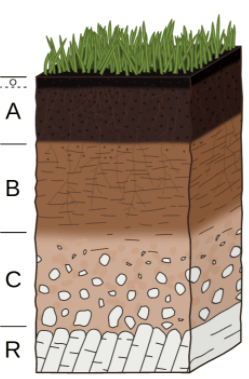
Layer R
100
Where would water located at number 1 most likely travel?
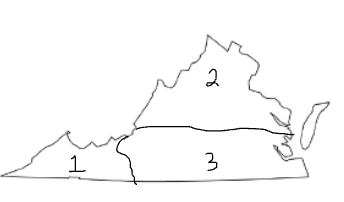
Mississippi River to the Gulf of Mexico
100
Which number represents the steepest slope of the hill?
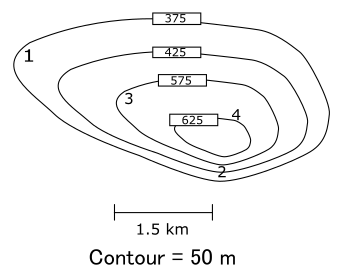
2
200
Which mineral property is least helpful when identifying minerals?
Color - Minerals can be multiple colors
200
These rocks are formed from heat and pressure of pre-existing rocks.
Metamorphic Rocks
200
Label Each set of arrows with the correct plate boundary name.
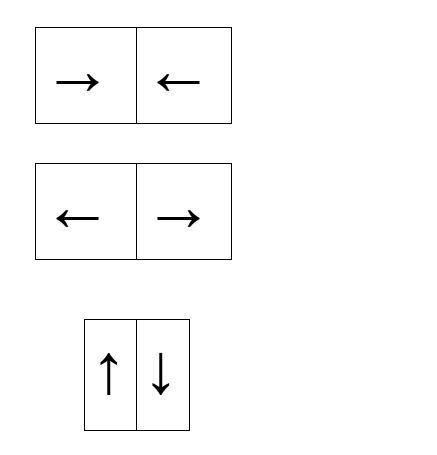
Convergent
Divergent
Transform
200
The place inside the crust where the earthquake originates is called what?
The Focus
200
What does number 4 represent?
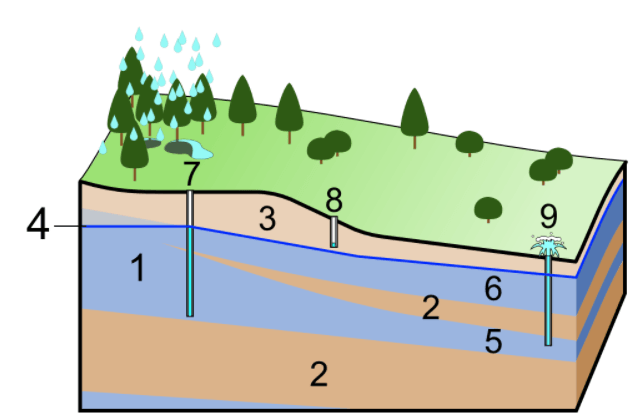
Water Table
200
What is the one factor you are testing or changing on purpose during a scientific experiment?
Independent Variable
300
What is the powder form of a mineral when rubbed on an unglazed porcelain plate?
Streak
300
What type of rock is shown in the picture below? (Be as specific as possible)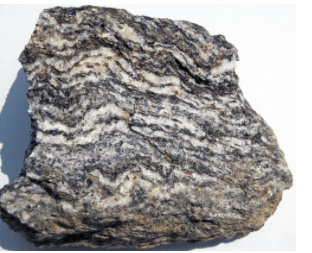
Foliated Matamorphic
300
What type of fault is shown?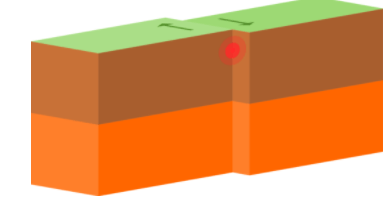
Strike-Slip
300
In the diagram, why is the crust moving?
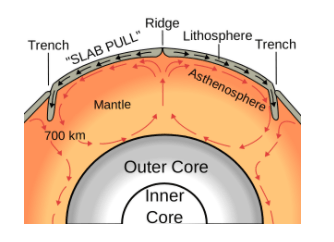
Convection currents in the mantle are forcing the crust to move.
300
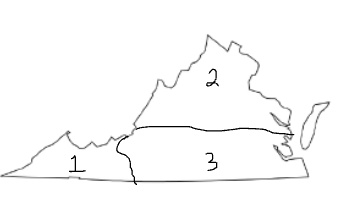
What watershed is labeled number 3?
North Carolina Sound
300
Which part of the hydrologic cycle includes the evaporation of water out of plants?
Transpiration
400
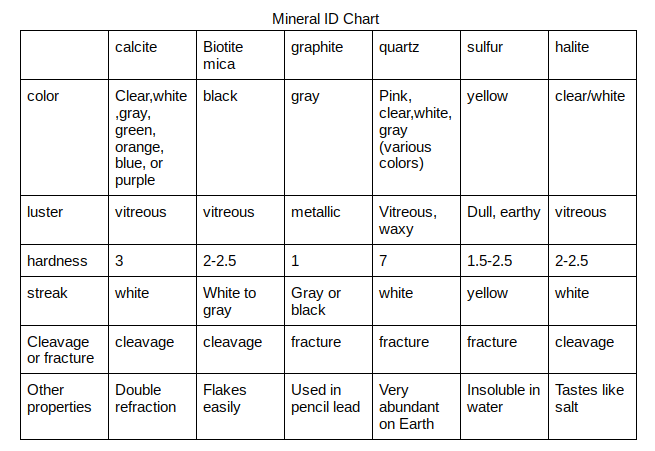
Olivia has a mineral that she would like to identify. It is clear, has a hardness of 2.5, a vitreous luster, a white streak, and cleavage. What mineral does she have?
Halite
400
describe the formation of igneous rocks
They form from the cooling and solidification of magma or lava.
400
Fill in the table using the word Bank Below:
Plates Collide, Plates Move away from each other, Normal Faults, Reverse Faults
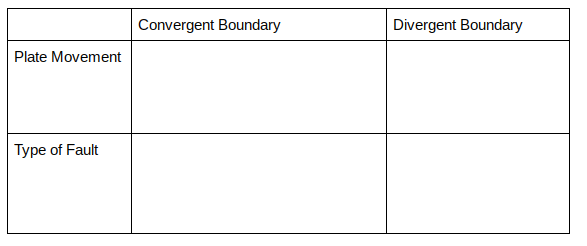
Convergent Boundary Divergent Boundary
Plates Collide Plates move away
Reverse Normal
400
When Limestone is slowly dissolved by weak carbonic acid in groundwater, what features do we get?
Karst Topography- Caves and Sinkholes
400
Josh goes on a field trip to a local cave and brings back a small rock he finds inside the cave. He brings the rock to the science lab and the teacher adds a few drops of dilute hydrochloric acid on it and it begins to fizz. Why is his rock fizzing?
The acid is chemically reacting with a mineral in the rock.
Chemical Weathering
400
Seth wanted to know if cold weather affected his tomato plants. How would he design an experiment to test his hypothesis?
Buy several tomato plants of the same species, grow each one a different temperature, and record their growth rates over a period of time.
500
Which of the following answers are characteristics of a mineral? Select all correct answers.
A. made from rocks
B. naturally occurring
C. solid at room temperature
D. man made
E. definite chemical composition
B, C, E
500
Fill in the Table using the following words:
Granite, Cooled Slowly, Large Grains, Inside the Earth, Obsidian, Cooled Fast, Small or no grains, On the surface of the earth
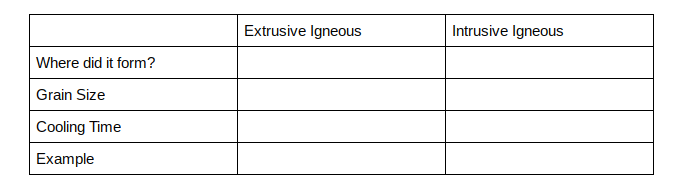
Teacher will check
500
What is the most abundant group of minerals found in the Earth's crust?
Silicates
500
What should number 1 be labeled as?
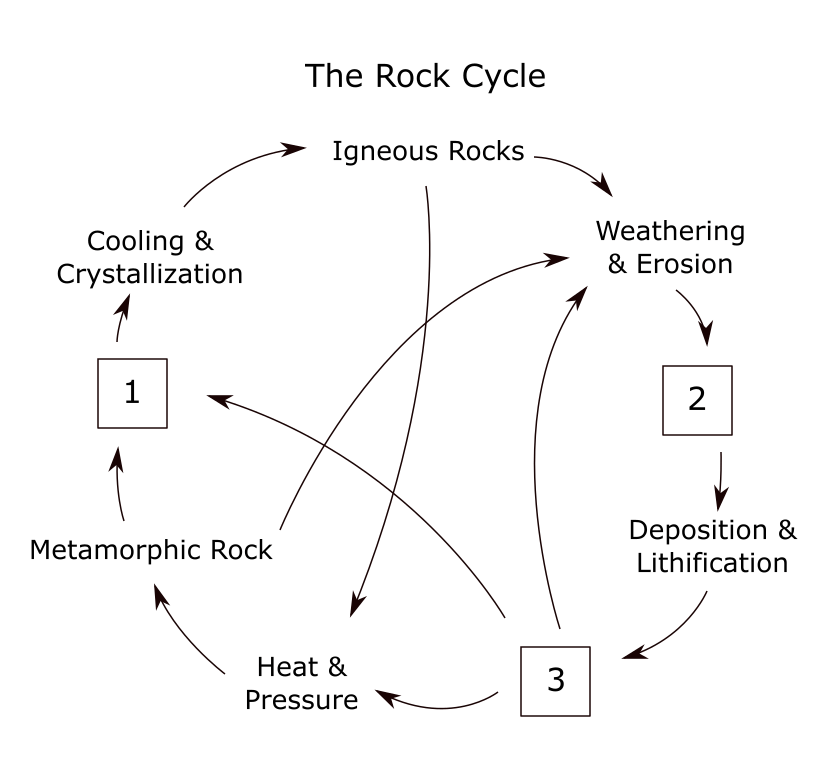
Melting (Magma or Lava)
500
Why could it be a problem if too many wells are drilled closely together?
The Aquifer could potentially become dry or the Water Table could drop.
500
Andrew needs to find the density of a small, irregularly shaped pebble he found near the river. He put the pebble on a scale to determine the mass is 16.2 grams. After finding the mass, he uses a graduated cylinder to find the volume. He puts 50.0 mL of water into the graduated cylinder, then puts the rock inside it. After putting rock into the graduated cylinder, it now reads 62.0 mL. What is the density of the pebble?
1.35 g/mL