Solve each equation by factoring.
Solve using square roots.
Solve each equation by completing the square.
Solve each equation with the quadratic formula
Complex Numbers
100
m2 − 5m − 14 = 0
(m - 7)(m + 2) = 0
m = 7 and m = -2
100
x2 + 10x + 25 = 9
(x + 5)2 = 9
x + 5 = +/- 3
x = -5 +3 = -2
x = -5 -3 = -8
100
a2 + 14a - 51 = 0
a = 3 or -17
100
-x2 + 5x = 2
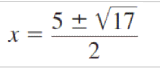
100
Simplify (-2 + 3i) + (7 - 6i)
5 - 3i
200
b2 − 4b + 4 = 0
b = 2
200
6x2 = 36
x = + sqrt 6
x = - sqrt 6
200
x2 − 12x + 11 = 0
x = 11 or 1
200
2x2 + 5x = 3
x = 1/2 x = -3
200
Simplify (9 + 3i) - (-2 - 7i)
11 + 10i
300
7r2 + 84 = -49r
-4, -3
300
(a - 2)2 - 2 = 0
a = 2 + sqrt 2
or
a =2 - sqrt 2
300
n2 = 18n + 40
n = 20 or -2
300
2x2 − 3x − 5 = 0
x = 5/2 x = -1
300
Simplify (5 + 6i)(-4 + 7i)
-62 + 11i
400
3v2 + 7v = 40
8/3, -5
400
3(x + 7)2 - 24 = 0
x = -7 + 2 square root of 2
or
x = -7 - square root of 2
400
Convert y = −x2 − 14x − 59 to vertex form
y = −(x + 7)2 − 10
400
What is the discriminate of -x2 - 6x -9 = 0
How many and type of solutions will it have?
b2-4ac = 0 --> 1 real solution
400
8 / (6-2i)
(48+16i)/40 or (6+2i)/5
500
9n2 + 39n = -36
n = -4/3 n = -3
500
5x2 + 5 = -175
x = +6i or -6i
500
Convert y = x2 − 6x + 5 to vertex form.
Identify the vertex
y = (x - 3)2 - 4
Vertex: (3, -4)
500
What is the discriminant of x2 - 6x = -10
How many/type of solutions will it have?
a = 1, b = -6, c = 10
b2-4ac = -4 --> 2 nonreal solutions
500
3i(2 + 5i) + (6 -7i) - (9 + i)
-18-2i