Algebra and Composition
of Functions
of Functions
Solve. Let f(x)= 4x+2, and g(x)=5x^2+2.
Find g(4) / f(4).
41/9
Find the inverse of the relation.
{ (6,1), (10,2), (8,3), (6,4) }
{ (1,6), (2,10), (3,8), (4,6) }
Simplify.
(r^2-9)/(6r+18)
(r-3)/6
Use the quadratic formula to find the exact solutions.
3x^2-14x-24=0
-4/3, 6
Let f(x)= 5x - 5 , and g(x)= 8x - 2
Find (f - g) (x).
-3x - 3
Using the horizontal line test determine whether the function is one-to-one. f(x)= x^3-5x+2
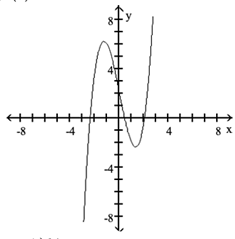
No, the function is not one-to-one.
Simplify.
(2x+16)/(2x-16)
(x+8)/(x-8)
Use the quadratic formula to find the exact solutions.
x^2+35=5x
5/2 +- (sqrt115)/2i
Let f(x)= x + 6 , and g(x)= x - 2
Find (f + g) (-3).
-2
-sqrt-49
-7i
Find the vertical asymptote(s) of the graph of the given function.
g(x)= (x+7)/(x-2)
x=2
Use the graph to find the vertex, the axis of symmetry, and the maximum or minimum value of the function.
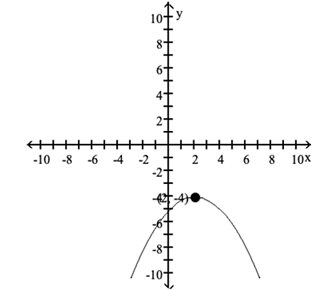
Axis of Symmetry: x=2
Maximum value : -4
Let f(x)=(x-2)/4, and g(x)=4x+1
Find (g ∘ f) (26).
25
Find the domain. Write interval notation for the answer.
f(x)= (x^2+1)/(x-4)
(-∞, 4) ∪ (4, ∞) All real numbers except 4.
Find the horizontal asymptote, if any, of the rational function.
f(x)=(x+6)/(2x^2+7x-3)
y=0
Find the vertex of the parabola.
f(x)=2x^2 -12x+3
Vertex: (3, -15)
Let f(x)= 7x + 14, and g(x)= 4x - 1
Find (f ∘ g) (x).
28x + 7
Determine whether the given function is one-to-one. If it is one-to-one, find a formula for the inverse.
f(x) = 6x - 7
f^-1(x)=(x+7)/6
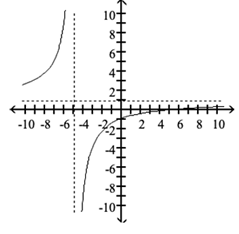
Graph the function, showing all asymptotes as dashed lines.
f(x) = (x-4)/(x+5)
Vertical Asymptote:
Horizontal Asymptote:
y-intercept:
x-intercept:
x-intercept: (4,0)
y-intercept:(0, -4/5)
A projectile is thrown upward so that its distance above the ground after t seconds is h(t)= -16t^2+312t After how many seconds does it reach its maximum height?
10 secs